





 Subscribe


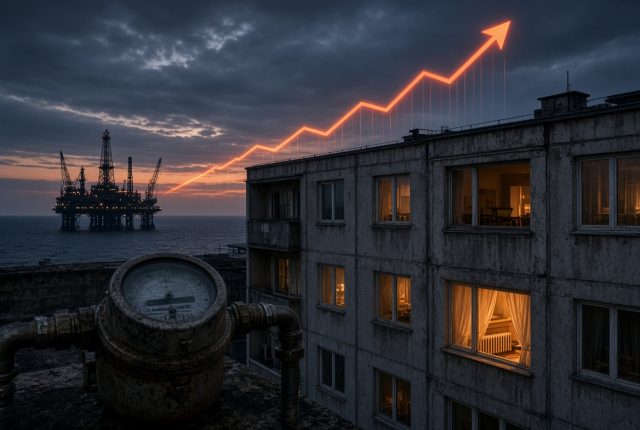
Romania was supposed to strike gold in the Black Sea. Instead, the country’s largest trade union confederation is warning that a freshly signed gas deal tied to the Neptun Deep field could send heating bills up by more than 100 percent, push electricity prices past 180 euros per megawatt-hour, and leave taxpayers footing the bill if the numbers don’t add up. Meanwhile, the government’s response to the energy squeeze isn’t more supply, it’s asking households to consume less, and paying them a small reward for doing it.
The trouble started with Law 171/2026, quietly promulgated by President Nicușor Dan, which authorizes Romania’s State Reserves Administration to finance the purchase of 49.9 TWh of natural gas from OMV Petrom, extracted from the Neptun Deep offshore perimeter. The contract runs from 2027 to 2034, is worth more than 2.4 billion euros, and locks in a price of 48.752 euros per megawatt-hour.
Blocul Național Sindical (BNS), Romania’s national trade union bloc, points out that 48.752 euros/MWh translates to roughly 256 lei/MWh. That is more than double the current regulated wholesale price of 120 lei/MWh that applies to gas destined for households and district heating plants. Framed against the 22.8 euros/MWh regulated benchmark for households, the new price represents a 113 percent increase, according to BNS calculations. As the union’s president, Dumitru Costin, put it in an open letter to the president: “We’re not talking about a marginal adjustment.”
The most alarming projection concerns district heating. Romanian cities that rely on centralized heating systems get much of their warmth from cogeneration plants that burn natural gas. If those plants start buying gas at more than twice the current price, BNS estimates the increase could flow straight into heating bills. A jump of over 100 percent for people connected to centralized systems.
Natural gas is also a major input for electricity generation, and BNS’s math here is blunt: producing one megawatt-hour of electricity requires roughly 2.5 MWh of natural gas. At the OMV Petrom offer price, fuel costs alone would push past 120 euros per MWh of power generated. Layer on transport, distribution, excise duties, VAT, and carbon emission certificates, and the final price could exceed 180 euros/MWh for both household and industrial consumers. That’s a number that would ripple through everything from grocery prices to manufacturing costs, since energy is a line item in nearly every Romanian industry’s balance sheet.
Perhaps the strangest part of this story is who is actually selling the gas. Neptun Deep holds an estimated 100 billion cubic meters of natural gas, split evenly between OMV Petrom and Romgaz and Romgaz is a state-controlled company. BNS’s letter asks the obvious question: why is the Romanian state buying gas from OMV Petrom at all, when it already owns half the resource through Romgaz.
There’s also a market-timing problem. Dutch TTF hub estimates for 2027 gas prices sit around 45 euros/MWh, below the 48.752 euros/MWh Romania has locked in for seven years. If open-market prices fall further, as BNS warns they might, the state would be buying gas above market value and could be forced to resell it at a loss, with the difference absorbed by public money. BNS has formally asked President Dan to convene the Supreme Council of National Defense (CSAT) to force the Energy Ministry, the energy regulator ANRE, and the Competition Council to lay out, in detail, exactly how this contract will affect bills, inflation, the state budget, and industrial competitiveness before its effects become irreversible.
While that debate simmers, Romania’s energy regulator has rolled out a different kind of fix. ANRE president George-Sergiu Niculescu announced that Romania is now the first EU country to adopt a “demand flexibility” mechanism, through which electricity market participants and households can get paid for voluntarily cutting their consumption during specific hours.
The mechanism works through Transelectrica, the grid operator, which will run auctions: companies and, in time, individual consumers with smart meters bid on how much demand they’re willing to shed and at what price, and the cheapest offers get accepted first. Niculescu was candid about the timing, noting the tool “could be used in the current period,” when the system is under real demand pressure and generation capacity has been shrinking. For households, the catch is technological: the scheme requires smart meters, which ANRE is still pushing distribution operators to roll out faster, with fresh Modernization Fund money earmarked for the hardware.
Put side by side, the two stories tell an uncomfortable story about Romania’s energy strategy. On one hand, the state is locking itself into an expensive, seven-year gas contract that its own unions say could double heating bills and push electricity costs to levels that scare off industrial investment. On the other, the policy response isn’t to expand cheaper domestic supply, reopen mothballed capacity, or lean harder into the very gas reserves Romania co-owns, it’s to ask people to use less and reward them modestly for doing so.
BNS’s letter captures the frustration succinctly: “Romania’s resources should be a source of prosperity for Romanians, not a source of losses for the budget or price hikes for consumers”.