





 Subscribe


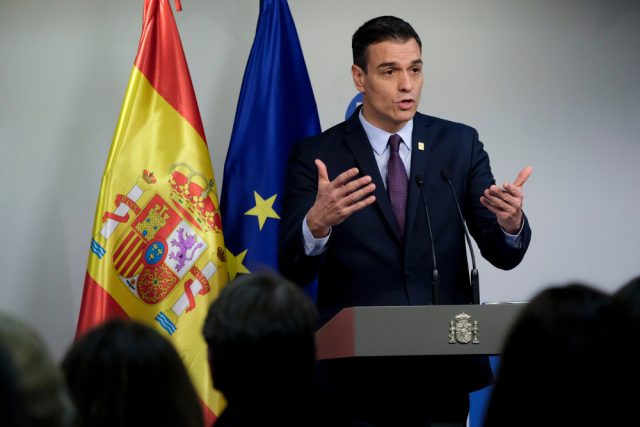
Pedro Sánchez has become very fond of the Spanish economic miracle. The phrase itself may not always be used, but the story is repeated often enough. Spain is growing faster than Germany, France and Italy. Employment is at record levels. European money is transforming the country. The conclusion, delivered with the usual confidence from La Moncloa, is that the Socialist government has found a model that works.
Maybe so. But if this really is a miracle, it is a hard one to see.
Many Spaniards hear that their economy is racing ahead while finding themselves unable to buy a home, absorb an unexpected expense or recover the purchasing power lost during the inflationary years. The statistics describe a country advancing briskly. Daily life feels much more stationary.
Sánchez does not have to change the numbers. He just needs to highlight the ones that look best.
Total GDP tells a better story than GDP per person. Record employment sounds more impressive than weak productivity. Allocated money attracts more attention than the results achieved. Nominal wage increases are celebrated without dwelling on prices, taxes or housing costs. Billions received from Brussels are presented as proof of national economic strength, even though the funding is temporary and much of the ultimate return is still unclear.
Every number can be correct, and the overall picture can still mislead.
The Miracle Behind the Headline
Spain’s real GDP grew by 2.8 per cent in 2025. Compared with the torpor afflicting several large European economies, that is a respectable achievement. Yet IMF estimates put real GDP growth per person at about 1.5 per cent. Positive, certainly, but hardly the transformation suggested by government rhetoric.
Part of the explanation is demographic. A larger population and labour force produce more, consume more and increase the size of the economy. Immigration has helped Spain avoid some of the labour shortages and demographic stagnation seen elsewhere in Europe. But a larger economy is not necessarily a more prosperous society. If output grows because there are more workers while productivity barely improves, the gains available to each person remain limited.
This distinction rarely survives contact with a ministerial speech.
Spain’s longer record is sobering. Between 2004 and 2024, it experienced one of the smallest increases in real household income per person in the European Union. More than a quarter of the population remained at risk of poverty or social exclusion in 2025. More than a third could not meet an unexpected expense. Housing costs have made independence increasingly difficult for younger Spaniards, even when they are employed.
There has been some progress. Incomes have risen, severe deprivation has fallen slightly and having a job is plainly better than not having one. The government deserves credit where its policies have contributed to those improvements.
Yet the better the headline growth appears, the harder the underlying question becomes. If Spain has enjoyed strong GDP growth, record employment and an unprecedented inflow of European funds, why has the improvement in ordinary living standards been so restrained?
The recovery funds sit at the centre of this puzzle. Spain has been one of the largest beneficiaries of the EU’s Recovery and Resilience Facility. Money has gone into energy, transport, digitalisation, training, industrial projects and public administration. Sánchez himself has acknowledged that such funds have been a major driver of economic performance.
This matters because the programme is temporary. Its milestones had to be completed by the end of August 2026, with final payments due before the end of the year. The taps will not simply run at the same pressure indefinitely.
There will be no sudden collapse when they close. A railway does not disappear because the grant that financed it has ended. Equipment purchased today can remain productive tomorrow. Other European programmes will continue, as will private investment.
The danger lies elsewhere. European funding may have supported activity without repairing the weaknesses that made the assistance necessary. It may have allowed the government to avoid difficult reforms while still enjoying the appearance of economic development. Worse, temporary money may have helped create permanent expectations and obligations.
That is an old political temptation. Spend now, announce the benefit and leave the financing problem to a later budget — preferably one prepared by somebody else.
What Happens When Brussels Turns Off the Tap?
The same caution applies to the public accounts. Spain cannot freely invent its deficit. Eurostat, the European Commission and the Independent Authority for Fiscal Responsibility provide meaningful external scrutiny. Yet there is ample territory between honest accounting and outright fabrication.
Expenditure can be moved between years and obligations can emerge later than expected. Similarly, governments can publish optimistic revenue forecasts, emphasise gross allocations over actual execution and describe temporary measures as exceptional whenever that treatment improves the preferred fiscal narrative. Finally, inflation can increase tax receipts without any explicit tax rise, particularly when thresholds are not fully adjusted.
This is less dramatic than cooking the books. It is also more common. Call it political accounting: displaying everything that has been gained while keeping tomorrow’s liabilities just outside the frame.
The warnings are already visible. Spain’s fiscal watchdog has questioned the remaining room for manoeuvre and identified risks around compliance with expenditure rules. The European Commission continues to point to weak productivity, limited innovation, administrative obstacles and regulatory fragmentation. Public spending is projected to grow faster than the recommended path, even after allowing for defence-related flexibility.
None of this suggests that Spain is about to go bankrupt. It does suggest that Sánchez’s self-portrait deserves considerably less admiration than Sánchez gives it.
Political Accounting… by someone else?
The possible political change in 2027 makes the situation more consequential. Polls disagree, as polls often do, but several place the Popular Party and Vox within reach of a parliamentary majority. A coalition between them is plausible, though far from assured.
Were such a government to take office, it could inherit a grim mixture: weaker growth, exhausted recovery funding, permanent spending commitments, an ageing population, pressure to spend more on defence and widespread frustration about housing and purchasing power.
The Inheritance Waiting in 2027
For the Spanish right, the echoes of 2011 would be impossible to miss.
Mariano Rajoy entered government after José Luis Rodríguez Zapatero with the economy stagnating, unemployment at catastrophic levels and credit badly restricted. The 2011 public deficit proved dramatically worse than its target. Initially recorded at 8.5 per cent of GDP, it was later revised to approximately 8.9 per cent after additional regional expenditure came to light. The target had been 6 per cent.
Today’s Spain is not the Spain of 2011. Employment is stronger, banks are in better condition, and the main forecasts point towards slower growth rather than collapse. Any comparison that ignores those differences becomes propaganda.
Even so, the political pattern is uncomfortably familiar. A Socialist government takes credit during the optimistic phase; a right-wing government arrives when the bills are clearer, and the room for manoeuvre has narrowed.
A PP–Vox coalition might enter office promising lower taxes, stronger borders, higher defence spending and greater support for families. It could quickly discover that these commitments cannot all be financed at once. It would then have three unattractive choices: abandon its programme, increase taxes or cut expenditure. Just like Rajoy did.
Sánchez and his allies would predictably call any retrenchment an ideological assault on public services. The government responsible for deferring the reckoning could then blame its successor for confronting it.
Vox would face a test of its own. Opposition parties can demand tax cuts, military strength, industrial investment, and generous family policies simultaneously. Government places those promises in the same spreadsheet. National conviction, however sincere, does not settle the arithmetic.
Nor should the PP romanticise the Rajoy experience. His administration restored a measure of confidence, but it also increased taxes, broke commitments and imposed painful measures that helped shatter Spain’s old party system. Fiscal repair carried out without political imagination can save the accounts while destroying the government responsible for it.
The Ghost of 2011
The alternative begins with honesty before the election. Spaniards should be told which recovery-funded programmes will continue, how much they will cost and where the money will come from. And announcements should be better paired with measurable results.
Above all, every celebration of aggregate GDP should be accompanied using figures for output per person, productivity, real disposable income and housing affordability. Those measures come nearer to answering the question that matters: are Spaniards becoming more prosperous?
Sánchez can legitimately claim that Spain has grown and created jobs. What he cannot convincingly claim is that these achievements have settled the argument over his economic stewardship.
The verdict will come when the exceptional European support has faded, growth has slowed, and somebody must finance the commitments made during the good years. If productivity rises and living standards follow, Sánchez’s confidence will have been justified.
If they do not, his economic miracle will look less like a transformation and more like an elaborate exercise in timing.
And the bill, as so often in Spanish politics, will have been left for the next government.