





 Subscribe


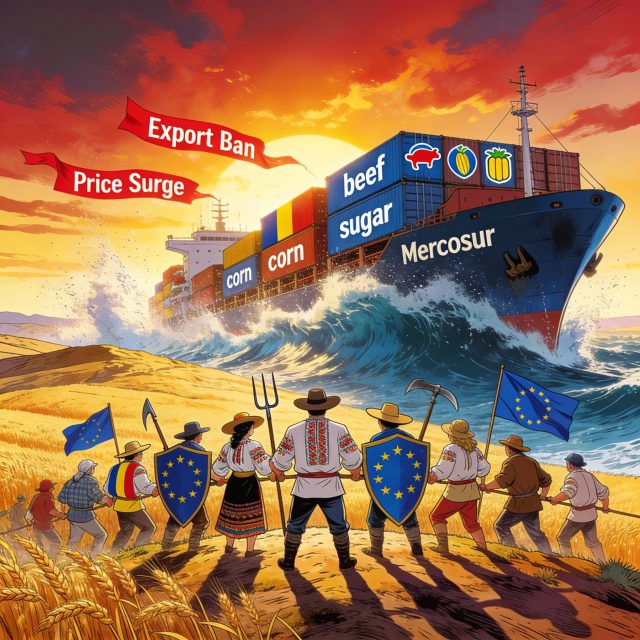
Regional and European Union Farm Food Security: The Trade Deal and the European Farm System. Romanian farmers perilously close to the brink of ruin now that the EU-Mercosur deal is on the books, about to flood markets with inexpensive South American imports that are not up to Europe’s stringent standards. This deal undermines not only local agriculture, but it is also a direct attack on food sovereignty as countries in the bloc have recently banned the export of Romanian meat, driving rising prices throughout the bloc. Borrowing from urgent calls from farming alliances and official protests, this article lays bare the stakes.
The EU-Mercosur agreement creates possibilities for huge sales of beef, poultry, sugar, ethanol, honey, and corn from Brazil, Argentina and its allied countries, where loose regulations on pesticides, antibiotics, animal rights and environmental conservation reign supreme. Stripped of energy supply by climate pressures and bureaucracy, Romanian farmers have been exposed to “disproportionate burdens” that compromise their competitiveness, warns the Alianța pentru Agricultură și Cooperare (AAC) in appeals to Romanian authorities. Agriculture Minister Florin Barbu has denounced the deal as damaging the agri-food sector, pledging to prevent it unless there is a three-year transition and enhanced protections in place.
The European Commission has provided few safeguard measures, which depend upon slow “grave harm” evidence instead of early signals to the market. Protests: Thousands of people were mobilizing in Brussels on December 18, 2025, following AAC calls for Romania to join France, Poland, Hungary and Italy in a blocking minority comprising more than 35% of EU population. “European farmers are the food producers that power Europe — we should keep our hands on them and not sabotage them,” AAC announces.
The recent ban on Romanian sheep, goats and live animals, which the European Commission has extended to date until December 31, 2025 in part because of bluetongue virus fears even though there is scant evidence to prove it occurs in Romania, has sharply curtailed vital exports, striking farmers who lost 600,000 sheep under prior culls. These measures, which first took effect in 2024 and continue to affect all EU countries until at least late 2025, cut through intra-EU flow and left Romania’s meat industry in a tailspin. Romania being among the EU’s largest grain exporters by exporting volume 2024-2025, the animal protein scarcity has since been spreading into wider EU market.
Bans make it worse, creating vulnerabilities and feeding EU food inflation—Romania’s reached 7.86% in September 2025, while agri-imports like cocoa and coffee rose in 2025, narrowing trade surpluses to €3 billion by January 2025. EU agri-food imports jumped 19% year-over-year, buoyed by high commodity prices and poultry and egg imports also increased by a steep 30%, squeezing local supplies. Mercosur’s accession could make this worse, packing into the country hormone-treated beef and pesticide-laden crops not suitable for European norms that compromise traceability and health.
Food security is hanging by a thread: Fewer Romanian exports also mean fewer EU sources of meat, driving increasing prices as consumers grapple with shortages. Parliamentary queries illuminate regional disparities: a €1 billion fund floated but funding uncertain in the present Multiannual Financial Framework. Greenpeace and Greens-EFA echo some farmers: cease Mercosur to protect people living in it.
On December 18, 2025, more than 10,000 farmers from all EU member states will gather in Brussels for a historic protest organized by Copa-Cogeca, the EU’s largest group for farmers and agricultural cooperatives. This is the first time that people from all EU countries will come together to call for immediate action to protect the future of EU farming. The protest is timed perfectly with a meeting of EU heads of state in the European Council and comes before von der Leyen’s trip to Brazil to finalize the Mercosur deal.
Romania faces a decisive vote, Minister Barbu threatens vetoes on unanimity issues if forced on farmers. With Parliament debating protections on December 16, 2025 and farmers uniting in Bucharest and Brussels, the message is unambiguous: refuse this deal or see agriculture collapse. Prioritise EU standards vs. cheap imports; protect borders from unfair trade. Romania’s farming is not just a field, it’s the bloc’s breadbasket.