





 Subscribe


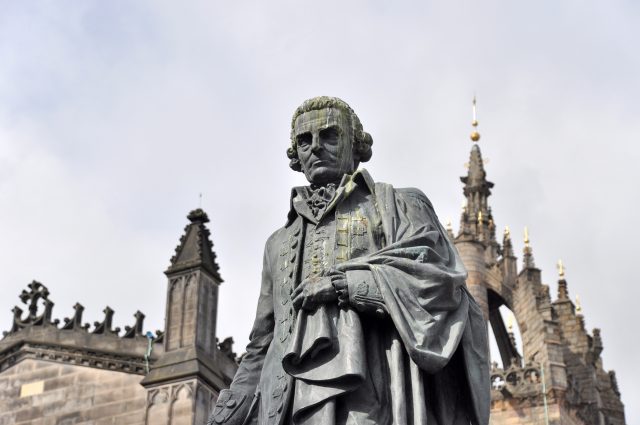
At a meeting of the Mont Pelerin Society in Marrakech, Morocco, on 7–10 October 2025, a debate took place between Professor Peter Boettke of George Mason University, Virginia, and Dr. Nils Karlson of Ratio Institute, Sweden, on the topic: Is liberalism progressing in the right direction? Of course, what was meant was classical liberalism, that of Adam Smith (depicted here), Edmund Burke, and Friedrich A. von Hayek, not the moderate socialism which goes under that name in the United States. Participants in MPS meetings are not supposed to quote speakers, so I shall add my own reflections here.
Clarification of the Concept of Liberty
The first task of liberal scholars is to clarify what liberty is. It is always liberty under the law. Outside the law, there is no liberty, neither in the jungle nor on a desert island. Liberty refers to the protected domains of everybody under the law. Thus, it presupposes a certain kind of equality, namely equality under the law. If some enjoy legal privileges denied to others, for example, if only males may own property, if only sons of workers may be admitted to universities, or if Muslims have to pay lower taxes than Christians (all historical examples), the freedom of some has been reduced, that of women, capitalists, and Christians, respectively. I find the clearest account of the equal freedom of all in the works of Herbert Spencer, Michael Oakeshott, and Robert Nozick.
Making the Invisible Hand Visible
The second task is to make the invisible hand visible. Liberals have to explain that most goods can be produced by individuals trading in the free market and that the private pursuit of gain is often in the public interest. Probably the only truly public goods are defence and law and order, and the latter good can at least partly be produced privately (remember fences, locks, alarm systems, security cameras, doormen, guards, and arbitration councils). Consider the lighthouse. It used to be a textbook example of what government had to provide because the service offered could not be priced. But Ronald Coase showed that, in fact, the service of lighthouses had been priced as a component of port fees. I find the best explanations of coordination without commands in Adam Smith and Friedrich A. von Hayek (who founded the Mont Pelerin Society in 1947).
Revealing the Cost of Government
The third task is to reveal the real cost of government intervention. A minimum-wage law leads to the disappearance of jobs that pay less than the minimum wage, thus hitting hard the most vulnerable part of the labour force: teenagers and unskilled workers. Rent control reduces the supply of rental housing. It has probably destroyed more houses than bombing did in the Second World War. The prohibition of immoral activities, such as the consumption of addictive drugs or prostitution, just drives them underground and encourages the formation of criminal gangs. ‘Naturam expellas furca, tamen usque recurret.’ Drive Nature out with a pitchfork, she’ll come right back. Many other regulations have similar non-obvious adverse effects. I find the best arguments against socialism and interventionism in the works of Ludwig von Mises and Milton Friedman, despite their many differences.
Appealing to Voters
These three tasks are for scholars to perform. The international network of research institutions, Atlas Network, inspired by Hayek, does excellent work in suggesting alternatives to government intervention. But the first task, I fear, has been neglected. Moreover, ideas have to be implemented, horses found to pull the wagons. I find the hostility of some classical liberals to nationalism and populism misguided. A distinction must be made between non-aggressive nationalism, which seeks to protect and develop a nation’s cultural heritage, and militant, expansionist nationalism. The free man needs a sense of belonging: membership in a community that fills him with pride and ambition, and a forum for his or her creative powers. A distinction should also be made between good and bad populism. The good populism of Ludwig Erhard, Ronald Reagan, and Margaret Thatcher was about creating people’s capitalism and a share-owning democracy, whereas bad populism appeals to the lowest instincts of the masses and tries to rally them against imaginary enemies. Wine should not be defined by the drunkard, and populism not by Hitler.