





 Subscribe


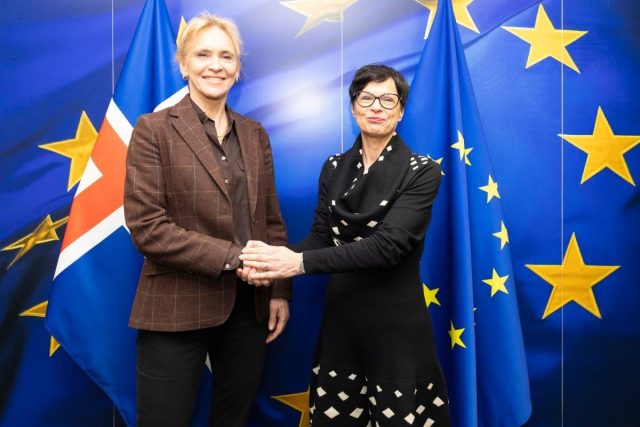
Icelandic Foreign Minister Thorgerdur K. Gunnarsdóttir wants Iceland to join the European Union and has therefore met several times with the EU Commissioner for enlargement, Marta Kos from Slovenia (see the photo above). But who is Marta Kos? The answer is partly provided in a book published in March 2026 by the Slovenian historian Igor Omerza, The Commissioner: Marta Kos as a reliable collaborator of the communist secret police. The book presents archival evidence that Kos had ties to the Slovenian secret service under communism. Consequently, the Slovenian prime minister, Janez Janša, who assumed office on 4 June 2026 for the fourth time, has called for Kos’s dismissal.
A Survivor in Politics
Janša has an interesting background. A dissident imprisoned for six months in 1988 by the communist regime, he was Minister of Defence during the brief war with Serbia that followed Slovenia’s declaration of independence in June 1991. Since 1993, he has been leader of the centre-right Democratic Party, a member of the European People’s Party. In 2004, he became prime minister and served for four years. Shortly before the 2008 elections, he was accused of accepting bribes from a Finnish arms manufacturer. Prime Minister again in 2012, for only a year, he was convicted of corruption in 2013 and spent five months in prison, but the Slovenian Constitutional Court unanimously overturned his sentence for lack of evidence and improper procedures. Janša saw the case as politically motivated, as did his followers. He accused Drago Kos, Marta’s brother, of being behind it. Janša became prime minister again in 2020, serving for two years.
The Young Journalist
Marta Kos also has an interesting background. She studied journalism and, in 1989, was hired by the Slovenian Broadcasting Service (RTV). According to Omerza, she was already then registered as a ‘source’ by the Secret Service under the code name ‘Tara’. The Secret Service subsequently actively promoted the young Slovenian journalist for a job in 1990 at the German radio station Radio Deutsche Welle (RDW), which had a section broadcasting in Slovenian. By then, she had been upgraded to a ‘collaborator’ under the code name ‘Blanka’, Omerza claims. The files suggest she briefly reported to agents of the Secret Service. But communism was now collapsing in Central and Eastern Europe. The communists lost control of the Secret Service, and most of its files were destroyed, although copies may have been kept in Belgrade, the capital of former Yugoslavia, of which Slovenia had been a part.
The Commissioner
In 1993, Kos became the Bonn correspondent for the Slovenian Broadcasting Service. She returned to Slovenia in 1997, becoming, in turn, a government spokesperson and a businesswoman. A favourite of the Slovenian Left, she was appointed Ambassador to Germany and then to Switzerland. In 2020, Kos abruptly left the Foreign Service for reasons that are still not clear. In 2024, the left-wing Slovenian government nominated her as EU Commissioner. Ahead of the 2025 elections in Slovenia, she stated that she did not want Janez Janša to become prime minister again, even though the European Commission’s code of conduct requires commissioners to ‘abstain from making public statements or interventions on behalf of any political party’. Despite a complaint, the Commission took no action.
Less than Truthful?
At hearings in the European Parliament, Kos categorically denied any collaboration with the Slovenian Secret Service under communism, noting that its reports are not always reliable. However, Omerza’s claims that she was, however briefly, a source named ‘Tara’ and a collaborator named ‘Blanka’ appear to be supported by the archive material he reproduces in his book. Of course, Kos was no mysterious Mata Hari. She was probably just an able and hard-working young careerist with sporadic contact with the Secret Service in the last years of communism. But as they say, it’s not the crime, it’s the cover-up. Kos seems to have been less than truthful about this chapter of her life. The Brussels bureaucrats have chosen to ignore the evidence presented in Omerza’s book. They probably value management skills over truthfulness.
(Photo: EU. Lukasz Kobus.)