





 Subscribe


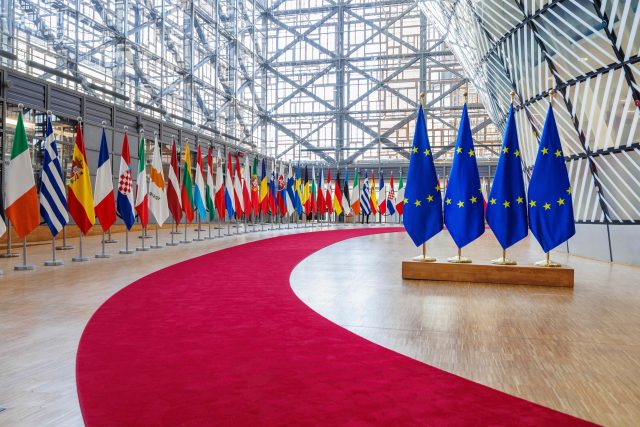
Three major events or processes have shaped the European Union in recent decades. First, the accession of new states has increased diversity within its borders, reinforcing sources of tension. Second, Great Britain, with its strong tradition of freedom and democracy, has left the EU. Third, the EU faces two serious external threats: Russian aggression, as shown in Georgia and Ukraine, and mass immigration from the Middle East and North Africa. Meanwhile, the elite controlling the European Commission and the Court of Justice of the EU has relentlessly pursued efforts to construct a federal state, despite considerable resistance. A thoughtful analysis of the EU at this stage is offered in a recent book by Slovak political theorist Dalibor Rohac, Governing the EU in an Age of Division (Cheltenham: Edward Elgar, 2022). He writes from what he calls a pro-European perspective, while insisting that the EU needs radical reforms.
Managing Diversity or Building a Superpower?
Rohac distinguishes between two competing visions of Europe. One was that of the conservative liberals Friedrich von Hayek, Wilhelm Röpke, and Luigi Einaudi, who envisaged individual European states assigning certain tasks to a federal authority while keeping them to the minimum necessary for free trade and legal certainty. This vision, Rohac points out, was largely shared by Catholic personalists. The competing vision was that of the technocrat Jean Monnet, who wanted a united Europe with extensive powers, formed gradually. For the conservative liberals and personalists, the EU should be a necessarily imperfect platform for managing relationships between European countries and utilising gains from cooperation and trade; a nexus of institutions, rules, and relationships linking and constraining national governments. By contrast, for the technocrats the EU was about building a superpower; it was an effort, as Rohac puts it, to scale up the nation state to the European level. Europe is, however, too diverse for this project to succeed, he argues, although this is indeed what the elite controlling the EU institutions in Brussels and Strasbourg actively strives for: an ever-closer union.
Sources of Conflict
One source of conflict is the EU’s effort to reduce income disparities between European countries not through competition and trade, but through redistribution from richer to poorer countries. Opportunity makes the thief: EU funds are mostly received by countries with weak infrastructure, limited civic consciousness, and unscrupulous elites, and they tend to reinforce persistent corruption in those countries. Another source of conflict is that the EU seeks to impose supposedly ‘European’ values on countries with moral principles that differ widely, as in cases such as abortion, same-sex marriage, hate speech, and immigration control. The subsidiarity principle—that decisions should be made by those who are directly affected, to the utmost extent possible—is in theory supposed to be followed in the EU, but Rohac notes that it is almost totally disregarded in practice. He also points out that nationalism has been much more resilient than the founders of the EU expected. Europe’s nation states are not retiring from history anytime soon, he aptly comments.
The EU: a Project or a Platform?
Rohac contrasts two conceptions of human society: as a complicated, unwieldy order inevitably falling short of moral ideals, and as a common project aimed at social betterment. He rejects the EU as a project rather than a platform. In a similar vein, Rohac criticises what he calls liberal moralism, the attempt to remake the world according to ideals invented in university seminars. Liberal moralism, he suggests, is not only bound to fail but also provokes a counter-attack by right-wing populists. If the EU is to succeed, it has to return to a much more modest role, essentially that envisaged by Hayek, Röpke, and Einaudi. Rohac argues that the choice between the EU’s further centralisation and the repatriation of competences to individual states is false: what matters is recognising diversity, disagreement and division, and encouraging the development of institutions that enable the peaceful coexistence of European states and communities. He describes his ideal of a polycentric Europe, where citizens could belong not only to individual states and to the EU, but also to various communities and associations, both within and across borders, while individual states could also form communities and alliances within the EU.