





 Subscribe


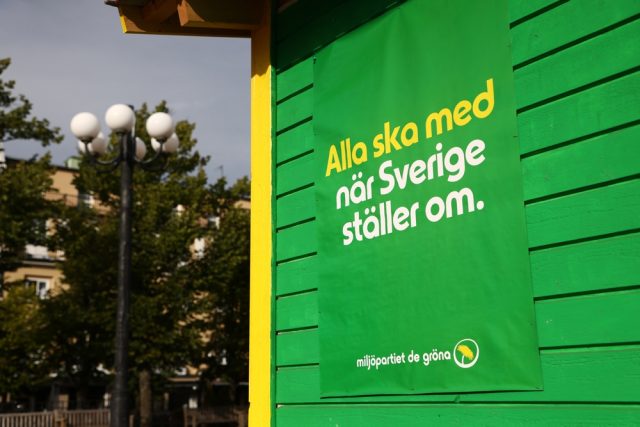
The annual festivities at Almedalen took place on the island of Gotland at the end of June. This is where Swedish political parties go to launch new campaigns and proposals, and to reinvent themselves before the electorate. Especially during an election year, the town of Visby nearly triples in size from all the party officials, journalists, economic interests, lobbyists, activists, and politically cognizant citizens who drop in and out during the week.
Each party represented in the Swedish parliament has their own ‘half-day’ at Almedalen, where the party leader holds a speech, and the media gives them unconditional attention for a few hours. The tone set during these events is carefully calculated to impress the voters. New policies, the releasing of manifestos, and new graphical profiles are some of the things that the parties concentrate their time on, in their bid to win voters. Due to the minute control that surrounds such arrangements, the words of party representatives weigh significantly more in this context than were it any other day of the year.
Thus it is important that the Green Party’s party leader for the occasion, Daniel Helldén, demonstrated in his speech an ambition that was less stereotypically green and environmental, and more on the fringe side of left-wing politics.
The green movement is socialist in nature
I have written previously on The Conservative about the oft-underestimated left-radical character of green parties. While finding their niche in an issue, climate change, that according to mainstream culture has broad appeal across both aisles, green parties have almost exclusively approached climate concerns and environmentalism from a strictly leftist angle. And gotten away with it, to boot.
Politically green intellectualism consists largely of Marxist anti-capitalism and ‘woke’ intersectionalism. Somehow, the movement is irreconciliable with criticism of mass immigration and the centralisation of power to the EU, even though both stances would fit neatly into an environmentalist world view. Something that would be offensive even to the centre-right, is their ideological opposition to the free market and their belief in extensive economic intervention – even though green solutions very much can be produced by the former and impeded by the latter.
Despite this unpragmatic approach to realising their goals, many green parties in Europe have successfully sold themselves into the public consciousness as something resembling centrists. They have routinely worked with both the left wing and the centre-right in governing constellations on various levels in several European countries. In retrospect, the centre-right has paid such a heavy price to their credibility for these deals, that it is almost incomprehensible that so many mainstream conservative parties allowed themselves to get played by greens.
The Swedish greens relaunch themselves as red
The Swedish Green Party showed its true colours at Almedalen in exactly this fashion. Some of the things that Daniel Helldén focused on was shortening the work week to four days, eliminating class differences, redistributing resources to single parents, introducing a billionaire tax, stopping deportations and increasing immigration. Typically green issues were barely left a footnote, and mainly in terms of electric car subsidies. The inherent good of electrification wasn’t addressed, as if it was as obvious as the sky being blue.
There are several observations and analyses that can be made from Helldén’s speech. To address the absent elephant in the room first, what happened to the climate? That so-called social justice comes hand in hand with a “sustainable” green society is a given according to green dogma. But spending 30 out of 40 minutes only mimicking the socialist Left Party does not really instill the listener with the sense of climate urgency that environmentalists usually like to inspire.
The past four years, the ruling centre-right government consisting of the so-called Tidö Parties, the Moderates, the Christian Democrats, and the Liberals, supported by the nationalist Sweden Democrats, has been incessantly scrutinised for its “regressive” climate policies. Keeping fuel costs low and shifting energy policy to favour the expansion of nuclear rather than wind power has been the priority for this government, which has led to reports about Sweden failing to meet emission reduction goals. These reports (the exact veracity of which, on a side note, has been questioned) have been used by the Green Party as a club to beat the right wing with just about since the Tidö parties won power. The situation hasn’t exactly changed in the last few months – so where’s the climate outrage, when the Green Party finally has all eyes on them?
Is the climate out of vogue?
Polling has shown that climate concerns are not at the top of mind for Swedish voters right now. Nor have they been for several years, even if climate continues to linger as a passive top five issue. Has the Green Party opted to broaden its appeal to further cement itself with its leftist peer parties, rather than insisting on a battle that nobody is interested in? It would seem so.
Climate concern is often seasonal. An out-of-the-ordinary heat, cold, drought or wetness of a particular season can lead to alarming newspaper headlines, which may raise climate awareness for many voters. This is a window of opportunity that green parties are not late to take advantage of.
But such windows have eluded Swedish environmentalists for a few years. Currently, we are looking at a standard summer, whereas the two summers preceding this election year have been lukewarm or even cold by what we’ve come to expect. Heatwaves in continental Europe, meanwhile, are a blunt instrument for a green party in Scandinavia. With such a lacking relevance for most Swedes, the Greens know better than to shoehorn climate into the debate.
Another viable explanation is that the Green Party has long made its name as the climate party of Sweden. They rest easy on their laurels, perhaps knowing they have peaked the support they are able to muster on that one topic.
Incidentally, the nationalist Sweden Democrats have been criticised on right-wing social media and other nationalist circles for not advancing remigration hard enough, or shifting away from migration altogether in their communication. This could be an expression of the same phenomenon; both the Greens and the Sweden Democrats are sitting comfortably at their respective thrones, and are using their solid bases to develop other policy areas.
It must be said, again drawing semi-parallels to the Sweden Democrats, that the Green Party has almost never performed better in polling than it currently is doing. For many years, especially during their time in government between 2014 and 2021, the Green Party was on the brink of elimination in polls. They barely managed to scrape by the 2018 elections, which required four percent of the votes. In this context, they feel afforded the confidence to cast a wider net, and be more ambitious than merely being the climate party of Sweden. They sense that the winning ticket right now is to address the daily economy of some of the Swedish society’s least fortunate. The Sweden Democrats have similarly tried to build confidence on issues that do not traditionally belong to them either, in the same vein.
Arms race in social justice
Daniel Helldén’s echoing of the Social Democrats and the Left Party may be surprising in its intensity – but not in its deployment. The Green Party is far from the only party to come with ‘populist’ proposals on public spending and welfare. Raised child benefits, an end to “greedy” capitalist practices in private schooling, and a targeted support for single parent households are all variants of demands that have circulated the politics of Sweden ever since the pandemic. This is the bread and butter of the more archetypically socialist parties, the Social Democrats and the Left Party, but welfare investments have become somewhat ubiquitous across the political spectrum lately.
Ending supposedly predatorial practices in private medicine and education are more or less agreeable positions no matter who you ask in Sweden. The solutions vary from party to party, but the left is hardly even alone in wanting to clamp down on “welfare profiteering”, as it has come to be known. The Tidö government has imposed restrictions on private education enterprises being publicly traded, and the Liberals largely want to completely re-nationalise schools. There is no unique edge to win here.
But what motivates the Green Party to focus on benefits for children and single parents? Is this a blind spot for the other parties?
Hardly. Even the first speaker at this year’s Almedalen week, the Christian Democrats’ leader Ebba Busch, vowed to raise child benefits significantly. With a few exceptions, every major Swedish party is competing in an ‘arms race’ to have the biggest, best investments into welfare.
Is the Green Party strong or is it desperate?
The Green Party is doing well in the polls. As such the party is also in a generally good position to, in the event of a red-green election victory, wield significant influence over the Social Democrats, who have been stagnating over the long term despite being the main opposition party. It was a long time ago since it must have felt this good to be a green voter in Sweden.
So is this very definite leftward turn a victory lap for a boosted party? Or is it, though the polling numbers do not yet tell the tale, an uncreative attempt at staying relevant when they cannot be in the centre of the debate?
It can be argued in the context of the Swedish political trends of today, that the latter is true. The Green Party is exposing its weaknesses in a public debate that has shifted away from their core. When there is no climate concern to exploit, the party drapes itself in the red garments of the socialists, and tries to compete with the rest of the left in promising the best material rewards for the voters.
There is one definite crack in the Greens’ facade, faint as it may be, yet discernible still. Those who paid close attention to the election of Daniel Helldén as one of the party’s two leaders (the other spokesperson being a woman as per the party’s constitution) in 2023 might remember the hysterical leaked internal debate that surrounded his person. His legacy in the municipal politics of Stockholm was that he was not shy of cooperating with the Moderates and other ‘bourgeois’ parties on a liberal green platform between 2014 and 2022. This “blue-green” rule has subsequently been criticised for privatisations and various kinds of welfare cutbacks.
Upon his selection to be the male spokesperson for the Green Party alongside his female co-chair Amanda Lind, the general sentiment was that the Green Party was going to shift its focus away from social justice and more clearly towards climate action and pragmatism. It was the overbearing ‘woke’ attitudes of the previous Green Party leadership that had brought the party into the gutter to begin with, so it was at the time only seen as natural that they had opted to return to their roots.
This was all advanced speculation by commentators at the time. Whatever Helldén’s true character may be, he will during this election cycle ironically not be remembered for his pragmatism or his championing of the climate – but perhaps the most overtly socialist campaign ever run by the Green Party.