





 Subscribe


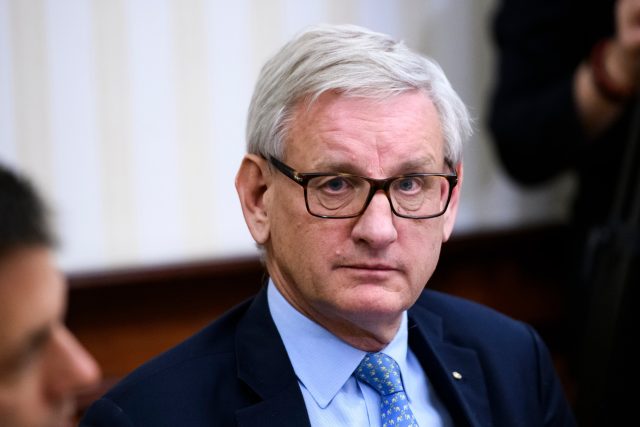
Carl Bildt is one of Europe’s most respected politicians, and deservedly so. Swedish Prime Minister from 1991 to 1994, he halted Sweden’s slide toward socialism. From 1870 to 1970, his country had maintained one of Europe’s freest and fastest-growing economies. But pragmatists in the dominant Social Democratic Party were replaced by ideologues who increased the tax burden, over-regulated the economy, and stifled innovation. Sweden fell behind countries such as the United States and Switzerland. As Prime Minister, Bildt sought not only to halt this trend but also to reverse it by privatising, liberalising and deregulating. The economy began to grow again, and when the Social Democrats returned to power, they largely accepted these reforms. Later, Bildt served as Foreign Minister for eight years, from 2006 to 2014.
Back in 1974
I first met Carl Bildt in 1974 at the general meeting of the European Democrat Students. I was a delegate from Iceland, while he led the Swedish delegation. The colourful Tom Spencer from the United Kingdom (later a Member of the European Parliament) was stepping down as EDS President, and the choice was between Bildt and a German student leader. It was a tight race, and the Icelandic delegation’s vote was decisive: he was elected President. A good speaker and an effective negotiator, he was slightly aloof. Another memorable delegate was the loud and lively American Karl Rove, the future senior adviser to George W. Bush, who is still going strong as a current-affairs commentator, as is Bildt.
Iceland and Sweden
Now, Bildt wants Iceland to join the European Union. Iceland will hold a referendum on 29 August to decide whether to resume accession negotiations, put on hold in 2013. Bildt suggests that the uncertainty in the North Atlantic created by US President Donald Trump may encourage Icelanders to seek shelter in the EU. He argues that a compromise might be reached on the all-important Icelandic fisheries. The Icelanders would be welcomed in the EU, he says. It is certainly true that Iceland has friendly relations with the four other Nordic countries. Indeed, for a short period, Iceland and Sweden shared the same king. Since 1262, Iceland had been a tributary of the Norwegian crown, which passed in 1319 to Magnus Eriksson, already king of Sweden. Magnus, an unpopular and ineffective ruler, lost the Norwegian crown to his son in 1355 but kept Sweden and Iceland. The Swedes deposed him in 1364, but he retained control of Iceland until his death in 1374.
Torgny and Cassel
Sweden and Iceland are connected in many ways. In his chronicle of the Norwegian kings, for example, Icelandic poet and politician Snorri Sturluson quotes a 1018 speech by the Swedish lawman Torgny, in which two principles of Germanic political thought were invoked: government by consent and the right of rebellion. In his speeches, Bildt has often referred to Torgny. Another notable link is that the founders of Iceland’s conservative-liberal Independence Party in 1929 were strongly influenced by the renowned Swedish economist Gustav Cassel, one of his country’s many outstanding economists.
The North Atlantic Angle
It is not certain, however, that the Icelanders will follow Bildt’s well-meant advice. They have a defence treaty with the United States, which regards Iceland as strategically important. It will take the European countries ten years or more to build the military strength needed to defend themselves: they cannot even deal with the Red Sea pirates! Long-term foreign policy is anyway not decided on the basis of reckless remarks by a President who has only two and a half years left in power. Moreover, the Icelanders have developed a sustainable and profitable fisheries system. It is clear from the EU Basic Law, the acquis communautaire, that once in the EU they would have to transfer ultimate control over their fertile fishing grounds to Brussels. This would be unacceptable to most Icelanders.