





 Subscribe


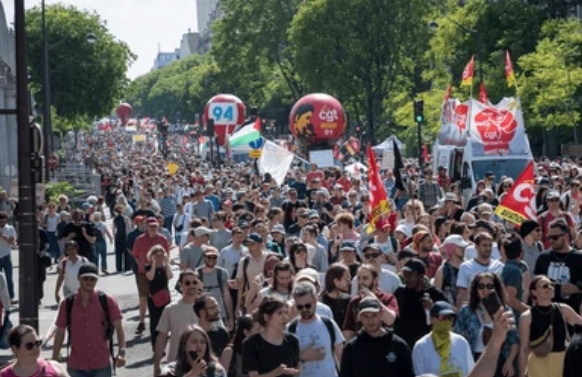
Student protests that periodically sweep across France belong to a well-established political and cultural tradition in European history. For generations, the streets of Paris have served as both a barometer and a sounding board for the social discontent simmering throughout the rest of Europe. However, in light of recent mobilizations, two crucial questions arise: can these demonstrations truly evolve from temporary outbursts of dissent into a broader process of revolution and social transformation? And, above all, will the European left, eager to harness the energy of young people to mobilize crowds across the continent, be able to channel this energy into a credible political project, moving beyond aimless protest and episodes of urban destruction?
France occupies a unique position in Western Europe because of its ability to turn sector-specific or youth-led demands into full-blown institutional crises. Whether the issues involve education reforms, job insecurity, budgetary constraints or environmental policies, French students rarely protest solely to defend their own interests. Schools and universities are seen as the last strongholds of the republican model of social integration. When this model comes under pressure, student protests become a catalyst for much broader discontent.
Today, younger generations face several overlapping challenges. The transition from education to employment is increasingly marked by temporary contracts, stagnant starting salaries and a widespread perception that social mobility is declining. At the same time, access to decent housing has become an almost insurmountable obstacle for students in major European cities. These difficulties are compounded by climate anxiety and a growing distrust of political institutions, as young people increasingly believe that those in power are incapable of implementing the radical changes required. When these factors converge, youth protest ceases to be a temporary university-related phenomenon and becomes a broader critique of the entire socioeconomic system.
Historically, the spread of French protests across Europe has been driven by imitation and shared structural problems. The economic and social difficulties that motivate students in Paris are largely the same as those faced by their peers in Rome, Madrid, Berlin and Athens. For European left-wing parties, particularly their more radical and grassroots-oriented factions, student movements represent an invaluable political resource. At a time when traditional channels of political participation, including political parties, trade unions and other intermediary institutions, are experiencing declining membership and a crisis of representation, youth movements offer enthusiasm, direct participation and a strong sense of purpose.
However, replicating the French protest model across the continent presents several challenges. France has a long tradition of highly confrontational and centrally organized demonstrations aimed at putting direct pressure on the state. Elsewhere in Europe, protests tend to be more fragmented, often remaining local or focusing on specific issues. In France, student movements have frequently formed tactical alliances with major trade unions, such as the CGT, whereas relationships between young protesters and traditional unions in other European countries are often more distant or strained. Moreover, mass demonstrations in France have sometimes succeeded in forcing governments to withdraw legislative reforms, while elsewhere in Europe it has often proved more difficult to translate street mobilization into concrete legislative change.
The real challenge for the left and youth movements, however, lies not in their ability to organize demonstrations but in what comes next: building a comprehensive political vision.
Contemporary protests too often fall into the trap of purely reactive opposition, defining themselves as anti-establishment or simply against a particular reform without managing to outline a viable alternative. For a movement to develop a political project that extends beyond temporary confrontation, it must address three fundamental issues.
The first is the rejection of violence and destruction. Urban clashes, damage to public infrastructure and the destruction of commercial property represent a serious limitation for any mass movement. While expressive violence is sometimes justified as a response to systemic violence, its political consequences can be damaging. Media attention shifts away from the reasons behind the protests and focuses almost exclusively on public order. The middle classes may become alienated, leaving youth movements isolated without the support of families and workers. Furthermore, violent incidents give governments political justification to adopt tougher security measures and discredit the protest movement as a whole.
The second challenge is to transform protest into a viable political programme. To be credible, a movement must engage with the complexities of policymaking. Calling for increased public spending or price controls is not enough; it must also explain how such measures would be financed, how wealth would be redistributed and which institutional reforms would be necessary. A programme aimed at improving the prospects of younger generations must include housing policies that make rents more affordable, substantial investment in research, public education and vocational training, and employment initiatives that guarantee minimum wage standards.
The third challenge is to build solidarity between generations. Social revolution cannot succeed by simply opposing younger people to older generations. Instead, it requires a new social pact that brings them together. Youth movements risk remaining elitist and politically marginal unless they can connect their demands with those of employees, middle-aged workers in insecure jobs and pensioners.
Student protests in France demonstrate that the forces driving social conflict in Europe are far from exhausted. The structural problems pushing young people onto the streets are tangible, urgent and deeply rooted in their everyday lives.
History nevertheless shows that the energy of mass demonstrations alone cannot produce lasting change unless it is channelled into organized movements and institutions capable of achieving concrete political results. If the European left merely exploits youth discontent for political gain, using street protests as a rhetorical weapon against incumbent governments, the inevitable consequences will be frustration, growing abstention from elections and a hardening of security-focused policies.
Conversely, if social movements and political parties can combine radical analysis with realistic proposals, reject the use of violence as a political shortcut and accept the challenge of governing effectively, current protests could mark the beginning of a new era of social reform across the continent.
The future credibility of Europe depends precisely on this ability: transforming the anger expressed in the streets into a new vision of society.
Giuseppe Arnone.