





 Subscribe


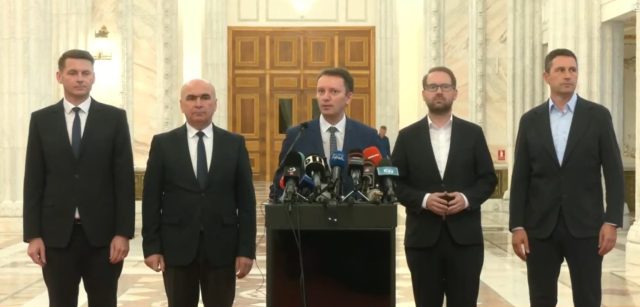
Romania has spent more than four months without a fully empowered government, ever since the Bolojan cabinet was toppled by a no-confidence motion in May. Into that vacuum, President Nicușor Dan chose to nominate Siegfried Mureșan, a Brussels-based MEP with no experience running a ministry, knowing full well that he did not have anything close to the 233 votes needed to be confirmed. It is worth asking plainly: why hand the country’s most urgent political task to a man doomed to fail before he even started?
When Dan announced the nomination on September 17, he admitted it himself: “We do not have a clear majority, despite all these hours of discussions”. Mureșan started with, at best, 169 votes from PNL, USR and UDMR, later stretched to roughly 187 once the national minorities’ group is added. The threshold needed to pass is 233. The math was never close, and everyone in the Palace of Parliament knew it. Dan chose him anyway, not because he could govern, but because he had received the most votes among party leaders during a fresh round of consultations. That is not a mandate to build a majority. It is a coin toss dressed up as constitutional procedure. This is the part that should alarm every Romanian, regardless of party. The government crisis has now dragged on since May. Mureșan was handed the mandate on September 17 and given ten legal days, once the decree was published, to present a full program and a complete list of ministers. Yet by September 24, seven days later, all he had produced was a thin sheaf of “28 guiding lines,” not a real governing program, covering everything from health to defense to agriculture in the same recycled, slogan heavy language.
Media outlets ran the document through two separate AI detection tools, ChatGPT and Gemini, and both concluded the text bore the unmistakable fingerprints of AI generation: repetitive phrasing, suspiciously uniform paragraph structures, and buzzwords like “predictability,” “efficiency” and “modernization” copy-pasted across radically different policy areas. PSD leader Sorin Grindeanu mocked the document as a “second-hand Bolojan program” and joking that on an MEP’s salary, Mureșan could at least afford the premium version of ChatGPT. Mureșan denied it, insisting he had opened the app “three or four times” in his life, but the denial only underlined how low his preparation actually was.
Now, unable to persuade Romanian lawmakers directly, Mureșan turned to a far more troubling strategy: leveraging his own standing inside the EPP to pressure rival parties through their Brussels affiliates. In an interview with Politico, he called on European socialist leaders to intervene with PSD, framing Tuesday’s vote as a “moment of truth” and warning that European socialists “will have a very serious credibility problem” if they stay silent while their Romanian sister party edges toward cooperation with AUR. He went further at home, reminding PSD parliamentarians directly that if the government fails, snap elections could cost them their seats: “I wouldn’t like to be a PSD MP and find out from television that Parliament will be dissolved”.
This is coercion. Mureșan is not winning votes on the strength of a program, because he has none worth presenting. He is trying to manufacture a majority by mobilizing Brussels party machinery against a sovereign national parliament’s right to freely reject a nominee it does not trust. It is precisely the kind of supranational pressure that conservative and nationalist voters have warned about for years, and it is happening in plain sight, reported by DW itself.
Beyond the arithmetic of votes, Romanians are entitled to ask what Mureșan actually stands for. His voting record in the European Parliament since 2009 shows a lawmaker who has voted “For” on the vast majority of the roughly 2,300 measures he has cast a ballot on, consistently aligned with the EPP’s progressive-leaning legislative agenda on social issues, including measures tied to LGBTQ+ rights and their promotion within educational frameworks. Conservative outlets in Romania have flagged him directly as “an active LGBT-ist” whose values sit far outside the traditional, family-centered worldview that most Romanians outside Bucharest’s political bubble still hold. For a country whose Constitution defines marriage as a union between a man and a woman, and where the vast majority of parents want a say over what is taught to their children in the classroom, handing the premiership to a figure with this record would be a disaster.
While Mureșan negotiates in Brussels and Bucharest simultaneously, AUR has offered the only demand that actually respects democratic legitimacy: early elections, and if the president refuses to organize them, his suspension. AUR’s National Council voted unanimously back in the summer to begin both procedures, arguing that Nicușor Dan is deliberately blocking not just Parliament but the country as a whole by refusing to allow Romanians to vote again. Party vice-president Dan Dungaciu has stated the argument with total clarity: “He blocks Romania, not just the Parliament, because he doesn’t trigger those early elections. That’s the main argument, legal and political”. AUR senator Niculina Stelea has put it even more bluntly, arguing that Dan “trembles at the thought of suspension” because his entire strategy depends on keeping PSD, PNL, USR and UDMR alive in whatever coalition can be assembled, rather than letting voters render their verdict. Mureșan himself has all but confirmed the stakes, warning that if his government is not confirmed, “then we organize for the next elections”.
The logic AUR presents is straightforward and, frankly, difficult to argue against on democratic grounds. Four failed or half-formed governments since May. A designated prime minister without a real program, without a finalized cabinet, without a majority, and without the trust of the Romanian people expressed through any actual ballot since the last elections. Every month this drags on is a month the president avoids the one solution the Constitution was designed to allow: returning the mandate to the voters. AUR’s position, that Dan should be suspended if he keeps refusing snap elections, is the only proposal on the table that treats Romanians as citizens with a right to decide their own government, rather than spectators to a backroom arrangement negotiated between Bucharest and Brussels.