





 Subscribe


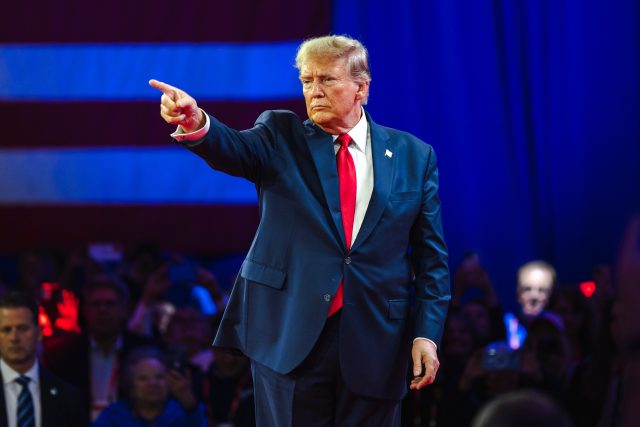
Sitting beside Taoiseach Micheál Martin in Dublin on 12 September, Donald Trump was asked about Irish reunification and replied: “Well, I don’t want to cause any problems, but I will tell you, I’d love to see it unified.” He went further — “It’s going to happen eventually … I think it would be a fantastic thing” — before suggesting that “it may as well happen now.” It was later reported he had brought up the topic, unprompted, when meeting the Irish President; asking how the ‘merger’ was progressing.
The following day he doubled down, describing unification as “one of the naturals of all time”.
To say that Trump’s comments shook the Irish political landscape would be an overstatement, but they have certainly rejuvenated the conversation around a United Ireland. Aside from those comments, his visit was largely an uneventful occurrence; a routine visit by the US President, something which Ireland has gotten used to in recent years. His conversation with the left-wing President Catherine Connolly was reportedly cordial, putting to rest any fears of a confrontational meeting. Ultimately,Trump’s remarks on Irish Unity have been read as an open signal of American support for constitutional change on the island of Ireland, with an explicit preference to the interests of the Irish Republic. Consequently, the debate on unity which has languished in recent years has come to the forefront of Irish politics.
Martin’s response to Trump’s remarks was, characteristically, one of indifference. He dismissed commentary surrounding the statement as “an overreaction”, noting that the US President was simply discussing unity in terms of logical geographic boundaries for an island nation. That characterisation of the President’s remarks, as an observation rather than explicit support, must be understood as an attempt to delay and distract the public on this issue. The Taoiseach has his own vision of Irish Unity, spearheaded by the Shared Island Initiative since 2020, that aims to promote reconciliation before unification. Or in other words, Martin’s vision for a United Ireland is one which the can is kicked down the road for another generation or two.
Despite signals of inaction from the Government, the leading opposition party Sinn Féin saw an opening readily available to exploit. Party leader Mary Lou McDonald declared that “our national journey is now reunification” and that “the onus is on the Taoiseach to begin planning.” Ironically for Martin, his Government voted down a Sinn Féin bill in July of this year requiring the Taoiseach to publish a green paper on unity within eighteen months and convene a citizens’ assembly. Notably, the legislation was supported by every opposition party in Dáil Éireann. Privately several coalition TDs indicated they would have backed it on a free vote. In the words of Sinn Féin TD Donnchadh Ó Laoghaire “after listening to the speeches across the Chamber today and talking to colleagues, to be honest, the only conclusion I can arrive at is that we would not even have a division tonight, except for the views of one man.” Within the Taoiseach’s own party there is substantial division about his approach to Irish unification. In June, Minister for Justice Jim O’Callaghan told a Belfast conference that the next government must prepare for unification and declare the constitutional changes it is willing to accept. That line is directly contrary to the Taoiseach’s wait and see mentality, but it is a position which Donald Trump’s comments may now necessitate.
London’s response to the President’s controversial statements was, by contrast, uniquely consistent. The Prime Minister Andy Burnham had said only weeks earlier that a border poll was “off the table”, and was later forced to backtrack over outcry that under the Good Friday Agreement he did not have the authority to make such a claim. The power to call a border poll lies with the Northern Ireland Secretary, a position filled by Labour MP Chris Bryant, who posted the text of the Good Friday Agreement online as a “refresher course” following Trump’s comments. Tory leader Kemi Badenoch accused Trump of “shooting from the hip”, while Nigel Farage broke with Trump, defending the integrity of the Union.
DUP leader Gavin Robinson’s comments were the most indicative of the political shockwave Trump unleashed on the British Isles — he stated that Northern Ireland’s constitutional future would not be decided by the voices of external actors. That message of British sovereignty under threat of American intervention indicates that across the political spectrum in Britain, Trump’s comments have been treated as a marker of hostility towards British interests altogether. Coupled with the President’s support for Argentinian President Javier Milei and the resurgence of territorial debates around the Falkland Islands, that assumption appears to be accurate.
However, even if a border poll was called, it would first need majority support for a United Ireland. One Amárach survey published in May 2026 found 63% in Northern Ireland would back a united Ireland as part of the EU, against 29% opposed. In the Republic, 59% supported unity on those terms against 22%. The honest assessment is that a border poll before 2030 is plausible, but it is still unlikely. Only if the party of Irish unification, Sinn Féin, were to enter government in Dublin could a poll realistically become an aim of Irish government policy.
On the question of how the European Union would react to Irish Unity, the debate is already settled. At an April 2017 Brexit summit, the European Council formally declared that in the event of unification, “the entire territory of such a united Ireland would thus be part of the European Union” — no accession process, no Article 49, no veto. The precedent which Irish Unity will follow is German Unification in 1990. It will be treated simply as the territorial enlargement of an existing member state, and not admission of a new one.
Nationalists in Edinburgh and Cardiff will note this special treatment of Northern Ireland with some bitterness. Northern Ireland has a treaty-based exit route and guaranteed EU re-entry. Scotland and Wales have neither. Secession from the United Kingdom would leave both outside the Union, obliged to apply under Article 49 as new candidate states — meaning potentially years of negotiation that will require navigating the sensitive roadblocks of member states with their own separatist movements.
The electoral picture has nonetheless shifted. In May, the SNP took 58 seats at Holyrood, seven short of a majority, with John Swinney claiming an “emphatic” fifth term in power for his party, and reiterating his intention to seek a referendum by 2028. In Wales, Plaid Cymru won 43 seats, making Welsh separatist leader Rhun ap Iorwerth First Minister, ending the Labour Party’s political dominance in the country and setting Wales on its own mission for independence.
Though President Donald Trump has no real political standing as an actor in any of these debates, his off-the-cuff remarks in Ireland have forced a very uncomfortable admission into the open for the Irish government. Namely, that the State has an aspiration for constitutional change but has not put in the preparatory work to achieve it. For the United Kingdom as a whole, his comments have effectively opened Pandora’s box at a time when the social fabric of the Union is perhaps the weakest it has ever been. Regardless of whichever outcomes ultimately take place, we can conclude that the British Isles appear to be on the cusp of serious political change.