





 Subscribe


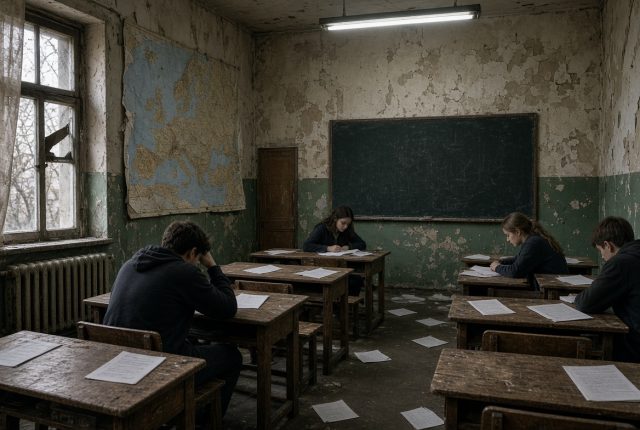
Almost half of 15-year-olds in Romania cannot reliably understand a moderately long text. This is the PISA 2025 finding released this month: 48% of Romanian students fall below Level 2 in reading, up from 41.7% in 2022. In mathematics the share is 52%. In science, 46%. Worse still, 38.5% sit below the minimum in all three domains at once, nearly double the OECD average.
In a single school year, about 15,900 children left primary and lower-secondary education. For the cohort that started preparatory class in 2015–2016, only 89.7% reached eighth-grade graduation on time. In rural Romania the figure drops to 80.3 %. Early school leaving among 18- to 24-year-olds stands at 15.5 % against an EU average of 9.1 %. Among 15- to 29-year-olds, 19.2 % are neither in work nor in education or training, the highest NEET rate in the Union. One recent OECD snapshot put the 18–24 NEET share at 23 %, against 14 % in the EU. These numbers represent weaker hirability, thinner tax bases, and heavier social spending. Tertiary attainment among 25- to 34-year-olds is 23.2 % versus 44.1 % in the EU. Only 7.2 % of recent vocational graduates had genuine workplace learning, against 65.2 % in the EU. High-school completers earn about 18 % less than the national average wage. A system that fails to teach reading and calculation does not just disappoint parents, it creates dependence.
Public education spending was 2.4 % of GDP in 2023, against 4 % across the OECD. Romania spends $3,783 per primary pupil, while the OECD average is $12,893. In primary schools, 86 % of current spending goes to salaries, leaving little for books, labs, transport, meals, or the extra hours that actually close gaps. Between 2022 and 2024 more than €2.2 billion was drawn and spent on education, yet reading scores fell 16 points and the share of students below the floor in all three subjects rose. Smartboards do not teach a child to follow an argument if the teacher is exhausted, the class is oversized, and the curriculum keeps changing before anyone has been trained to teach it. Socioeconomic status explains 21.7 % of the variance in science scores in Romania, almost twice the OECD average. The gap between advantaged and disadvantaged students is 122 points. Which school you attend accounts for at least half the variation in science. A child in a poor rural commune is not competing on the same track as a child in a well-staffed urban high school.
And yet, on the morning these figures sit on every news site, Romania still does not have a fully empowered government. The Bolojan cabinet fell in May. Two investiture attempts failed. A third designate, Siegfried Mureșan, is trying to push a minority PNL–USR–UDMR list through Parliament without the votes. PSD and AUR have said they will not back it. Interim rule is not a governing strategy. The Education Ministry is part of that drift. Mihai Dimian, minister since March and proposed again for the Mureșan list, received a negative opinion from the joint parliamentary education committees on 29 September. Senators from more than one party said the programme he presented was vague, unquantified, and interchangeable.
AUR’s education argument is fairly simple: stop improvising on children, put the teacher back at the center, and measure results instead of press conferences.
Senator Luminița Păucean-Fernandes used the PISA release to ask the ministry the questions that should already have answers: a multi-year plan to cut functional illiteracy, with indicators; an honest evaluation of those €2.2 billion; a strategy for rural and poor schools that is more than a funding line; and a shift from rote learning for grades toward critical thinking and usable literacy.
AUR deputy Silviu Gurlui has argued that the new high school framework should not be forced through before teachers are trained, textbooks aligned, and parents and universities consulted. Reforms built only in Bucharest tend to land as chaos in classrooms allover Romania.
The party’s concrete items: a single national high-school admission instead of parallel school-level exams that privilege those who already know the system. Roll back class-size increases and teaching-load changes introduced in the Bolojan education law of August 2025. Cut the teaching norm so teachers can actually teach, not just survive the timetable. Generalize a hot meal in primary and lower secondary. Keep the national capacity exam rather than dissolving the one common standard that still exists. Protect the teaching career bonus instead of treating teachers as the first place to save money. Tie research funding to a predictable tax credit and connect upper-secondary tracks to real workplaces, not to PowerPoints about “the jobs of the future.” School uniforms, which AUR has pushed for years, are a smaller piece of the same idea: fewer visible class markers, less bullying, a shared school identity.
Romania already knows the cost of delay. Every year of functional illiteracy is a year of young people who cannot follow a contract, a safety sheet, or a ballot paper with confidence. Every NEET is a person the labor market did not claim and the budget still has to carry. The OECD and Eurostat numbers are not an insult to Romanian children. They are a verdict on the adults who ran the system while arguing about government coalitions.