





 Subscribe


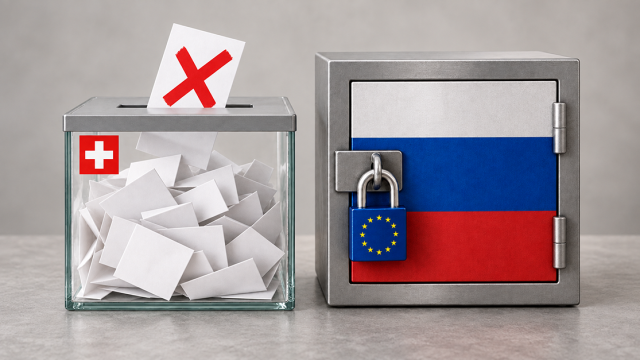
A decisive referendum defeat keeps Bern’s foreign policy options open and protects a crucial element of Europe’s economic response to Moscow.
Swiss voters have overwhelmingly rejected a proposal to impose a stricter definition of neutrality, preserving the government’s freedom to cooperate with international partners and maintain sanctions against Russia. The result carries consequences well beyond Switzerland, removing a potential obstacle to European efforts to sustain economic pressure on Moscow while demonstrating that Swiss neutrality remains open to interpretation.
The initiative was defeated by 70.2% to 29.8%, with all 26 cantons voting against it. Only in Ticino was the margin comparatively narrow. Turnout reached 47.1%. Such a broad rejection represents a substantial setback for the proposal’s supporters and gives the federal authorities a clear mandate to retain their existing room for manoeuvre.
Backed by the rightwing Swiss People’s Party, known as the SVP in German and the UDC in French and Italian, the initiative sought to place tighter constitutional limits on foreign and security policy. Despite substantial campaign funding, its advocates failed to persuade voters that Switzerland needed a more restrictive framework. According to Le Temps, silence descended on their headquarters at Bern’s historic Casino as the outcome became clear.
The central issue was how neutrality should operate in a world where military conflicts also generate financial, commercial and diplomatic confrontation. Supporters wanted stronger constitutional guarantees against involvement. The result suggests that most voters preferred to preserve political discretion, although a referendum alone cannot establish the individual motivations behind every ballot.
Under the proposed amendment, Swiss neutrality would have been explicitly defined as perpetual and armed. Switzerland would have been barred from joining military or defence alliances and from cooperating with them unless it faced an actual or imminent military attack. Participation in military conflicts between other states would also have been prohibited.
The most consequential provision concerned economic sanctions. Switzerland would generally have been prevented from imposing them on belligerent states, with exceptions for United Nations sanctions and measures intended to stop sanctions being circumvented. This would have created a much narrower basis for Swiss participation in the restrictions adopted by European countries against Russia.
For Brussels, that prospect raised an immediate strategic concern. Switzerland is outside the European Union, but its financial importance means that its policy choices can influence the effectiveness of European measures. A sanctions regime becomes harder to sustain when major neighbouring financial centres operate under substantially different restrictions.
The rejected proposal therefore mattered for more than diplomatic symbolism. Restrictions on financial transactions, dealings with designated individuals and commercial activity depend partly on cooperation across jurisdictions. If Switzerland had been constitutionally constrained from maintaining comparable measures, European policymakers would have faced a more fragmented environment in which to pursue their objectives.
Nevertheless, the precise consequences of approval would have depended on implementation and legal interpretation. The exception covering measures against circumvention would have required particular scrutiny. It would therefore be excessive to claim that every restriction affecting Russia would automatically have disappeared. The more defensible conclusion is that the initiative threatened Switzerland’s capacity to maintain its existing alignment with European sanctions.
Its defeat preserves that capacity. It does not create an obligation for Bern to adopt every future EU decision, nor does it transfer responsibility for Swiss foreign policy to Brussels. Switzerland retains its own institutions and decision processes. What voters rejected was a constitutional restriction that would have sharply reduced the options available to those institutions.
Moscow had an obvious interest in the outcome. A Swiss retreat from European sanctions would have weakened the political cohesion behind economic pressure on Russia. The United Nations exception also carried special significance because Russia holds a permanent seat and veto power on the Security Council, allowing it to block substantive resolutions directed against itself.
That institutional reality exposes a difficulty in treating UN approval as the principal test for acceptable sanctions. The framework may appear to provide a universal standard, yet its operation depends on the consent of powerful states, including states directly involved in a conflict. In such circumstances, the absence of UN sanctions does not necessarily indicate international agreement that no response is warranted.
The wider debate turns on the distinction between military neutrality and political or economic disengagement. Switzerland’s government maintains that neutrality is compatible with sanctions and international cooperation. Its official explanation of the initiative states that Switzerland largely adopted EU sanctions following Russia’s attack on Ukraine while continuing to uphold its neutral status.
That position reflects a view of neutrality as a means of protecting independence and security while supporting international order. Advocates of stricter rules take a different approach, placing greater emphasis on distance from competing power blocs. The referendum decisively rejected their proposed constitutional formula, but it is unlikely to settle this underlying disagreement permanently.
Switzerland’s neutral tradition has deep historical roots, reaching back to the sixteenth century, and received international recognition in 1815. The country remained formally outside both world wars and joined the United Nations only in 2002. Yet this history has never eliminated the practical need to manage relations with surrounding powers.
Neutrality also underpins Switzerland’s reputation as a diplomatic intermediary. Its capacity to offer mediation depends on credibility and acceptance by the parties concerned. Whether sanctions strengthen that credibility by defending international principles, or weaken it by suggesting alignment, remains a contested question. Neither interpretation can guarantee that governments at war will accept Swiss mediation.
For Europe, the vote illustrates the increasingly complex choices facing neutral countries. Austria and Ireland are EU members, whereas Switzerland is not, so their institutional positions differ substantially. Even so, all face the challenge of reconciling established national traditions with demands for security cooperation and responses to conflicts that affect the wider continent.
The Swiss result should not be read as an endorsement of military alliance membership. Voters were deciding on a particular constitutional amendment, not choosing whether to abandon neutrality altogether. The political message is more specific: an overwhelming majority opposed binding future governments to the initiative’s restrictive definition.
A second referendum produced another emphatic rejection. Voters defeated a food sovereignty proposal by 72.5%, turning down an initiative that sought a Swiss self-sufficiency level of at least 70%. Although the subject was different, both ballots raised questions about how extensively national autonomy should be protected through binding domestic requirements.
There are limits to drawing a common ideological lesson from the two results. Food production and foreign policy involve different interests, costs and expectations. Still, the simultaneous defeats show that appeals to sovereignty alone were insufficient to secure majority support for either proposal. Each initiative had to convince voters that its practical consequences justified the constraints it would introduce.
For Bern, the immediate outcome is continuity. The constitution remains unchanged, the government retains flexibility, and cooperation on European sanctions can continue. For Brussels, a potentially serious source of uncertainty has been removed. For the initiative’s backers, the scale and geographical breadth of the defeat demand a reassessment of their argument.
The next challenge will be to use that flexibility convincingly. Swiss authorities must continue explaining how individual decisions serve national interests and fit their understanding of neutrality. The referendum has preserved the tools of foreign policy; it has not removed the responsibility to justify their use. Switzerland’s voters have left that judgement in the political arena, where changing circumstances can be debated and decisions reconsidered. That leaves Switzerland neutral, but still able to respond when international crises place its principles and interests under pressure.
Alessandro Fiorentino