


 Subscribe


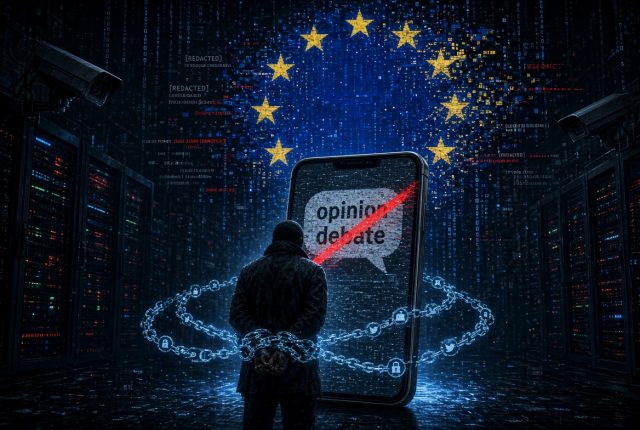
In a room in Stockholm this November, conservative politicians and experts gathered under the banner of the ECR Party for a panel on the tension between individual freedom and the expanding regulatory state in the digital sphere. Almost two centuries after Alexis de Tocqueville described democracy’s danger as soft, quiet control through a net of small rules rather than a tyrant’s whip, the speakers treated the European Union’s Digital Services Act as that net made concrete. It does not ban speech outright. It makes platforms responsible for “systemic risks,” arms “trusted flaggers,” and threatens fines of up to 6% of global turnover. The practical result, several argued, is that lawful political speech becomes too expensive to defend.
The panel opened with the blunt question of who decides what a citizen may say, read, pay with, or keep private. Nikola Grmoja, the Croatian MP and former justice minister from the MOST party, answered that the decision has moved out of national constitutions and courts and into a closed room shared by Brussels and a handful of large platforms. Most public debate in Croatia now happens on American services. When those services change rules to stay on the right side of the Commission, users in Dubrovnik and Zagreb simply see posts disappear or reach collapse. No judge ruled the content illegal. The Commission insists the DSA is not censorship. The first major fine against X, formally about transparency, nevertheless told every platform that the safe choice is to remove more. Grmoja’s test is simple: if a post is illegal, a judge should say so. If it is legal, nobody should bury it.
Peter Kalil, director of Free Speech Ireland and a fellow at the Edmund Burke Institute, added the economic mechanics. Very large online platforms face liability if they fail to moderate in line with Brussels expectations. Because the definition of illegal content often rests on national law, and because the penalty is calculated on worldwide revenue, companies err on the side of caution. Kalil noted that Ireland’s failed “incitement to hatred” bill had temporarily lowered one risk, since the DSA relies on member state definitions of illegality. Still, the broader effect is a lowest common denominator standard that restricts legitimate speech and, more quietly, the ability of Europeans to build competing services. Setting up a business or embracing AI tools inside the Union is already slow and expensive and the DSA adds another layer of uncertainty. His practical advice to anyone who wants to innovate in the digital space was short: leave.
Joe Weil, CEO of Unplugged, approached the same problem from the device rather than the statute. Regulations that focus on specific settings or ad identifiers, he argued, miss the architecture. Smartphones and free apps exist to attribute people, map relationships, and monetize them. Turning off an ad identifier in 2021 was supposed to wound the advertising model. Meta’s stock later rose far higher. The same data exhaust that platforms harvest for commerce is now usable for targeting in conflict zones. Weil’s company is building hardware and software that lets users, including militaries, control the signal rather than merely minimize it. Presenting an alternate, believable picture instead of trying to go silent. In a world of ubiquitous signals, he said, the old Cold War idea of hiding is obsolete. The larger opportunity for Europe is not more regulation but products that do not depend on the twentieth-century advertising model.
Sigríður Andersen, speaking from Iceland’s position inside the European Economic Area but outside the Union, underscored how little room smaller countries have. Iceland must implement most EU rules. Politicians, she noted, are often decades behind the technology and rely on bureaucrats to tell them what to sign. The result is legislation written in narrow silos that misses the cumulative effect on speech and privacy. She stressed the importance of keeping due process intact and of subjecting courts themselves to public scrutiny, since judges are appointed for life. Awareness, not just new rules, is required as many people do not realize the extent of the surveillance or simply say they have nothing to hide.
Eric Prince’s keynote later that morning placed the DSA in a longer history of control over communication. Rome held its empire by controlling roads and the imperial post. The printing press broke older monopolies until authorities answered with licensing and an Index of Forbidden Books that lasted until 1966. In the present, platforms have already shown they can remove entire networks in days, as happened after the 2020 U.S. election. The DSA writes that control into law. Prince cited the German pensioner whose early-morning police visit followed a post calling the chancellor “an idiot”, and the Finnish Supreme Court’s conviction of a former interior minister over a church pamphlet written twenty years earlier. Chat control, the proposal to scan private messages before encryption, would move the scanner into the pocket. The device itself becomes the telescreen.
These arguments land with particular force in Romania, where conservative voices have repeatedly collided with both national authorities and the practical operation of EU digital rules. AUR has described the DSA as a mechanism that converts political opposition into “systemic risk.” Party figures have called it an instrument of control that moves decision making from courts to administrative and platform discretion, and they have written to the European Commission warning that Romanian institutions used the regulation during electoral periods to treat opinions as illegal content.
The 2024 presidential election supplies the clearest illustration. After independent candidate Călin Georgescu unexpectedly led the first round, the Constitutional Court annulled the entire process days before the runoff, citing intelligence assessments of coordinated social-media activity and alleged Russian interference. AUR and its allies called the decision a coup that disenfranchised millions of voters. The election was later re-run and the original winner was barred from standing again. Whether or not foreign interference occurred, the episode demonstrated how quickly platforms, algorithms, and emergency regulatory powers can be invoked to reverse an electoral outcome that established parties found unacceptable.
A more recent case involves AUR MP Dan Tănasă. In October 2026 prosecutors sent him to trial on charges of inciting hatred and discrimination. The indictment rests on an August 2025 Facebook post in which he urged Romanians to refuse deliveries made by non-Romanian workers from Asia and Africa and warned against following Western Europe’s path on immigration. AUR responded that opposing immigration policy is political speech protected by the Constitution, not a crime. Separately, Tănasă has challenged in court a National Audiovisual Council decision that would impose notification and registration requirements on digital content creators who meet certain audience and output thresholds. He argues that popularity does not turn a personal account into a television station and that fundamental rights cannot be restricted by administrative rules.
None of the speakers claimed the DSA creates new categories of illegal speech on paper. They described instead a system of incentives, fines, trusted flaggers, and risk assessments that pushes platforms to remove more than the law strictly requires and that leaves citizens outside the room where the practical boundaries of speech are drawn. In Romania, that system coincides with canceled elections, criminal charges for immigration commentary, and administrative rules that treat high visibility conservative voices as regulated entities. The net of small rules is already tight. Whether national parliaments and courts can still loosen it, or whether the practical standard will continue to be set in Brussels and on platform dashboards, is the question the panel left hanging.