


 Subscribe


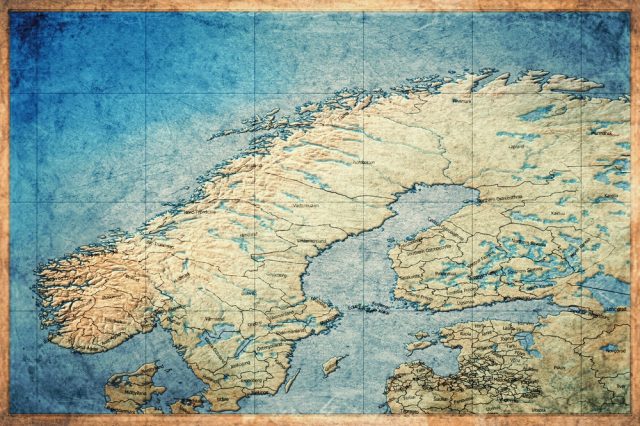
Recent archaeological discoveries have confirmed old myths to be closer to fact than what modern science up until this point believed.
The old Goths, notorious conquerors across Europe during late antiquity, were indeed sprung out of Scandinavia. The Germanic language family too seems to have entered mainland Europe from the Scandinavian peninsula. This was presented in the journal Nature in recent weeks.
The studies combine archaeology, modern DNA research, and linguistic studies to paint a picture of early European history outside of the Mediterranean, in a realm that has long been subjected to both romanticism and excessive skepticism. The latter likely arose as a result of the first.
But now the “romantics” of Germanic history have been validated. The Goths need no introduction for those well-versed in European history, but the latest findings justify the question nonetheless; who were they – really?
“The sources knew more than we thought they did”
The Goths left an indelible genetic trace across Central and Eastern Europe, originating in Scandinavia, and making a large sudden impact on what is now the Polish Baltic coast around 50 AD. Findings relate these people, who subsequently spread across much of the Eastern European plains and the Carpathians, to the Iron Age Swedish population.
The key difference between this movement of people, charted out with modern genealogical technology, and the established scientific view of the Goths, is that it was quite a large migration. As of the latter half of the 20th century, the Goths have been viewed in the scientific community as a small group of peoples, while potentially hailing from Scandinavia, constituted more of an elite in the subsequent tribal environments of post-classical Europe. The DNA findings of late however support the “romantic” view that the emergence of the Gothic culture in Eastern Europe was a significant mass migration of people, who largely displaced the settled inhabitants of the land from which they later warred against the Roman Empire. Goths are widely known in Western historiography to have sacked Rome in 410 AD, and for establishing kingdoms on the ruins of the great city’s empire.
It has previously been known that the Gothic language branched off the languages of Northern Europe at the start of the first millenium, as the Goths grew to become a distinct culture after their emigration from Sweden. The researchers now link this development to the settling of Goths in Eastern Europe. This means that the Gothic language and other cultural hallmarks that have been used by historians and archaeologists to identify the group was not necessarily only handed down to other groups from a narrow Gothic elite (which has been the established view), but may in fact be evidence of an extensive population replacement in Eastern Europe.
The dramatic movement of Goths into mainland Europe from Scandinavia was chronicled by classical and medieval authors, such as Jordanes, who himself was a Gothic historian in the 6th century. According to his account, which subsequently became the foundation for the Medieval and Renaissance Gothic romanticism which lasted well into the 20th century, the Goths descended from the island of Scandza, believed to be Scandinavia. The Swedish provinces of Götaland (Western Götaland and Eastern Götaland) and Gotland have been believed to testify to this origin owing to their similar namesake.
The status as progenitors of the Goths was embraced by the Swedish elite already in Medieval times, and was highly promoted during the country’s Great Power era in the 17th century. Nationalists continued to evoke Gothicism in the 19th century, and the movement saw some support from the scientific community around this time as well, lasting into the 20th century.
By the 1950s, Sweden being the cradle of the Goths was a questioned idea. The image of the Goths as anything but a name was too largely seen as obsolete. The latest modern findings however show that there is something to the primitive yet intuitive methods of using traditional myths to approach historical reality. The reaction of historian Noel Lenski of Yale University is quoted by Science: “What the genotyping is showing is what the ancient sources report, and what late–20th century historiography has been working very hard to deny […] We have to […] admit the sources knew more than we thought they did”.
That is not to say that the view of the Goths as a cultural torch that was also carried on by groups of other backgrounds is completely discarded. The findings point to strong Scandinavian DNA profiles in Gothic burial sites in southern Poland from several centuries after the people’s arrival on the coast around 50 AD, that were often found to be patrilineal. This means that Gothic men intermingled with women of other groups in the region, with the resultant mixing of cultures carrying on the Goths’ name and language, but with the genetic make-up altered. The Goths diverged into separate groups as they ventured in different directions in Europe, with Ostrogoths and Visigoths representing two of the Roman Empire’s most vicious antagonists. In Visigothic burials on the Iberian Peninsula, only a third of the skeletons have clear Scandinavian ancestry, according to the study.
The findings overall however support the theory that language, culture and traditions have historically been best carried by the descendants of their originators. The Gothic language failed to catch on in the wake of the Gothic conquests even though the Goths developed a level of intellectualism, and produced writing. There were simply not enough of them in the end, to establish a total lasting dominance over the ruins of the Roman Empire.
The new discoveries also contribute to the history of Scandinavia, and is a feather in the cap of Swedish national romantics, who have so long been derided as holding fantastical notions of history to be truth. It turns out that their perennial wisdom won over the anti-Gothic school that has permeated Swedish academia for several decades.
New information on the origin of Germanic languages
The Goths’ emigration from the North is, as it turns out, merely one instance of Scandinavians venturing out and leaving lasting impressions on their surrounding regions. The Vikings stand out as the most well-known example of this in contemporary times. But the most impactful of these proto-Nordic southward migrations was when they spread their language.
The researchers have with the newly charted DNA studies dated the presence of an archaic Palaeo-Germanic language in Sweden by the Late Bronze Age between 1200 and 600 BC. The development of Palaeo-Germanic into Proto-Germanic has been known to linguists before through meticulous reconstruction, and is often attributed to the adoption of certain loanwords from neighbouring cultural groups. What has been discovered through the DNA studies is that there was little to no genetic admixture in Scandinavia, at least not in Denmark (which seems to have been a node for migration movements in this region in this period), around the time of this transition. As such, the development towards the Germanic language that later went on diverge into what is the modern Scandinavian languages, German, Dutch and English, happened in Scandinavia at the hands of the Germanic peoples that inhabited the region. In more layman-like terms, countries like Sweden and Denmark are cradles of the Germanic tongue. This may not have been obvious to previous researchers, where Scandinavia itself has often taken a more peripheral role in the spread of Germanic culture.
For much of the North Sea region and the Germanic-descended Europe, migrants from Danish Jutland were the primary proliferators of the Germanic language of the late Iron Age (first to sixth century AD). Traced ancestry from population groups in the Netherlands, Germany, and England reveal close historical ties to this peninsula.
In the Baltic region, such as with the aforementioned Gothic migrations into current-day Poland, the corresponding ancestry found in Iron Age burials is instead commonly traced to Sweden. This Germanic migration into Eastern Europe left no permanent linguistic legacy, but was swept away during later migration waves.
Nevertheless, the new language traces also place Sweden, and by extension the entirety of Scandinavia, closer to the centre of the emergence of post-classical Europe than it has usually been acknowledged to be by scholars. The historical obsession of the Swedish elite with Gothicism, and even the theory of Sweden as the location of the ancient Atlantis (as posited by Olof Rudbeck the Elder), can in some respects be seen as a compensation for the widely perceived status as being a nation on the fringes of the civilised world. This status has been maintained into modern times, but may soon come to change.