





 Subscribe


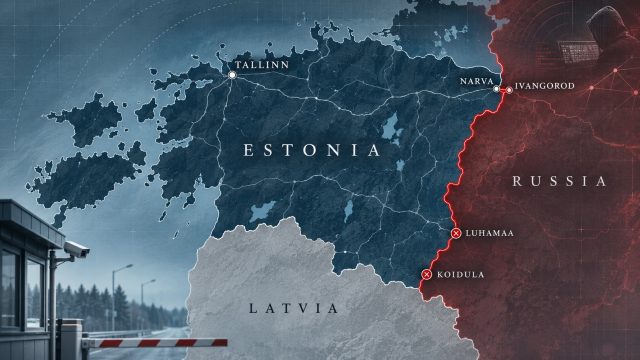
Tallinn is closing its border crossings with Russia following attacks against its defence industry. Yet the latest sabotage attempt reveals a more complicated reality: hostile operations can move across Europe even when its eastern borders are shut.
The images coming out of Ivangorod, the Russian town facing Narva across the river, tell a story that goes beyond the imminent closure of a border. Travellers carrying suitcases, families bringing forward their journeys, residents forced to rearrange their daily lives. From 1 December, Estonia will suspend road crossings with Russia, turning what has long been a routine journey for thousands of people into a considerably more complicated undertaking.
The decision, formally announced by the Estonian government on 20 November, covers five border checkpoints: Narva-1, Narva-2, Koidula, Luhamaa and Saatse. Only three were still actively operating. The suspension will be reviewed after six months, while rail freight will continue under existing restrictions.
To understand the political significance of the measure, however, we need to look beyond the queues at the border and consider what happened just days earlier in Viimsi, near Tallinn.
During the night of 14 November, a group of individuals attempted to set fire to the premises of Threod Systems, an Estonian company specialising in unmanned aerial vehicles. The attempt was thwarted through the intervention of the company’s security personnel and the authorities. Eight Latvian nationals were detained. According to Estonia’s Internal Security Service, KAPO, the operation had been ordered and coordinated by Russia’s military intelligence agency, the GRU.
It was not the first incident. In August, another Estonian defence company, Milrem Robotics, had been targeted in an arson attack that Tallinn’s security authorities also attributed to Russian intelligence services. Moscow denies the allegations, while the individual criminal responsibility of those under investigation remains subject to judicial proceedings.
Against this background, Prime Minister Kristen Michal’s government decided to act. Foreign Minister Margus Tsahkna explained that closing the border would reduce opportunities for Russian intelligence services to recruit, influence and organise hostile activities through direct cross-border connections, while also helping to counter sanctions circumvention.
This is a security assessment that Estonia’s authorities are entirely entitled to make. Yet it raises a question extending well beyond Estonia itself.
The sabotage operation that did not cross the Russian border
The most revealing detail of the entire affair emerged from remarks made by Estonian Interior Minister Igor Taro during an interview with public broadcaster ERR, reported on 18 November.
The suspects involved in the attempted sabotage had not entered Estonia from Russia. They had arrived from Latvia.
The minister openly acknowledged this fact, while insisting that the suspects’ route into the country did not alter the broader assessment of the threat posed by Russian activities.
It is an important distinction. Closing the eastern border may help restrict certain operational opportunities available to Russian intelligence. It does not necessarily prevent Moscow from organising attacks through individuals already present on European territory or recruited in other countries.
The Threod case also demonstrates that existing European cooperation can deliver results. According to the Latvian State Security Service, VDD, intelligence collected by the Latvian authorities and shared with their Estonian counterparts helped prevent the attack. Subsequent investigative operations in Latvia led to the seizure of explosive devices, pyrotechnic materials, ammunition, electronic equipment and other items relevant to the investigation.
Cooperation between two national security services therefore proved effective before the attempted sabotage could achieve its intended consequences.
This is where the episode offers its most valuable strategic lesson.
Territorial sovereignty remains indispensable. A state must be able to control access to its territory and adopt exceptional measures when sufficient grounds exist to consider national security under threat. But hybrid warfare also exploits connections that do not follow the administrative boundaries separating Europe’s democracies.
Criminal networks can serve as intermediaries. Foreign nationals can be recruited remotely. An operation may be planned in one country and carried out in another. The geographical origin of those executing an attack does not necessarily reveal where the order originated.
Europe’s response must recognise this reality without confusing freedom of movement with the absence of security controls, or treating every cross-border traveller as a potential suspect.
The domino effect along Europe’s eastern borders
Estonia is not the first European country to drastically restrict connections with Russia.
Finland has kept its land border crossings with the Russian Federation closed since December 2023. In that case, the decision was primarily motivated by concerns over the instrumentalisation of migration flows, which Helsinki believed were being facilitated by Russian authorities to exert political pressure and undermine national security.
The Finnish government has maintained its restrictions into 2026, illustrating how measures initially adopted in exceptional circumstances can remain in force when the underlying security conditions fail to improve.
The Finnish and Estonian cases are not identical. The former primarily concerns the use of migration as an instrument of pressure, while the latter responds to sabotage and clandestine operations. Both experiences, however, expose a common problem: when one country closes a route, some of the traffic tends to move elsewhere.
The Estonian authorities themselves acknowledge this in their official guidance. Following Finland’s decision to close its border, crossings by Finnish citizens through the Estonian-Russian land border increased from just over 7,000 in 2023 to approximately 65,700 in 2024.
Tallinn now considers it highly probable that traffic will increase through Latvia and, potentially, Lithuania. Latvian border guard officials have also anticipated a greater operational burden, although as of 20 November Riga had not indicated an intention to introduce a comparable full closure.
This movement of travellers should not automatically be interpreted as a security threat. Most people crossing international borders do so for entirely legitimate reasons. The issue is different: the redistribution of traffic changes the requirements for border management and may transfer some of the vulnerabilities that one country has sought to reduce to neighbouring states.
A national border can be closed through a decision taken by the government responsible for it. Within an area of free movement, however, the consequences of that decision rarely remain confined to the same territory.
National responsibility must therefore be accompanied by timely intelligence sharing, common assessments of emerging threats and sufficient operational resources in countries likely to experience the indirect effects of restrictions imposed elsewhere.
Europe’s defence industry has become a target
Another aspect of the Estonian case deserves particular attention. The two incidents that contributed to the government’s decision did not target institutional symbols or conventional military installations. They targeted industrial companies.
Milrem Robotics and Threod Systems operate in technological sectors of direct relevance to modern military capabilities, including unmanned systems.
Attacking such companies means attempting to interfere with one of Europe’s capacities to develop and manufacture defence technology. A major industrial facility does not need to be destroyed for an operation to have a destabilising effect. Even the repeated threat of sabotage can increase security costs, disrupt certain activities and create uncertainty among employees, suppliers and commercial partners.
These potential consequences must become part of Europe’s strategic calculations.
In recent years, much of the continental security debate has focused on the need to increase military expenditure, strengthen production capacity and reduce strategic dependencies. These are reasonable objectives, particularly in light of Russia’s aggression against Ukraine and the need to rebuild European defence capabilities.
But expanding production is not enough if the industrial infrastructure supporting it remains vulnerable to clandestine operations.
Protecting the defence industry must be regarded as an integral component of military preparedness. This also requires closer cooperation between public authorities and private companies, investment in the physical and digital security of industrial facilities, and particular attention to infiltration and recruitment attempts.
The Estonian experience suggests that these measures can work. The attack against Threod was prevented in part because of the preparedness of the company’s security personnel and effective cooperation between national authorities. Such preventive capabilities deserve to be strengthened rather than treated as secondary to investment in weapons systems.
The human cost of strategic decisions
There is also a dimension that conservative analysis should not overlook: the relationship between national security and local communities.
Narva is more than a location on a map. It is a city of over 50,000 inhabitants, connected by family, language and economic ties to neighbouring Ivangorod. The border separates two states whose relations have deteriorated profoundly, but it also cuts through the everyday lives of ordinary people.
Mayor Jaan Toots has asked the government to consider humanitarian exemptions for residents who need to care for elderly relatives, attend funerals or deal with other urgent family circumstances. He has also expressed concern about the economic and employment consequences of the closure.
The official guidance currently available does not provide for individual humanitarian exemptions at the affected checkpoints. People wishing to travel to Russia or return to Estonia will have to find alternative routes.
National security may justify significant sacrifices. Yet precisely because those sacrifices are demanded of citizens, the state has a responsibility to assess them, explain them and, wherever possible, mitigate their consequences.
Estonia’s decision to review the measure after six months provides an opportunity to examine its effects. The assessment should concern not only the number of border crossings, but also the restriction’s actual effectiveness in reducing the risks identified by the authorities.
Supporting Estonia’s right to protect itself does not require ignoring the difficulties faced by its citizens. On the contrary, the resilience of border communities is itself an element of national security.
European security built on the responsibility of nations
The European Union is not starting from scratch in confronting these threats.
In its conclusions of 15 and 16 October 2026, the European Council acknowledged the intensification of hybrid attacks, including acts of sabotage against Member States, and called for stronger protection of critical infrastructure and a coordinated response.
Significantly, the document explicitly recalled the primary responsibility of Member States in this area, alongside the availability of European instruments for countering hybrid threats.
On 16 November, the Council of the European Union also adopted additional sanctions against thirty individuals and two entities involved in Russian information manipulation and malicious cyber activities. These measures were unrelated to the specific Threod investigation, but reflected the broader range of destabilising activities confronting European institutions.
The problem, then, is not a complete lack of awareness. It is the ability to translate that awareness into cooperation sufficiently rapid to anticipate hostile operations.
From a conservative perspective, this does not necessarily require another transfer of powers to Brussels. It requires states to exercise their responsibilities fully and to cooperate wherever the threat cannot be addressed effectively by any one of them acting alone.
The joint intervention of Latvian and Estonian intelligence services provides a particularly instructive example: national authorities retaining their autonomy, sharing sensitive information and achieving a concrete operational result.
It is a model of European cooperation based on practical capability and mutual trust, rather than the multiplication of decision-making structures.
The eastern border remains the immediate responsibility of the states protecting it. Its security, however, concerns the entire Union, just as the protection of defence industries, energy networks and strategic infrastructure concerns every European country.
The Estonian case therefore suggests a practical agenda: faster exchanges of intelligence concerning recruitment and sabotage attempts, stronger protection of strategic companies, coordination in managing the consequences of border closures, and regular assessments of the effectiveness of the restrictions adopted.
Tallinn has chosen to close its border crossings with Russia, and its authorities have publicly presented the security reasons behind the decision. It would be mistaken to dismiss the measure as disproportionate simply because the suspects involved in the latest sabotage attempt entered Estonia from Latvia.
It would be equally mistaken to assume that protecting the border is sufficient in itself.
The incident in Viimsi demonstrates how a threat can be organised beyond the European Union’s borders, move through networks of people and interests already operating within Europe, and strike a company far removed from the physical frontier with Russia.
Estonia has decided to reduce one vulnerability. The question facing the rest of Europe is how to prevent that vulnerability from reappearing elsewhere, in a different form.
In hybrid warfare, closing a border may be a necessary instrument. Recognising and countering those operating beyond it remains the more difficult task.