





 Subscribe


When foreign correspondents arrive in Iceland, they usually contact three groups for information and analysis: officials in the Foreign Service, journalists, preferably at the Public Broadcasting Service, and university teachers, especially in international relations. In Iceland, these three groups are, almost to a man, in favour of joining the European Union. I should know: most of them are my former students. I tried in vain to alert them to the disparity of power between small and large states, famously expressed by the Greek chronicler Thucydides in the Melian Dialogue: the strong do what they can, and the weak suffer what they must. A correspondent for The Economist who recently wrote about the 29 August referendum in Iceland on the European Union has clearly been speaking to members of these three pro-EU groups. He (or she) asserts that opponents of EU membership make several false claims. But in fact, it is the correspondent who makes false claims, indeed three of them.
The Referendum Decided when Biden was President
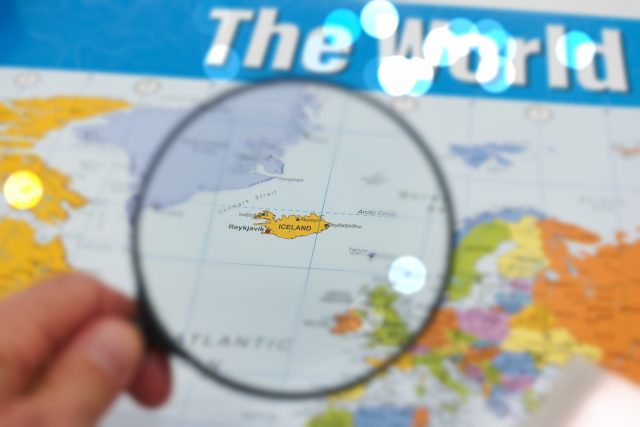
The Economist’s first assertion is that the referendum is largely driven by uncertainty in the North Atlantic stemming from President Donald Trump’s behaviour, such as threats against Iceland’s neighbour, Greenland. In fact, the present government’s decision to hold a referendum was made at the end of 2024, when Joe Biden was still president. Moreover, Trump—who will only serve two and a half more years—has hardly been mentioned in the election campaign. The United States signed a defence treaty with Iceland in 1951, under which it undertook to defend Iceland, which has no military force. Although the treaty was made within the framework of the North Atlantic Treaty Organisation (NATO), it is the only one with a NATO member state in which the US—the mightiest military power in history—explicitly guarantees its security. A glance at the map shows that Iceland is strategically important to the US. It is therefore highly unlikely that the US will cancel the defence treaty. A country’s foreign policy is not based on a few statements by a politician whose bark is known to be worse than his bite. The Trump effect is a talking point of the pro-EU groups with whom the correspondent has been socialising.
The Referendum about EU Membership
The Economist’s second assertion is that the Icelandic No Movement falsely claims the referendum is about EU membership. On the contrary: This claim is true. The formal question is whether Iceland should resume the negotiations that began with an application for membership in 2009 and were halted in 2013. In other words, it is about whether to renew the 2009 application. It is true that, when the negotiations end, another referendum will be held to accept or reject membership. But it is just a talking point of the pro-EU groups that what is now being sought is not really a renewal of the old application but merely a fact-finding mission, an exploration of the conditions for membership. Countries normally apply for EU membership only if they are serious about it, and it is quite clear what is on offer: the whole EU regulatory framework, the acquis communautaire. This would imply that Iceland would transfer control over fisheries, agriculture, foreign trade, and monetary affairs to Brussels. Moreover, as a prosperous country, Iceland would contribute much more to the EU than it would receive in EU funds.
A European Army?
The Economist’s third assertion is that the Icelandic No Movement falsely claims that Iceland, as a member state, would have to participate in a European army. This is a straw man. No serious person claims this. There is no European army. However, EU leaders have repeatedly proposed such an army, for example, Angela Merkel and Emmanuel Macron in 2019, Guy Verhofstadt in his address to the Icelandic pro-EU Reform Party in 2024, and the EU commissioner for defence, Andrius Kubilius, in 2026. The European Parliament has also published a report on the possible introduction of conscription. This remains only a proposal, but it cannot be dismissed. Inevitably and reasonably, some arguments against EU membership focus on risks rather than facts.