





 Subscribe


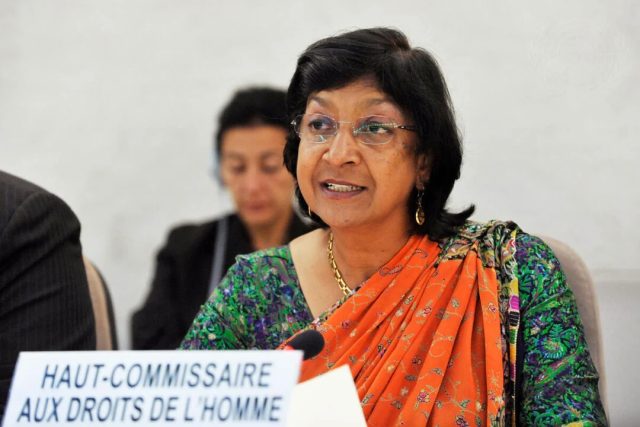
South African lawyer Navanethem Pillay was awarded the Nobel Peace Prize in 2026. A former United Nations High Commissioner for Human Rights, she shows extreme bias against Israel and in favour of authoritarian regimes. In her role at the U.N., she ignored human rights violations in Cuba, Iran, North Korea, Saudi Arabia and Belarus, while repeatedly condemning Israel. She calls Israel an apartheid state, which is absurd, given that the two million Arabs in Israel enjoy full political rights. She accuses Israel of genocide, which is a blatant abuse of the legal concept: genocide presupposes intent to destroy members of a group because of what they are, not what they have done. Of course, Israel could have killed all Palestinian Arabs if that had been her intent, but their number has gone up from one to five million since Israel was established in 1948. In the Gaza War, the Israeli Defence Force seeks to minimise civilian casualties, which is difficult because Hamas uses women and children as human shields.
Obama: An Absurd Choice
Ironically, Pillay did not attend the 2010 ceremony in Oslo, when Chinese dissident Liu Xiaobo received the Peace Prize. Yet again, the Nobel Prize Committee has embarrassed itself. Its most absurd choice was Barack Hussein Obama in 2009, nine months into his presidency. Obama received the Prize not for what he had done, but for who he was, the first black (half-black) U.S. President. Around the time he was in Oslo, he sent troops to Afghanistan to fight the Taliban. In 2011, he ordered air strikes on Libya to oust the dictator Muammar Gaddafi, who had, some years earlier, tried to accommodate the West by abandoning his nuclear weapons programme. Gaddafi was killed, but Libya lapsed into anarchy. Obama also sent troops to Syria and Iraq to fight the murderous ISIS extremists. Unlike the Libyan blunder, his military initiatives against the Taliban and ISIS were justifiable, but they were not peaceful.
Menchú: Facts Ignored
Another extraordinary choice was Rigoberta Menchú, who received the Prize in 1992 for her work on behalf of indigenous peoples in Guatemala. They suffered greatly during a brutal civil war from 1960 to 1996. Menchú published a widely quoted book in 1983 about her fight, I, Rigoberta Menchú. But in 1998, American anthropologist David Stoll presented compelling evidence in another book, Rigoberta Menchú and the Story of All Poor Guatemalans, that her account contained serious exaggerations and inaccuracies. For example, a brother who was supposed to have starved to death never existed. Another brother, who did exist, was not burned alive by the military while his family was forced to watch, as she said; he was killed in different circumstances. Her claim that she never went to school and only learned to read and write late in life was false; in her youth, she attended respected Catholic boarding schools. Moreover, Menchú contributed nothing to ending the civil war: she was a far-left admirer of Cuban dictator Fidel Castro. Despite Stoll’s revelations, the Nobel Committee refused to revoke her Prize, arguing it was not awarded for the book. The Guatemalans were unimpressed. When Menchú ran for president in 2007 and 2011, she received only three per cent of the vote each time.
Some Worthy Non-Recipients
Those who truly deserved the Nobel Peace Prize include Ronald Reagan and Margaret Thatcher: they ended the Cold War through their firm stance against the ‘Evil Empire’, where human development was stifled and opposition silenced. Four other remarkable individuals are less well known. South African authors Leon Louw and Frances Kendall published a 1986 book arguing that oppression of one group by another in South Africa could be minimised by dividing the country into largely self-governing cantons, as in Switzerland. Peruvian entrepreneur Hernando de Soto published two books on the ‘other path’ in Latin America and elsewhere: not revolution, but creating opportunities for people to escape poverty by registering, accumulating, and trading capital. Guatemalan entrepreneur Manuel Ayau established a successful university in his country that emphasises economic freedom: your propensity to shoot at your neighbour diminishes if you see in him a potential customer. Make trade, not war.