





 Subscribe


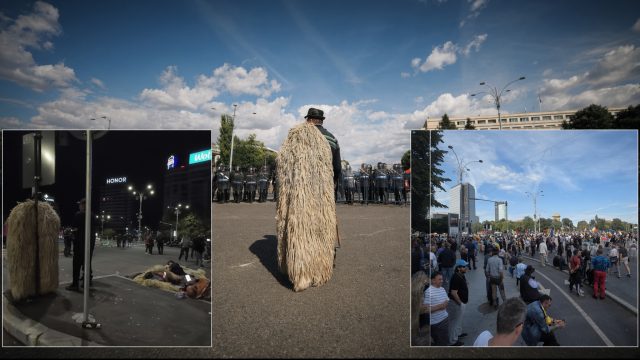
The images from Bucharest were easy to consume: raised voices, crowded streets, tense exchanges and, according to reports, acts of violence. The deeper story was harder to fit into a headline. Romanian shepherds and farmers did not come to the capital to create disorder. They came because the rules governing their livelihoods have made it increasingly difficult to sell their animals, move their flocks, protect their income or plan for the future.
Yet much of the media coverage has focused primarily on the most dramatic allegations surrounding the protest. The result is a familiar form of media distortion: the confrontation becomes the story, while the reasons that brought people into the street are pushed to the margins. That does not mean allegations of violence should be ignored. Any aggression, intimidation or damage must be investigated fairly. But responsible journalism should also ask a more fundamental question: what were the protesters demanding, and why had they reached the point of coming to Bucharest?
One of the strongest economic arguments raised by the shepherds concerns the collapse of export opportunities for sheep and goats. Because of outbreaks involving peste des petits ruminants and sheep and goat pox, Romania has been subjected to severe veterinary restrictions. Exporting animals to non-EU countries has been restricted, and movement to other EU member states has also been affected. The European Commission has extended restrictions concerning exports to third countries until 31 December 2026.
For farmers who built their businesses around export markets it means that animals which would previously have been sold may remain on the farm, generating costs for feed, veterinary care and labor without producing revenue. The seriousness of the problem is confirmed by the state itself. Romania’s National Sanitary Veterinary and Food Safety Authority, ANSVSA, has submitted an action plan to the European Commission aimed at unlocking exports. That fact alone should make it impossible to dismiss the shepherds’ complaints as invented or politically manufactured.
Another central demand concerns the compulsory slaughter of entire herds in areas affected by disease. There is a legitimate public-health and veterinary rationale for controlling contagious animal diseases. In certain circumstances, sanitary slaughter may be necessary. The dispute, however, is not simply about whether disease control is needed. It is about whether the destruction of an entire herd should become the automatic response, even when other epidemiological measures might be available.
The shepherds are asking authorities to consider vaccination, isolation, testing, zoning and other proportional measures whenever they are scientifically possible. Their first demand submitted to the Government reportedly called for an end to the administrative slaughter of sheep as an automatic solution. Even the Government’s own position acknowledges that slaughter should be applied only when there are no viable alternatives. That admission deserves far more attention than a short television segment showing an angry crowd.
Behind this demand are families facing the loss of their entire source of income. Agricultural media have reported the case of a farmer from Tulcea who said that her whole flock was slaughtered, leaving her without the livelihood on which she depended. For a large industrial company, a loss can appear in a balance sheet. For a small shepherd, the loss of an entire flock can mean the disappearance of a family’s future.
The shepherds’ third major complaint is easy to understand. If the state prevents a farmer from selling animals in order to protect public health and the wider agricultural sector, why should the entire financial loss be left with the farmer?
Their official demands call for the state to cover the costs and economic damage caused by compulsory sanitary-veterinary measures. The Government has acknowledged the issue and says it has worked with livestock organizations on a proposal to compensate some additional feeding costs. But compensation promises are not the same as compensation received. A farmer still has to buy feed, pay workers, service loans and maintain buildings while waiting for a decision, an approval or a payment. In the meantime, the flock continues to consume resources.
Some shepherds have also found themselves unable to move their flocks from mountain pastures to wintering areas because of veterinary movement restrictions. As the cold season approaches, this is not a minor administrative problem. Sheep must be moved in time, and delays can threaten both animal welfare and the farmer’s ability to survive the winter. The protesters are therefore asking for exemptions and clearly defined “corridors” that would allow the legal movement of flocks under controlled conditions.
They also point to what they describe as an inconsistency: in some places, animal exhibitions have reportedly been organised while ordinary farmers were told that their flocks could not be moved legally. This specific allegation requires independent verification in each case. It should not simply be repeated as established fact. But neither should it be ignored.
A serious media outlet would investigate whether the rules are applied consistently, who receives exemptions, how movement permits are issued and whether the burden falls disproportionately on small producers.
Farmers interviewed by Romanian Television have complained that the price of milk fell from approximately 2–2.40 lei to around 1.60 lei, while diesel, feed, fertilizers, machinery and financing became more expensive. Some say they have been forced to sell animals to pay instalments on tractors, combines and other equipment. The economic mechanism is brutally simple: when the price received by the farmer falls while production costs rise, the farm’s profit margin disappears. For a business financed through leasing or bank credit, the resulting cash-flow crisis can quickly become a threat to survival.
Drought has made the situation worse. Farmers are asking for compensation systems that cover real losses, including damage to pastures. The Ministry of Agriculture has reportedly supported this demand in principle, while acknowledging that finding the necessary funds remains a problem.
These are not marginal complaints. They concern food production, rural employment, domestic supply chains and Romania’s ability to maintain a functioning agricultural sector.
- Why were exports blocked or restricted?
- How many farms have lost animals through compulsory slaughter?
- What compensation has actually been paid?
- Can shepherds move their flocks before winter?
- How have falling milk prices affected farm survival?
- Which institutions were warned before the protest?
- What alternatives to mass slaughter have been examined?
Ignoring these questions is not neutrality. It creates a distorted picture in which the reaction is visible but the cause is invisible.
The shepherds are not asking the public to accept every allegation they make without verification. Their claims should be checked, documented and challenged where necessary. But the same standard must apply to official statements and media framing. Alleged violence should be investigated, not used as a convenient substitute for investigating the grievances that produced the protest.