





 Subscribe


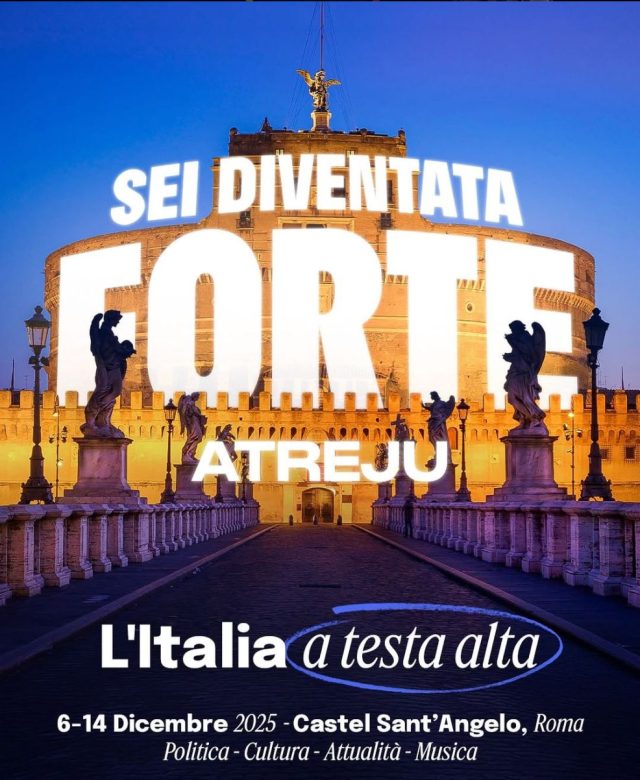
In December, all roads lead to Rome, where, in the Eternal City, the traditional festival of the Italian right, Atreju 2025, has been taking place since the 6th of December. As part of the festival, which has been running since 1998 and is held at Castel Sant’Angelo, each day represents an opportunity for anyone interested to learn and interact in a dialogue about the future of Europe with experts and academics from the highest levels of the European Union, with political figures and economic decision-makers from the great European conservative family.
It should be noted that the evening of the 11th of December is European Conservatism Day, a special event celebrating the 100th anniversary of the birth of Margaret Thatcher, the Iron Lady and founder of the conservative school of thought known as “New Direction.” On Friday, the 12th of December, at 9 p.m. in the Rosario Livatino Room, there will be a panel discussion entitled Conservative’s challenges, moderated by Antonio Giordano (Secretary General of the ECR and FdI deputy). Elisabetta Gardini (FdI deputy and president of the Italian Delegation to the Parliamentary Assembly of the Council of Europe) will open the debate. Among the speakers invited to the debate, the Rosario Livatino Hall will welcome some big names from the European conservative political scene. These include Marion Maréchal (ECR Party Vice President, Leader of the IDL Party, Head of the French delegation to the ECR Group), George Simion (ECR Party Vice President, Leader of the AUR Party – Romania), Adam Bielan (PiS International Secretary, Head of Polish delegation ECR Group), Kemi Badenoch (Leader of the Conservative Party – UK), Gila Gamliel (Minister of Science and Technology – Israel), Sigmundur Gunnlaugsson (Leader of Centre Party – Iceland), Kristoffer Storm (EU Affairs Chairman of DD Party, Head of Danish delegation ECR Group).
This year’s challenges have found the European conservative movement at a moment of strategic redefinition, marked by rapid geopolitical transformations caused by conflict at the Union’s borders, economic tensions, and intensified ideological competition between the world’s major powers (China, the US, and the EU). In this context, we can anticipate the main challenges and topics that will be debated by those who will take the stage at the Rosario Livatino Hall. Firstly, in a world characterized by uncertainty and competition, strengthening transatlantic cooperation between Europe and the United States remains a fundamental pillar of Western security. Discussions in academic, political, and economic circles will highlight the need to strengthen energy security, boost economic resilience, coordinating responses to global threats, and maintaining support for lasting peace in conflict-affected regions, particularly Ukraine. Therefore, a strong and confident Europe, anchored in the transatlantic partnership, is seen as essential for global stability. The topic defining Central Europe’s role in redefining the EU will certainly be addressed, as Central European states are gaining influence in shaping the European Union’s political directions. The approaches that will be promoted will emphasize diversity of perspectives over uniformity, respect for national identities, and balance between integration and sovereignty. This development represents both an opportunity and a challenge for conservatives, who must harmonise different regional visions into a common agenda. The training of a new generation of leaders will certainly be brought up for discussion because academic institutions emphasize the importance of civic education, responsible leadership, and preparing young people to manage the complexity of the contemporary world. That is why, for the conservative movement, investing in the younger generation is crucial for the continuity of social, economic, and cultural projects. It is absolutely true that the leaders of the conservative movement seek to consolidate a common platform capable of decisively influencing the direction of the EU by uniting the European right. That is why we believe that the debates will focus on sovereignty and strategic autonomy, the protection of national traditions and values, and will take a pragmatic approach to European policies. The future of Europe may mean the unification of conservative currents under a coherent vision.
The defense of the family model and ethical debates will certainly be a topic that will be brought to the forefront because European conservative leaders always promote issues related to demography, family, and social support policies at various meetings. It is well known that conservatives promote policies to protect the family, active measures to increase the birth rate, and opposition to practices considered incompatible with human dignity, such as certain forms of surrogacy. This direction is part of the broader dispute over cultural identity and the values of European society. The year 2025 has accentuated the confrontation between different cultural and political models. In this “civilizational battle” and ideological competition, conservatives believe that the main stake is the defense of European civilization, the protection of social cohesion, and the maintenance of cultural continuity in a context of external and internal pressures. The conservative movement aspires not only to resist change, but also to propose its own direction for the future of Europe and, implicitly, of the European Union.
The Atreju 2025 festival will end in front of thousands of participants on the 24th of December with a speech by Italian Prime Minister Giorgia Meloni. Before Giorgia Meloni’s speech, which the whole of Europe is waiting for, Mateusz Morawiecki (President of the ECR Party), Fabio Roscani (FdI MP and President of the National Youth), Antonio De Poli (Senator and National Secretary of the UDC), and Maurizio Enzo Lupi (Deputy and President of Noi Moderati) will take the stage in the “Sala Giustizia giusta” starting at 10:30 a.m. Fabio Roscani (FdI deputy and president of the National Youth), Antonio De Poli (senator and national secretary of the UDC), Maurizio Enzo Lupi (deputy and president of Noi Moderati), and Matteo Salvini (Minister of Infrastructure and Transport and vice president of the Council of Ministers).