





 Subscribe


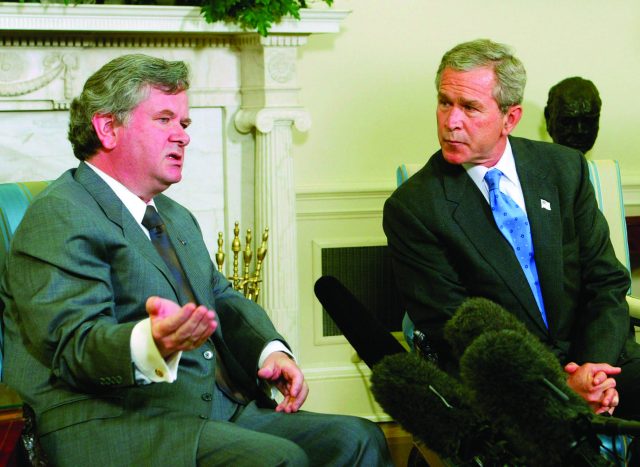
The Icelandic statesman Davíd Oddsson passed away on 1 March 2026, at the age of 78. He was not only the most influential politician in our history by far: Mayor of Reykjavik, Prime Minister, Foreign Minister, Governor of the Central Bank of Iceland, and Chief Editor of the daily Morgunbladid. He was also my best friend. Therefore, I cannot claim to be impartial, but on the other hand, I occupied a front seat in the arena in which he acted, so perhaps my observations are worth something.
David the Victorious
How could Davíd dominate Icelandic politics for a quarter of a century? One explanation lies in three adjectives: decisive, courageous, and crafty. As a politician, he had a keen sense of timing. He knew what he wanted, but he also sensed when the time was ripe. Becoming Mayor of Reykjavik in 1982 after a stunning victory over the united Icelandic Left, in the following nine years he improved the city’s finances, got rid of the previously persistent shortage of building plots, and built a City Hall. He privatised the loss-making Municipal Fishing Company: arguably, the City Hall cost Reykjavik taxpayers nothing, as it was built with the money saved from this. The son of a single mother with modest means, as a law student Davíd had earned extra money as a radio comedian, and his wittiness stood him in good stead as Mayor. When the leftists proposed that Reykjavik be declared a nuclear-free zone, he replied that this was a good idea, but perhaps it would be prudent first to declare an outlying part of the city as a nuclear-free zone, and if this proved effective, the rest of the city. Thus, he exposed the silliness of the proposal.
David the Lawmender
In the spring of 1991, Davíd was elected leader of the Independence Party, the conservative-liberal party that had long dominated Icelandic politics. He led it to victory in parliamentary elections shortly afterwards and formed a coalition government, first with the Social Democrats, then the Agrarians. Davíd’s goal was clear: liberalising the economy to make it internationally competitive. He abolished several funds that had supported loss-making enterprises, cut taxes, and privatised state companies, large and small, using the proceeds to eliminate the public debt. At the same time, he continued earlier initiatives, strengthening both the efficient system of individual transferable quotas in the fisheries and the pension system (which is now probably the most solid in the world). As a result, the economy flourished. Davíd also introduced many laws to combat discrimination and abuse of power. He was a strong supporter of Iceland’s traditional alignment with the United States, and on 6 July 2004, I accompanied him to a meeting with President George W. Bush in the Oval Office of the White House, where we sang ‘Happy birthday to you, Mr. President’ for Bush (the photo above was taken on that occasion).
Davíd in the Financial Crisis
Davíd stepped down as Prime Minister in the autumn of 2004, and after a brief period as Foreign Minister, in the autumn of 2005, he became Governor of the Central Bank of Iceland. There, he encountered a problem. The good reputation Iceland had earned as a consequence of his reforms had enabled the newly privatised banks to obtain almost unlimited credit abroad and to expand enormously, far beyond what the Central Bank or the Treasury could back in a crisis. In private, he issued many warnings against this danger, to no avail. In the autumn of 2007, an international liquidity crisis began, where Iceland was on her own. Davíd strenuously opposed the idea of trying to bail out the banks, and after some hesitation, the government agreed. The whole Icelandic banking system collapsed in October 2008. A new left-wing government saw it as its first task to oust Davíd from the Central Bank, despite the fact that he had been almost the only one to warn against and do something about the impending danger. But perhaps the best argument for Davíd’s liberalisation programme was how quickly Iceland was to recover from the collapse: the economy was basically sound. In the autumn of 2009, Davíd became Chief Editor of Morgunbladid, where he used his eloquence, experience, and wit to fight against leftist attempts to expropriate the fishing firms and to surrender Iceland’s sovereignty to the Brussels bureaucrats.