





 Subscribe


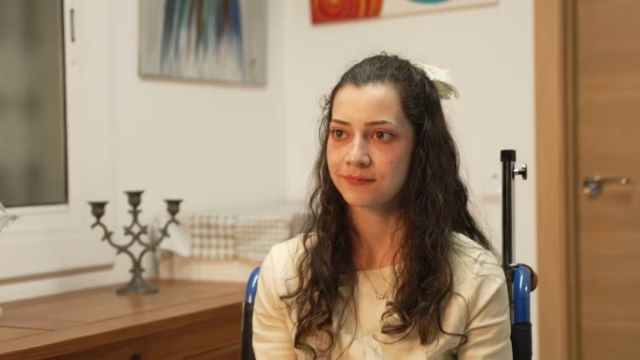
On 26 March 2026, in a hospital room in Sant Pere de Ribes, near Barcelona, 25-year-old Noelia Castillo Ramos died after receiving euthanasia under Spain’s Law on the Regulation of Euthanasia, which entered into force in 2021. Since then, more than 2,400 people have formally requested euthanasia in Spain, and just over 1,100 have ultimately received the procedure—euphemisms aside, being killed. However, her case has quickly become one of the most widely debated applications of the legislation since its adoption.
Legally speaking, everything proceeded according to protocol. After a lengthy process that included medical evaluations and a protracted judicial battle, the courts ultimately concluded that the conditions required by the law had been met. The procedure itself followed the established medical protocol: deep sedation was administered, followed by medication that caused cardiac arrest. And yet the fact that something is legal does not necessarily settle the deeper question of whether it is just, wise, or even humane.
But behind the legal case lies the story of a young woman whose life had been shaped by repeated trauma and abandonment, exposing a reality that shows the limits of such idealised narratives. From an early age, Noelia struggled with serious mental health conditions and spent part of her adolescence in protection centres. In that environment, according to her own testimony, she suffered abuse and exploitation, including a sexual assault by a partner while she slept and later a brutal gang rape that she never formally reported. These experiences left deep psychological wounds. Shortly after one of these assaults in 2022, she threw herself from a fifth-floor window. She survived the fall, but the injuries left her paraplegic and living with chronic pain that would define the final years of her life. From that point onward she sought euthanasia, and after a two-year legal battle the state ultimately granted it.
For many observers, the shock of the case lies precisely there. The law that had been justified as a compassionate measure for the terminally ill was now being applied to a young woman whose suffering, while undeniably real, belonged to a far more complex and tragic human story.
In the days following her death, several public figures in Spain and abroad acknowledged that cases like this have forced them to reconsider their earlier support for euthanasia. Among them was the Spanish politician Begoña Villacís, former Deputy Mayor of Madrid, who openly admitted that the law she once supported had been imagined under very different circumstances—circumstances that did not resemble the reality now unfolding before the public. She publicly said this case had changed her mind on the matter altogether.
This moment of reflection matters. It suggests that the debate about euthanasia was never truly settled. It was merely postponed. At the heart of the matter lies a deeper civilisational question. A society reveals its moral foundations not primarily through the freedoms it grants to the strong, but through the protection it offers to the weak. For centuries, Christian civilisation articulated a clear answer to that question. The measure of a society was found in how it treated those who could not defend themselves: the sick, the elderly, the abandoned, the child not yet born. Human dignity was not tied to productivity, autonomy, or independence. It was inherent, especially in those who suffered most.
From that worldview emerged the institutions that defined Europe’s moral landscape: hospitals, charitable orders, shelters, and systems of care designed to accompany those who were weakest, including the mentally-ill, which is the true nature of Noelia’s condition, and the true cause behind its tragic decision.
Modern societies across the West increasingly move in a different direction. In place of protection, they often offer elimination. Abortion, euthanasia, and assisted suicide are framed as expressions of autonomy and compassion. Yet when a civilisation begins to solve the suffering of the vulnerable by removing the sufferer, something essential has changed. Compassion becomes indistinguishable from abandonment.
The story of Noelia Castillo also contains another element that deserves recognition. Throughout the long legal process that preceded her death, her father fought tirelessly in court to prevent the euthanasia from taking place. Alongside him stood the Christian legal advocacy organisation Abogados Cristianos, which defended the principle that a vulnerable young woman with a history of psychological suffering should not be guided toward death. They fought for Noelia, and did not stop until the very end.
Sadly, their efforts were ultimately unsuccessful. After nearly two years of litigation, Spanish and European courts concluded that the legal conditions required by the euthanasia law had been fulfilled. Yet the fact that such a fight took place at all matters. It is easy, in a society increasingly accustomed to the language of autonomy and individual choice, to dismiss such efforts as paternalistic or ideologically-driven. But in truth they represented something older and perhaps more fundamental: the conviction that a life, especially a wounded and fragile life, is always worth defending.
Noelia Castillo’s life was marked by profound suffering. Such suffering ought to awaken compassion, not indifference, and certainly not judgment. Yet compassion must never become resignation. A society that begins to see death as the ultimate form of mercy risks losing the moral imagination necessary to accompany those who suffer and to fight for their dignity, even in the darkest circumstances. Very few people knew Noelia, and fewer still stood publicly in her defence. But her story may yet speak for many others who remain unseen—those who need care rather than abandonment, protection rather than despair, and a society willing to affirm that their lives are still worth defending.
May Noelia Castillo rest in peace. And may her story serve as both a warning and a spark—one that compels us to reflect seriously on the direction our civilisation is taking, and perhaps also a long overdue wake-up call. If her tragedy leads many to reconsider the path we have chosen, it may yet mark the moment when we find the courage to say, calmly but firmly, that enough is enough.