





 Subscribe


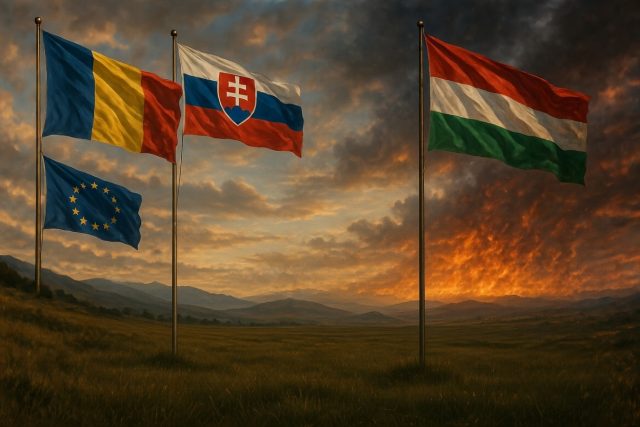
There is an unspoken rule in Romanian mainstream politics: if you are a conservative, sovereignist leader who puts your country first, you are a Kremlin puppet and a threat to democracy. But if you do the exact same things while offering the right energy deals and trade contracts, you get a military honour guard and a warm handshake at Cotroceni Palace. That rule was on full display on March 28, 2026, when President Nicușor Dan and Prime Minister Ilie Bolojan welcomed Robert Fico, Slovakia’s prime minister, to Bucharest for talks on military cooperation, energy, and bilateral trade.
The Romanian press barely flinched. No urgent editorials screaming about “pro-Russian influence.” No civil society mobs demanding the visit be cancelled. No hashtag campaigns. Just pleasant photos, diplomatic smiles, and talk of pushing bilateral trade toward 4.8 billion euros.
Let’s be completely direct about who Robert Fico is, because Dan and Bolojan clearly have no interest in telling you. This is a man who flew to Moscow to personally attend Putin’s Victory Day parade, openly defying EU calls for a boycott. He cut military aid to Ukraine. He has blocked EU sanctions against Russia repeatedly. He has said Ukraine has no place in NATO. And back home in Bratislava, his own police, supported by over 13,000 citizen signatures, launched a criminal investigation against him for treason, specifically because he cut emergency electricity supplies to Ukraine during an active war.
Now think about what Romanian officials and their media allies say about Viktor Orbán every single week. “He is a Russian asset. He is sabotaging Ukraine. He is tearing the EU apart. He is a danger to European democracy.” Some of those accusations are completely unfounded. But look at the concrete actions: by every real, measurable standard, Fico has done everything Orbán has done and gone further in several cases. Orbán has not been investigated for treason by his own police. Fico has. Yet Orbán is the monster of Romanian political discourse, and Fico gets a state reception with full ceremonial honors.
This is not principle. These are not European values. This is pure, undisguised political convenience.
The Romanian government’s obsession with Orbán has almost nothing to do with Ukraine and almost everything to do with domestic politics. Orbán has ideological and cultural ties to the Hungarian minority in Romania and the UDMR party, giving him a degree of political reach inside Romanian borders. More importantly, he represents a strain of conservative, sovereignist politics that resonates with millions of Romanians, including those who voted for George Simion in large numbers during the 2025 presidential race. For Nicușor Dan and the establishment camp he leads, Orbán is not primarily a foreign policy problem, he is a symbol of the domestic conservative opposition that they need to keep demonized and delegitimized.
So, the constant anti-Orbán messaging serves two purposes at once. It signals pro-EU loyalty to Brussels and to the Romanian urban, progressive voter base. And it poisons the well for any conservative or sovereignist political movement inside Romania by associating it with a figure the media has spent years painting as Putin’s best friend in Europe. It is a domestic political weapon dressed up as foreign policy principle.
Fico, on the other hand, is not Hungarian. He has no ties to Romanian conservatives. He offers energy cooperation and trade opportunities. He costs nothing politically to embrace and potentially delivers something economically. So, the same people who would lose their minds if Romanian officials met with Orbán sat quietly while the band played and the flags waved for the man under a treason investigation in Bratislava.
And then there is the jaw-dropping audacity of Nicușor Dan’s involvement in Hungary’s domestic politics. While hosting Fico, Orbán’s closest ideological partner in the EU, Dan simultaneously made his sympathies for Hungarian opposition leader Péter Magyar clear enough that he felt compelled to publicly state: “I do not want to interfere with the domestic affairs of Hungary”. Politicians who genuinely are not interfering do not need to say that out loud.
Romanian conservatives and Hungarian government observers were right to call it out. A Romanian president openly flirting with an opposition candidate in a neighboring country’s election, while condemning that same country’s government for alleged foreign interference, is not a coherent position. It is one rule for friends and another for enemies. Dan appears perfectly comfortable with the idea of nudging Hungary toward a political outcome he prefers, while simultaneously arguing that Orbán’s alleged interference in Romanian politics is an outrage.
What the Fico visit and the Magyar episode together reveal is something Romanian conservatives and anti-establishment voters have been saying for years: the current Romanian government does not actually operate on values. It operates on interests and on the political needs of the moment. “European values” is the brand. Selective outrage is the product.
Viktor Orbán, for all the fury directed at him, leads a country that has held consistent elections, maintained a functioning economy, and pursued a foreign policy based on Hungarian national interest, something Romanian leaders claim to do for Romania but abandon the moment Brussels raises an eyebrow. Orbán openly says what he believes and pursues it regardless of whether the EU press corps approves. That directness is precisely what terrifies the Romanian establishment. Not because it is dangerous, but because a growing number of Romanians find it refreshing.
Meanwhile, Nicușor Dan and Ilie Bolojan shake Fico’s hand, smile for the cameras, and go back to their press conferences about defending democracy. The hypocrisy is not hidden. It is not subtle. It is right there in the official photographs.