





 Subscribe


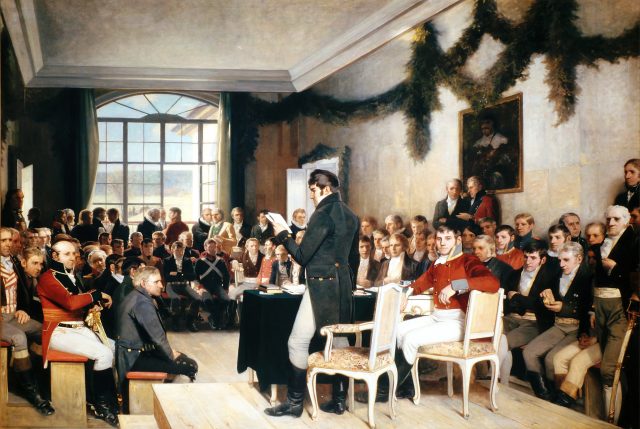
In one of his fairy tales, the Danish author H. C. Andersen wrote about a contest between two rags in a heap. The Norwegian rag boasted of the constitution of his country, which was as solid as her rocks of granite. The Danish rag responded by talking about the great literature of its country. Eventually, both rags were turned into sheets of paper, one used as a love letter from a Norwegian to a Danish girl, the other for a eulogy on Norway by a Danish poet. Indeed, the Norwegians are justly proud of their constitution of 17 May 1814, the oldest European one still in force. In January 1814, the European powers had decided to give Norway—previously ruled by Denmark—to Sweden as compensation for Finland, which Sweden had just lost to Russia. Incensed, the Norwegians convened a constituent assembly at the Eidsvoll mansion, near Oslo. It proclaimed Norway’s independence and adopted a constitution. A short war with Sweden followed, which ended with the Norwegians pledging allegiance to the Swedish king, who, in turn, allowed them to retain their constitution.
Two Progenitors: Snorri and Smith
The 1814 Constitution was quite liberal for its time, stipulating the separation of powers, freedom of the press and freedom of association, and, importantly, economic freedom: no new restrictions on trade were to be imposed. The Eidsvoll delegates were influenced by the American Constitution of 1789, but also by the Icelandic chronicler Snorri Sturluson and the Scottish philosopher Adam Smith. In his history of Norway, Heimskringla, Snorri had presented two political principles, government by consent and the right of rebellion. One of the Eidsvoll men, Christian Magnus Falsen (standing and speaking in the painting above), said that they were inspired by one of Snorri’s heroes, King Haakon the Good, who in the tenth century had returned expropriated land to the farmers while upholding the old law of the land. Another Eidsvoll man, Jacob Aall, had translated Snorri’s Heimskringla from Icelandic (Old Norse) into Norwegian. The connection with Adam Smith was also strong. The owner of Eidsvoll, Carsten Anker, had become Smith’s friend during a visit to Glasgow in 1762, and he had arranged for the translation of Smith’s Wealth of Nations into Danish in 1779–1780. As he was representing Norway in London, he was not at Eidsvoll, but members of his family were.
Urban Elites and Self-Educated Farmers
Two friends, the economist Anton Martin Schweigaard and the lawyer Frederik Stang, practically ruled Norway from 1845 to 1880, liberalising the economy, stabilising the currency, and providing the infrastructure necessary for economic progress. At the end of the nineteenth century, tiny Norway had the world’s fourth-largest merchant fleet. But during the nineteenth century, influential classical liberals came not only from the urban elite. The charismatic preacher Hans Nielsen Hauge was also a successful entrepreneur who believed God was best served by making a profit. He owned farms, copper mines, a shipping company, a brick factory, grain and paper mills, and various other enterprises. Five of the Eidsvoll men were his disciples. Later, in the Norwegian Parliament, the self-educated farmer Søren Pedersen Jaabæk, influenced by Adam Smith, was a relentless critic of public profligacy and opposed all attempts to expand government activity.
Hoff Keeping the Flag Flying
In the twentieth century, while socialism came to dominate Norwegian politics, the economist Trygve J. B. Hoff kept the flag of freedom flying, as editor of the business magazine Farmand. In 1939, his book on the difficulty of rational calculation under socialism was accepted as a doctoral dissertation at the University of Oslo. In 1941, Hoff had a remarkable correspondence with the socialist economist Ragnar Frisch, where he extended his argument on socialism to politics: Because central economic planning was bound to disappoint, the planners had to try to manipulate public opinion, and in order to do so, they had to restrict freedom of the press and freedom of association. Hoff was an active member of the Mont Pelerin Society, an international debating club on liberty founded by Friedrich A. von Hayek in April 1947.