





 Subscribe


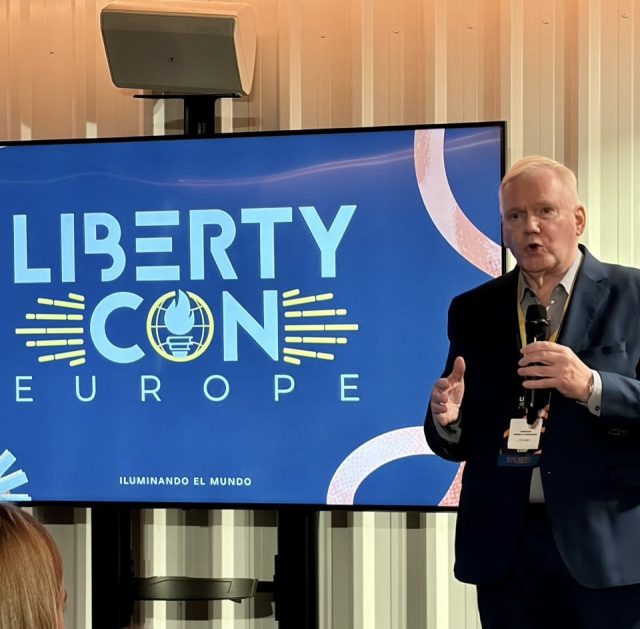
At the annual gathering of European students for Liberty, LibertyCon, now held in Madrid, 24–26 April 2026, I presented a new book that I edited and introduced, Conservative-Liberal Thought in the Nordic Countries: An Anthology, 946–1945. It had just been published by the Brussels think tank New Direction. It is 468 pages, of which my Introduction is 267 pages. The authors included are the three Icelanders Ari the Learned, Snorri Sturluson, and the unknown author of one of the Icelandic tales; Danish bishop Gunnar of Viborg, author of the preamble to the Law of Jutland; Danish King Erik Clipping, who (unwillingly) signed the first Nordic royal charter; Swedish bishop Thomas Simonsson who composed a poem about freedom; Swedish polymath Olaus Petri who wrote the ‘Rules for Judges’, still in force in Sweden and Finland; Swedish pastor Anders Chydenius who anticipated Adam Smith’s Wealth of Nations; Swedish poet Erik Gustaf Geijer who wrote poems and essays in support of liberty; Danish poet N. F. S. Grundtvig who presented in his poems and speeches what could be called national liberalism; two Swedish economists, Gustav Cassel and Eli F. Heckscher who anticipated Friedrich A. von Hayek’s Road to Serfdom; Danish economist Jens Warming who anticipated free-market environmentalism and the economics of welfare; Swedish legal scholar Nils Hurlitz who wrote about the Nordic heritage of liberty; Danish legal scholar Poul Andersen who defended freedom of expression in the Danish 1945 debate on democracy; and Norwegian economist Trygve Hoff who cogently criticised socialism in an exchange of letter with his socialist compatriot Ragnar Frisch.
The Tradition of Liberty under the Law
I pointed out that, as early as the first century AD, the Roman chronicler Tacitus had described the self-government of the Germanic tribes. French legal scholar Montesquieu commented that freedom in Europe was born in the German forests. The Icelanders, in their Commonwealth of 930–1262, went so far as to have no king but the law. The ideal of the rule of law, with corresponding protected domains of individuals, was influential in the Nordic countries, as seen in the preamble to the Law of Jutland, in Erik Clipping’s charter, and in the Rules for Judges in Sweden and Finland. This became a tradition strong enough to withstand both the assaults of kings claiming power by the grace of God and of social democrats claiming power in the name of the working class. The authors of the Norwegian 1814 and Danish 1849 constitutions were influenced not only by the British Whigs but also by this Nordic tradition, while it could be argued that both traditions, the British and the Nordic, had their roots in the self-government of the Germanic tribes.
Religion and Liberty
Czech student Jonáš Kurus, who ably chaired my session, asked about the connection between religion and the Nordic tradition. I replied that its roots were in pre-Christian times, but that both the Nordic tradition of customary law and the Roman and later Christian tradition of natural law served to restrain government and to preserve individual protected domains. St. Thomas Aquinas had even recognised the difference between monarchy and tyranny and the right to depose the king if he became a tyrant. However, the principle that what affected all should be decided by all was much stronger in the Germanic than the Roman tradition. The Germans did not necessarily presuppose a lawgiver, a king.
Lessons from the Nordic Countries
German student Anne Struffmann asked what other nations could learn from the Nordic tradition. I replied that the Nordic countries were often regarded as examples of successful social democracy, but that their success was, in fact, despite, not because of, social democracy. It rested on three pillars: the rule of law, including the protection of private property rights; free trade, which even the social democrats had maintained; and social cohesion. I added that social cohesion could not be constructed. It had to be developed over a long time. But perhaps on this issue, the ideas of N.F.S. Grundtvig were relevant: to provide civic education to all so that the transfer of power from the king to the people would not result in Jacobin terror. In particular, such ideas might be applicable at present in some newly liberated countries.