





 Subscribe


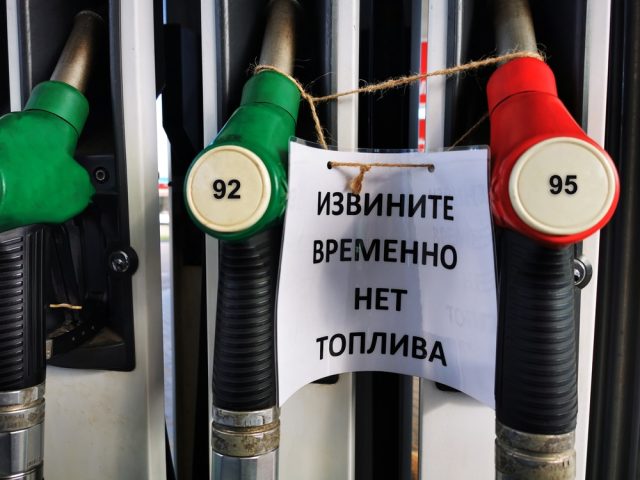
The suspension of civilian fuel sales in Russian-occupied Crimea is not a battlefield victory in itself. But it is a revealing sign that Ukraine’s long-range campaign against Russian logistics is beginning to impose real costs on Moscow’s hold over the peninsula.
The most revealing image from the war this week was not a burning tank or a shattered trench line. It was a petrol pump.
Russian-installed authorities in occupied Crimea have suspended fuel sales to private individuals and businesses, reserving supplies for state agencies and essential services. Sergey Aksyonov, Moscow’s appointed head of Crimea, said fuel would be supplied only to government bodies responsible for maintaining basic functions and security on the peninsula. No clear timeline was given for the restoration of ordinary sales.
That decision matters. Not because it means Russia is about to lose Crimea tomorrow. It does not. But because it shows that Ukraine’s campaign against Russian fuel, transport, and logistical infrastructure is producing tangible pressure far behind the front line. The war in Ukraine is often described in terms of territory gained or lost. Yet modern war is also decided by the less dramatic systems that keep armies and occupations alive: roads, bridges, ports, depots, refineries, rail lines, ferries, electricity and fuel.
Crimea is central to Russia’s war. It is a military hub, a political trophy, a naval platform in the Black Sea and a symbol of Vladimir Putin’s imperial project. But it is also a logistical problem. It must be supplied, protected and connected to Russia. When petrol stations can no longer serve ordinary drivers because fuel must be reserved for the state, the occupation’s vulnerability becomes visible in everyday life.
The current fuel crisis follows a series of Ukrainian attacks on energy and transport infrastructure in and around Crimea. According to reporting by the Associated Press, Ukrainian strikes on fuel infrastructure have contributed to what officials describe as the worst energy crisis in the region since Russia illegally annexed the peninsula in 2014. Politico Europe reported that the restrictions came after attacks on energy and transport links, including infrastructure near Kerch, a key supply corridor connecting Crimea to Russia.
This is the strategic logic of Kyiv’s campaign. Ukraine does not need to destroy every Russian installation. It needs to make Russia’s occupation more expensive, more fragile and more difficult to sustain. Fuel shortages force choices. Does Moscow prioritise civilian traffic, tourism, military mobility, police, emergency services or administrative control? Every litre reserved for one purpose is a litre denied to another.
That is why the empty pump is politically significant. Occupation depends not only on force, but on the appearance of normality. Russia has spent years trying to present Crimea as permanently absorbed, stable and secure. Queues at petrol stations, rationing, tourist hotlines and emergency restrictions tell a different story. They suggest that Crimea is not a settled province of the Russian Federation, but a militarised dependency whose connection to Russia can be disrupted.
This should not be overstated. Ukraine’s strikes will not, by themselves, collapse Russia’s fuel system or force Putin into immediate concessions. RANE’s assessment is cautious on this point: the attacks may not cripple Russia’s overall fuel network in the short term, but they can complicate supply management, especially ahead of the summer travel season and the harvest period, while forcing Russia to stretch air defences over greater distances.
That distinction is important. The West should resist both defeatism and euphoria. Crimea’s fuel crisis is not proof that the war is nearly over. It is proof that pressure works when it is applied intelligently, repeatedly and against the systems that sustain Russian power.
For European conservatives, there is a broader lesson here. Sovereignty is not defended by rhetoric alone. It is defended by capacity. Ukraine’s ability to strike Russian logistics at range is changing the cost-benefit calculation for Moscow. The same logic applies to Europe’s own security. A continent that wishes to deter aggression must be able to produce weapons, protect infrastructure, secure energy supplies and sustain military operations over time.
For too long, much of Europe treated defence as a diplomatic accessory rather than a material capability. The war in Ukraine has exposed that illusion. Ammunition stocks, drone production, air defence, fuel resilience, cyber security, repair capacity and industrial mobilisation are not technical details. They are the foundations of strategic independence.
Ukraine’s campaign against Russian logistics also offers a warning about the future of war. The battlefield is no longer confined to the front. Drones, long-range missiles and precision strikes turn supply chains into targets. Ports, refineries, depots and bridges become as important as trenches. The side that can disrupt the enemy’s rear while protecting its own will gain leverage out of proportion to the size of its forces.
There is, of course, a moral and political caution. Fuel shortages affect civilians too. A serious Western analysis should not celebrate civilian hardship. But responsibility for Crimea’s militarisation lies with Moscow. Russia turned the peninsula into a base for aggression against Ukraine. It used occupation to project power into the Black Sea and southern Ukraine. Kyiv’s attempt to isolate that military infrastructure is a response to a war Russia chose to begin and continues to wage.
The Kremlin understands the symbolism. Crimea is not merely territory; it is part of Putin’s domestic mythology. That is why visible disruption there is so uncomfortable for Moscow. If the state must ration fuel in order to preserve “security” and basic functions, then the promise of Russian permanence begins to look less convincing.
The danger is that Russia may respond by escalating. RANE notes that if Ukrainian strikes create sharper economic disruption or visible domestic security failures, Moscow could become more willing to impose reciprocal costs through larger missile and drone attacks against Ukrainian cities, logistics nodes and energy infrastructure. This risk should be taken seriously. But it should not become an argument for passivity. Deterrence does not mean avoiding pressure on the aggressor. It means ensuring that pressure is matched by resilience, air defence and political resolve.
Crimea’s empty pumps will not decide the war. But they reveal something essential: Russia’s occupation is not invulnerable. It rests on supply lines, fuel flows, transport links and the constant expenditure of resources. Ukraine has found ways to target those dependencies.
For Europe, the message is clear. The struggle for Ukraine is not only a contest of territory. It is a contest of endurance, logistics and industrial strength. Russia wants the West to believe that time is on Moscow’s side. The fuel crisis in Crimea suggests a more complicated reality: time can also wear down the occupier, if Ukraine is given the tools to keep striking the machinery of occupation.
Crimea, strategically, is a peninsula. Politically, for Putin, it is a trophy. Logistically, under sustained pressure, it can become a liability.