





 Subscribe


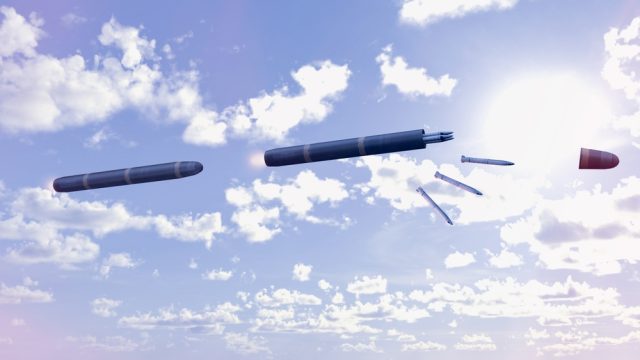
For years, Europe convinced itself that large-scale missile confrontation belonged to another century. The continent spoke the language of regulatory power, economic interdependence, green transitions and post-Cold War stability, while strategic deterrence gradually became a secondary concern delegated largely to NATO structures and American guarantees. The war in Ukraine has shattered many of those assumptions. The reported renewed deployment by Russia of the “Oreshnik” intermediate-range ballistic missile marks another step in that transformation.
This is not merely another escalation in the battlefield dynamics between Moscow and Kyiv. It is a strategic signal directed at Europe itself.
According to reports cited by Euronews, Ukrainian President Volodymyr Zelenskyy stated that Russia again used the Oreshnik missile in the Kyiv region during a large-scale assault involving dozens of missiles and hundreds of drones. Moscow later confirmed the strike, describing it as retaliation for alleged Ukrainian attacks on civilian targets.
The military significance of the Oreshnik system is substantial. Russian officials describe it as an intermediate-range ballistic missile capable of striking targets between 3,000 and 5,500 kilometres away. If accurate, that range effectively places most of Europe within reach. Even more importantly, the missile is believed to be nuclear-capable.
That fact changes the psychological equation of the war.
Europe is no longer dealing exclusively with a conventional regional conflict on its eastern frontier. It is increasingly facing the return of strategic coercion through long-range missile power — the same logic that dominated the most dangerous decades of the Cold War. The Kremlin understands perfectly well that the military value of such systems extends beyond their kinetic use. Their true power lies in uncertainty, intimidation and political pressure.
When a state deploys a nuclear-capable intermediate-range ballistic missile during an ongoing war in Europe, it is not only attacking military infrastructure. It is shaping the strategic imagination of an entire continent.
This explains the unusually strong European reactions. German Chancellor Friedrich Merz reportedly described the strike as a “reckless escalation,” while French President Emmanuel Macron characterised the use of the missile as evidence of both the deadlock in Russia’s war effort and a dangerous expansion of the conflict. European Commission President Ursula von der Leyen argued that the attacks demonstrated the Kremlin’s “brutality and disregard for both human life and peace negotiations.” EU foreign policy chief Kaja Kallas went even further, describing the deployment as “reckless nuclear brinkmanship.”
Such language matters because it reveals a growing awareness inside European leadership circles: the continent is entering a new missile age.
For decades, Europe benefited from a strategic environment shaped by treaties, predictability and the assumption that escalation thresholds would remain stable. But many of those frameworks have eroded. The collapse of the INF Treaty already removed one of the key pillars limiting intermediate-range missile deployment. The war in Ukraine accelerated the militarisation of Europe’s eastern flank. The emergence of systems like Oreshnik now introduces another destabilising factor: the fusion of conventional warfare, nuclear ambiguity and hypersonic-era deterrence.
This is precisely where the conservative strategic perspective becomes relevant.
European conservatives have long argued that peace cannot survive without credible deterrence. Stability is not maintained by declarations alone, but by military capability, industrial resilience and political seriousness. The Oreshnik episode reinforces that argument dramatically.
The problem Europe faces today is not simply a lack of weapons. It is the accumulated consequence of decades in which defence was politically downgraded while dependency became normalised. Many European states reduced military expenditure under the assumption that large-scale interstate conflict on the continent had become structurally impossible. Strategic industries were neglected. Air defence systems were insufficiently modernised. Ammunition production declined. Energy dependency on authoritarian powers expanded. Entire political classes embraced the illusion that economic integration alone could permanently neutralise geopolitical rivalry.
Ukraine destroyed that illusion. Oreshnik deepens its collapse.
The reported attack demonstrated once again the scale of the Russian combined-arms approach: ballistic missiles, cruise missiles and hundreds of drones used simultaneously to saturate defensive systems. According to the reports, even heavily protected infrastructure and urban areas suffered damage, including facilities linked to the German public broadcaster ARD in Kyiv.
This matters strategically because Europe’s current air and missile defence architecture remains fragmented and uneven. Some countries possess advanced capabilities; others remain dangerously exposed. A continent built around open societies, dense infrastructure and highly urbanised economies is inherently vulnerable to long-range precision strikes.
In practical terms, the Oreshnik issue forces Europe to confront several uncomfortable realities simultaneously.
First, missile defence can no longer be treated as a niche capability. It must become a continental priority. Air defence networks, anti-ballistic systems, radar integration and rapid-response interception capacities are no longer optional investments for the future; they are immediate strategic necessities.
Second, Europe’s defence-industrial base requires reconstruction at scale. Strategic autonomy cannot exist without production capacity. A continent unable to manufacture sufficient missiles, interceptors, drones and electronic warfare systems cannot credibly deter peer adversaries.
Third, support for Ukraine is increasingly tied directly to Europe’s own security architecture. This is not simply a humanitarian or ideological question. From a hard strategic standpoint, Ukraine currently functions as the forward line of European continental defence against Russian military revisionism. Every lesson learned on Ukrainian battlefields regarding missile interception, drone warfare and electronic warfare has direct implications for NATO and EU security planning.
Fourth, the missile threat reinforces the necessity of political cohesion among European allies. Moscow’s strategic doctrine has consistently relied on exploiting hesitation, fragmentation and fear within Western democracies. Intermediate-range systems like Oreshnik are valuable not only because of their destructive capacity, but because they can intensify political divisions inside Europe itself. Different threat perceptions between Eastern and Western Europe, disputes over military spending, disagreements about escalation risks — all become pressure points.
This is why the conservative response cannot simply consist of rhetorical alarmism. It requires strategic maturity.
Europe does not need panic. It needs deterrence.
That means rebuilding military credibility while avoiding reckless adventurism. It means strengthening NATO without abandoning the importance of national sovereignty and national defence capabilities. It means understanding that diplomacy without hard power becomes fragile in the face of revisionist actors willing to escalate coercively.
The emergence of systems like Oreshnik may also accelerate Europe’s own missile and hypersonic development programmes. Several European states are already increasing investments in next-generation strike and interception technologies. In strategic terms, the logic is unavoidable: when adversaries acquire faster, longer-range and harder-to-intercept systems, deterrence requires symmetrical adaptation.
This carries enormous consequences for the future of European security policy.
The post-Cold War European model was built on the assumption that economic integration and institutional frameworks could progressively marginalise hard military competition. That era is ending. The return of missile coercion means the continent is re-entering a historical condition many Europeans believed had disappeared permanently: one in which geography, military capability and strategic vulnerability again define political reality.
Conservatives across Europe have warned for years that history had not ended, that sovereignty still mattered, and that civilisations unable to defend themselves eventually become dependent on others for their security. The Oreshnik episode does not merely confirm those warnings. It demonstrates how rapidly strategic reality can return when deterrence erodes.
Europe now faces a defining question.
Will it continue behaving like a post-historical economic bloc, or will it finally accept the responsibilities of being a geopolitical power capable of defending its civilisation, infrastructure and citizens in an increasingly dangerous world?
The answer will shape the continent far beyond Ukraine.