





 Subscribe


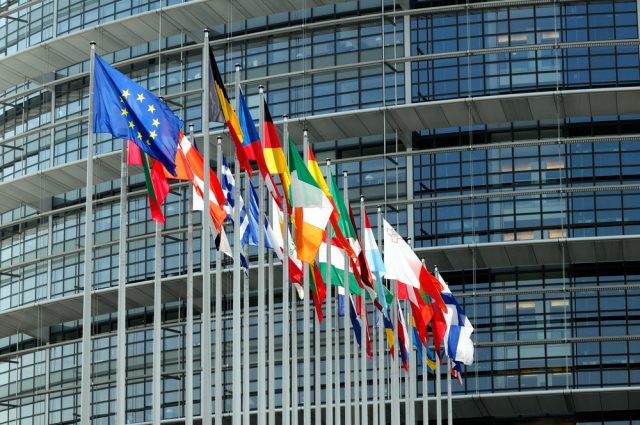
From the opening scenes of Ireland’s European Union Council Presidency, it is clear that the Irish government intends to depict the Emerald Isle as an EU success story. With hollow promises that Ireland will race the baton to the finish line for the EU enlargement negotiations of Ukraine, Macedonia, Moldova, and Albania, the hubris of Ireland’s coalition government could not be more obvious.
There is already a weft of nostalgic sentiment emerging across the island’s media organs discussing Ireland’s ‘European moment’ and self-applause for the progressive journey. We are, in effect, watching the Irish government’s spin doctors work overtime to construct a narrative that they very well know to be false.
But beyond the rose-tinted Europhilia that Ireland’s political class are fomenting, remains an underlying truth — that nobody at home or abroad truly believes in it. This might be the moment at which the European Union discovers plainly that the Irish government is all too good at making promises and very poor at keeping them. Though Irish voters have experienced this with the much hated Universal Social Charge and the consistent gaslighting from Fianna Fail and Fine Gael that it will be gone ‘some day’, it is now being broadcast onto the European stage.
Ireland’s history with the European Union Council Presidency has been historically lucky — holding the position amidst the fall of the Berlin Wall and the Eastern European accession wave of 2004. Ireland’s experience is uniquely tinged with post-Cold War nostalgia. Today, Micheal Martin, who by all accounts has been awaiting the European Presidency with glee, faces perhaps the most tense period in which Ireland has ever held a leadership role in the European Union. With the Transatlantic Alliance seemingly under strain, Europe’s deindustrialisation has hurt the continent, rising energy costs shackle business potentials, and the demographic crisis shows no signs of abatement. It appears that all the folly of the past decade is coming home to roost, all during Martin’s time to shine.
The simple truth is that Ireland’s capacity to manage its own bureaucracy is sclerotic at best, and that the pressure of administering the negotiations for the Council of the European Union will cause the government and civil service untold problems. Not to mention Irish politicians’ penchant for diplomatic gaffes, which no doubt will sour Ireland’s already worsening image in Europe. One wonders how many civil servants have been seconded from their original Departments just to cover the EU pageantry parade of Micheal Martin?
Regardless, Ireland will have a hard time pitching itself as a model EU member state when European officials come into close contact with their Irish counterparts over the remainder of Ireland’s Presidency. The capacity for self-delusion is remarkable. During Cyprus’ Presidency not one politician or media group batted an eye, but on July 1st Ireland somehow assumed the greatest responsibility and leadership role of the European Union?
The underlying crises of housing, migration and the cost of living have not been addressed by the Irish government despite its loathsome tenure in power. In fact, Ireland comes across as more of a case study in the political and policy failures of the European Union than it does a success story. Irish political leaders are consistently the most dogmatic on immigration, renewable energy and social progressive causes. All despite the ample public disdain for such positions. Yet Fianna Fail and Fine Gael will dismiss the threat of electoral immolation for the sake of their vast NGO, Quango, lobbyist sector which has hitherto kept the political pandora’s box of the populist right welded shut with consistently diminishing returns.
In fact Irish officials might have recently woken up to their ‘super junior’ image in European politics. The Employment and Social Affairs Ministers Council was scheduled to take place in Ballina, County Mayo over a two-day period — one of the first ministerial gatherings of Ireland’s Council Presidency. And yet not a single major European Minister turned up for the event, which was laughably held in a local secondary school. No doubt Fianna Fail politicians recalled the experiences of the Bertie and Haughey eras where European events could be used to flood their constituencies with funding and support to support their reelection bids. Yet it appears the old formula no longer works at a structural level, because Ireland is now incapable of organising a meeting with the people it wants! The embarrassment and hubris of thinking that a ‘high-level’ meeting could be held in a secondary school far from any major Irish city is shocking but unsuprising. It is sceptical whether Fianna Fail, a party which thinks of itself as famous for having a cowboy-like ‘shoot from the hip’ mentality, could for its cowboy-like lads culture, could even organise a piss up in a brewery.
European officials will come to discover the humorous and disastrous idiosyncrasies of the Irish political establishment over the coming months. Irish politicians are renowned for their love of vaguery and obfuscation. Something which might make meeting agenda-setting difficult at the European level. Not to mention the fact that for many Irish politicians they tend to speak over confidently before they determine whether or not they can act. In other words, their mouths run in fifth gear while their brains sit in neutral.
They are impervious to embarrassment as well. Consider for instance that one Irish diplomat commented on the no-show of senior figures to Ballina by saying that it is ‘a shame if people aren’t coming because it’s in a beautiful part of the country.’ The Ballina trick might have worked on the senile Joe Biden during his state visit to Ireland, but the Europeans will not tolerate being made a show out of for petty political interests. Perhaps if the meeting had not been held at a secondary school in rural Ireland, their European friends might have deigned to come. Irrespective of that fact, it shows that Ireland is actually unable to conduct the obligations bestowed upon it during the Council Presidency. It is for that reason we might expect none of the Irish goals to be achieved during Martin’s tenure as ‘King of Europe’.
There is also the matter that Ireland’s pageantry show has cost a significant diversion of police resources to cater to the never ending series of ‘high-level’ meetings and backdoor job interviews scheduled to take place in Dublin and Cork. During times of international attention, such as Joe Biden’s visit to Dublin and Ballina, police sprout like mushrooms from the ground where they had never patrolled before. There has been €125 million allocated to policing costs alone for the duration of Ireland’s Presidency. And yet once those events are finished the streets of Dublin will return to their rowdy, decaying and anti-social state.
Furthermore the investment in drone defences for the sake of these six months reflects the lack of care to invest in long-term infrastructure or defences by the Irish political elite. Out of fear of a repetition of the drones spotted over the Irish Sea during Zelenskiy’s visit to Dublin, they have now stationed anti-drone defences inland at Casement Aerodrome rather than find a suitable location along the Irish coast which might actually suit the needs of their defences.
It is plain as day that Ireland did not prepare for its Council Presidency, and that the behaviour of Irish politicians during this period will not be informed by an interest in defending European interests or negotiating complex budgetary or enlargement schemes. Instead, it will be a mundane, uneventful showcase of Ireland’s political hubris that is undeniably going to irk our European brethren as they are wheeled out across Ireland for show-and-tell sessions in the constituencies of a diseased and failing political regime.