


 Subscribe


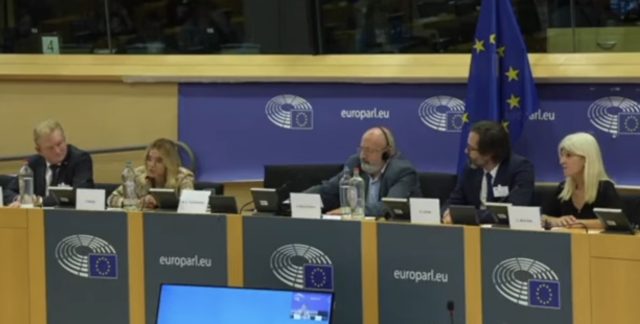
I moderated a panel in the European Parliament, hosted by AUR and the ECR group, on snap elections in Romania. I opened by saying that independent journalists are becoming fewer, then I listened as four of them made their case. They agreed Romania needs a vote. Their conditions for it were stricter than a simple call for an election.
I began with John F. Kennedy’s line that no administration, country or republic can survive without debate and criticism. Then I went somewhere the audience didn’t expect and quoted Senator Padme Amidala from Star Wars: “This is how liberty dies … in thunderous applause.” I used it to describe what I see as the annulment of democracy by constitutional institutions. The same systems that once put people in power were used to give complete authority to one person.
I asked two questions: “How do we give power back to the people? And what role should the media play?”
Sorin Roșca Stănescu spoke first. He ran the newspaper “Ziua” for decades and later served as a senator. He spoke in Romanian on behalf of the Romanian Press Club.
He praised George Simion and his team, saying they could restore democracy after what he called the coup of December 2024. His argument on the ballot was constitutional. Snap elections, he said, are not a failure of democracy. They are a way out of a political deadlock and a way to reconfirm a mandate. When governing forms can’t produce stability, going back to voters is “a matter of public responsibility.”
Rosca Stănescu then listed what makes a vote legitimate. Citizens need pluralism, equal chances and real participation. Every voter needs access and a safe ballot, and every competitor needs fair rules. Legitimacy, he said, comes from respecting the Constitution, from transparency and from press freedom. He summed up the press’s role by calling the citizen the only sovereign and the press the sovereign’s guard dog, then added that we had just heard from “a guard dog.”
Cora Munteanu has worked in media for 33 years. She hosts a show on Metropola TV and was recently named to the board of Romania’s public radio. What she said about our profession was hard to hear.
She described an anomaly: for years almost, the entire press has lined up behind the people in power. It repeats their abuses, she said, “perhaps even worse,” because the press can shape public opinion. We are taught to favor no one, she said, and if we must favor someone, it should be the weaker side. Munteanu pointed to the pandemic, when she said the government gave the press more than €50 million, and asked how anyone could criticize the government after that.
Her sharpest point was a counterfactual. If AUR were in power, she said, the press would be in the square with the protesters demanding justice. She said she spoke for people whose voices are no longer heard, not for a party. She also mentioned the people who traveled to the protest outside at their own expense, including many from Belgium and nearby countries. In her view that is a warning to Romania’s “temporary leaders.”
Jim Ferguson, who runs Freedom Train International, was among the first foreign journalists to cover Romania’s election crisis. He sees it as a free-speech story. Britain gave the world Magna Carta, he said, yet free expression there has moved in the opposite direction. He argued that censorship keeps growing, and that Eastern Europe, with its Christian faith and family traditions, still holds on to freedoms the West is losing.
He told us the US House Judiciary Committee report on the Romanian elections raised questions for him. He traveled to Romania, spoke with senators, deputies, leaders and journalists, and made a documentary. Ferguson also talked about reach. His show has more than a million viewers on his platform, and an MEP told him the real figure runs to tens of millions once other platforms pick it up. His conclusion was never to underestimate independent and social media. He predicted Simion could become prime minister or president, and said Georgescu could become a major leader once he is no longer “politically persecuted.” He finished with a call for unity among patriots.
Stephane Lucon, head of Le Monde Diplomatique Romania and now living in Romania, was the most cautious speaker. He agreed that early elections can restore trust. He added that more than 60% of Romanians consider the 2024 annulment illegitimate, and that he knows of no proof of Russian interference so far.
He warned of three risks:
- Fairness: Can the current system run a fair election and respect the result? Stephane said the people behind the Constitutional Court’s decision have faced no consequences, and he alleged a media cover-up of the governing parties’ role in the so-called Russian campaign. He called for full declassification.
- Censorship: He said it didn’t end with the annulment. His complaint, filed with Romania’s digital services coordinator and sent to the European Commission in July, argues that the Digital Services Act can be used as a weapon against independent voices. He also criticized the “rapid response system,” which he said operates under the law without being written into it.
- Foreign interference: Lucon said the FIMI framing is being turned into a weapon across Europe, and he named Macron and Tusk as examples of interference that nobody called manipulation.
His bottom line was that Romania should hold early elections, but only with close monitoring. Otherwise, the same people who benefited from what he called a judicial coup would run the vote.
Each speaker answered my question about the press in a different way. Roșca Stănescu spoke of constitutional duty, Munteanu of the press’s own failings, Ferguson of the reach of independent media, and Lucon of the rules for online speech. All four treated a free press as the condition for a legitimate vote.