


 Subscribe


“Some people make the mistake of calling that idea ‘democracy’ and imagining that any country can adopt it merely by holding elections.”
In Civilisation: The West and the Rest (2011), British historian Niall Ferguson offered a reflection that remains as relevant today as it was fifteen years ago: democracy cannot be reduced to the mere act of voting. Holding elections is necessary but not sufficient for a robust democracy. Democracy requires an institutional framework that transcends parliamentary majorities, the rule of law to constrain political power, and a political culture that recognizes that institutions do not belong to those who happen to govern them.
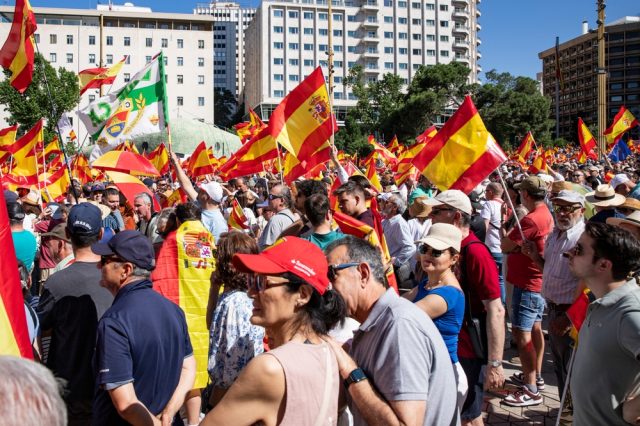
This reflection is especially relevant as Spain approaches its general election on November 29. The country will head to the polls amid political polarization, declining institutional credibility, and growing social discontent. Corruption scandals, housing affordability challenges, and uncertainty about the future have fueled a widespread sense of political exhaustion that extends far beyond the traditional party confrontation. Yet we risk mistaking the solution for a mere change in those who hold power. The question we should be asking is not simply who will govern Spain over the next four years, but which vision for the country will be capable of rebuilding the consensus we have gradually lost.
Miguel Ángel Quintanilla, an MP from Spain’s People’s Party, has spoken about three divisions in Spanish society: between generations, between different parts of the country, and between social groups. I believe these three problems help explain why so many Spaniards have lost confidence in politics.
The first is the divide between generations. For many years, Spanish families believed that their children would have better lives than they did. Our parents worked hard so that we could study, find good jobs, buy homes and start families of our own. It was a simple promise, and one that helped Spain make enormous progress over the past few decades. Today, that promise is becoming harder to believe.
Young Spaniards have more qualifications than ever before. Many speak several languages and have spent years preparing for the job market. Yet finding a stable job, leaving home or buying a flat has become a serious challenge. In cities such as Madrid and Barcelona, even renting a small flat can take up most of a young person’s salary.
We may be the best-educated generation Spain has ever had, but we are also facing the possibility of living worse than our parents.
This has consequences beyond the economy. When young people feel that working hard no longer guarantees a better future, they start to lose confidence in politics. Some may eventually lose faith in democracy itself. That should concern everyone, regardless of which party they support.
The second fracture is territorial. Spain has spent far too long immersed in a recurring debate about its own identity, its political organisation, and the legitimacy of certain foundations of its constitutional order. The territorial question has ceased to be exclusively a discussion about devolved powers or regional financing and has, at times, become a dispute over the very idea of Spain. Even institutions such as the monarchy, which form part of the constitutional settlement of 1978, periodically return to the centre of political controversy.
It is worth remembering that Spain’s transition to democracy was not possible because Spaniards abandoned their differences, but because they understood that none of those differences could take precedence over the need to establish a common framework for coexistence. That exercise in reconciliation, despite all its imperfections, helped usher in one of the longest periods of democratic stability in our history. The question is whether we remain willing to preserve that spirit or whether we have accepted that every consensus must be subordinated to the immediate political interests of each parliamentary majority.
The third divide is social. It has become increasingly difficult to disagree about politics without turning the discussion into something personal. People are often judged by the party they vote for, and political opponents are sometimes treated as enemies rather than fellow citizens.
We see this in parliament, on television, on social media and even in conversations between friends and relatives. Political debate has become so confrontational that finding common ground can seem almost impossible.
In response, it may be worth recovering the notion of a “common home” once advocated by certain strands of conservative political thought: a political and social space broad enough to accommodate dissent without abandoning the possibility of consensus. Democracy does not require everyone to think alike, but it does require the recognition of certain shared principles that no temporary majority should be entitled to dismantle.
Of course, none of these problems began when Pedro Sánchez became Prime Minister. Spain’s difficulties have developed over many years, under governments from different parties. Still, the current government must take responsibility for its own decisions.
Scandals involving people linked to the Socialist Party, along with disputes over several institutions, have raised serious questions about political responsibility and public trust. Any allegations of wrongdoing must be dealt with through the proper legal process. But politicians also have a responsibility to explain their actions and maintain public confidence.
The next government will have to address these concerns. And this is where the difference between changing a government and rebuilding institutions becomes important.
The next government will also have to answer a question about the Constitution of 1978. Do Spain’s political parties still believe in the system that made our democracy possible? Are they willing to defend its basic principles, even when those principles make their political plans more difficult?
I do not believe that defending the Constitution means opposing every reform. Spain has changed a great deal since 1978, and its institutions should be able to adapt. But there is a difference between improving a system and trying to replace everything simply because we disagree with those currently in power.
Political parties should explain how they intend to deal with these problems. Promising change is easy during an election campaign. Explaining how that change will happen, and what politicians are prepared to do differently once they are in office, is much harder.
This is why I believe the election on 29 November should be about more than deciding who becomes the next Prime Minister.
Spain may be entering a new period of change. I would not compare it directly with the democratic transition of the 1970s, but I do think we are facing a moment when we need to ask ourselves what kind of country we want to become.
Our parents and grandparents helped build a democratic Spain. They experienced a country that changed enormously in a relatively short period of time. My generation has inherited the benefits of that progress, but also a number of problems that remain unresolved.
We should not have to choose between defending what previous generations achieved and recognising that some things need to change. Both are possible.
For too long, Spanish politics has focused on who should be removed from power. We spend far less time discussing what should happen afterwards.
The next government will need to do more than win an election. It will have to decide where Spain should be heading, what needs to change and which parts of our democracy are worth protecting.
Dídac Sánchez