


 Subscribe


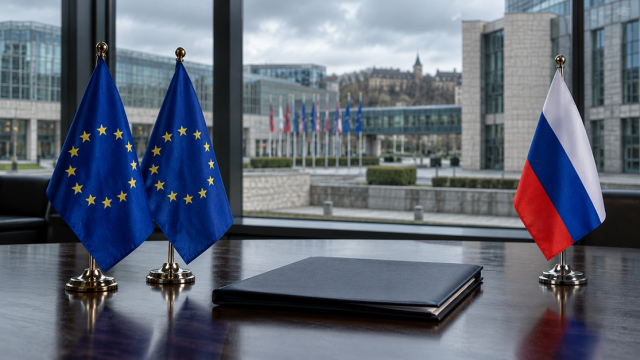
The proposed addition of 1,646 individuals and organisations would intensify pressure on Moscow after a contentious compromise over existing restrictions.
Europe is preparing a major expansion of sanctions against Russia, seeking to demonstrate that its support for Ukraine can withstand both internal bargaining and uncertainty over Washington’s position. The proposed measures would add 1,646 individuals and organisations to the EU’s sanctions lists, with Russia’s military industrial network accounting for most of the new targets.
EU foreign ministers meeting in Luxembourg on October 12 are expected to approve the additions. Foreign policy chief Kaja Kallas described the planned decision as the largest expansion of listings against Russia’s war machine since the invasion began. Ambassadors from the bloc’s 27 member states finalised the agreement in Brussels the previous Wednesday.
The scale matters politically as well as numerically. Following Donald Trump’s reversal of position, the initiative presents Europe as willing to intensify pressure on Moscow. It also offers a visible display of agreement after difficult negotiations over the renewal of existing sanctions.
Most of the proposed designations concern actors accused of supporting Russia’s invasion of Ukraine. The list includes 743 individuals and 826 entities, alongside 77 parliamentarians who stood as Russian candidates in occupied Ukrainian territories during September’s State Duma elections.
The inclusion of those politicians extends the package beyond industrial support for the war. It addresses Moscow’s efforts to impose Russian political institutions on occupied land. The elections were described as unlawful sham votes, with Ukrainian residents forced to participate under the supervision of armed soldiers.
Together, the categories bring the proposed additions to 1,646. For European governments, the package links pressure on the machinery sustaining the invasion with accountability for political actions carried out under occupation.
Marco Simoni, director of the Istituto Affari Internazionali and professor of practice in European political economy at Luiss Guido Carli University, sees the initiative primarily as a statement of European cohesion. In his assessment, adding more than 1,600 names at once sends a powerful signal, expanding the existing list by more than half.
That message, he argues, is particularly necessary now. Europe needs to reaffirm a shared commitment to protecting democracy, the rule of law and the basic human rights violated daily in Ukraine. The significance of the proposed twenty-second sanctions package therefore reaches beyond the individual people and organisations it would target.
The agreement follows a controversial compromise reached in late September. Two oligarchs close to Vladimir Putin, Alisher Usmanov and Mikhail Fridman, were removed from the sanctions list after pressure from Slovakia, France and Luxembourg, with overriding national interests cited as the justification.
At the same time, sanctions covering 2,998 listed subjects were extended until September 22, 2029. That represented a substantial departure from the usual renewal period of six months, placing the restrictions on a much longer timetable.
The removal of two prominent names could be read as evidence of competing national priorities. Simoni, however, rejects the interpretation that it revealed weakness or a fracture in Europe’s stance towards Moscow.
He regards the limited concession as an example of flexibility within a strong political system. The subsequent agreement on a much larger set of additions, reached little more than two weeks later, supports his view that compromise need not dilute collective resolve.
His argument draws a distinction between democratic negotiation and authoritarian rigidity. For Simoni, the capacity to accommodate a narrow exception while preserving a broader common policy demonstrates strength; inflexibility, by contrast, can conceal institutional fragility.
The immediate test is whether ministers translate the ambassadors’ agreement into formal approval. Until then, the package remains an agreed proposal awaiting adoption, rather than a completed decision.
Its practical impact will depend on how effectively the measures constrain those supporting Russia’s continuing war effort.
If approved, the expansion would give the EU a substantial new instrument of pressure and a renewed political message. After a contentious compromise, Europe would be presenting its response to Moscow through a broader sanctions list, a longer horizon for existing restrictions and a public reaffirmation of solidarity with Ukraine.
Alessandro Fiorentino