


 Subscribe


Sicily, the heart of the Mediterranean, is not merely a geographical destination; it is a sensory experience, a palimpsest of layered civilizations, and a visceral calling. While the global tourism industry increasingly shifts toward authentic and meaningful experiences, Sicily possesses an underutilized, powerful, and deeply human resource: its diaspora. With nearly one million Sicilians registered with AIRE (Registry of Italians Resident Abroad)—a figure that approaches the entire population of Palermo—there exists an immense “Sicily outside of Sicily” pulsing with an often latent desire for reconnection.
In this scenario, the project “L’Isola delle Meraviglie” (The Island of Wonders) emerges not as a simple promotional tour, but as a cutting-edge strategic vision. Conceived by the Association of Italians in Europe (Associazione Italiani in Europa) and strongly supported by the Department of Cultural Heritage and Sicilian Identity of the Sicilian Region, this European “archeo-tour” aims to leverage a potent blend of archaeology, linguistic heritage, and Sicilian-language cinema to stimulate a radically new form of tourism: identity tourism.
Archaeology as a Bridge, Not Just the Past Sicilian archaeology is monumental. The Valley of the Temples, Selinunte, Segesta, the Villa Romana del Casale, and the Greek theaters of Syracuse and Taormina are names that evoke the echo of great Classical, Roman, and Byzantine civilizations. However, for too long, these sites have been perceived by visitors—including the descendants of emigrants—merely as picturesque backdrops or relics of a remote past, disconnected from present life.
The “Island of Wonders” project turns this perspective on its head. Archaeology becomes the starting point, the tangible bridge between the past that shaped the island and the present in which its children live abroad. Across the tour stops—from Bedford in England to Munich in Germany, passing through Brussels and Zurich—Sicilian archaeological parks are presented not just through historical data, but through their ability to tell a shared story.
Sicilians abroad, who often left the island for economic reasons, carry with them a nostalgia that is also a lack of deep knowledge of their own roots. Presenting archaeology as the “common home” of Sicilian civilization offers a sense of belonging that goes beyond mere landscape. The use of digital tools, such as the virtual exhibitions scheduled on the tour, bridges the physical distance, allowing European visitors to “step inside” the archaeological sites and perceive the greatness that is part of their cultural DNA.
Reclaiming the Language: A Matter of Heart and Mind The strategic mix of this project has a second fundamental component: linguistic heritage. Sicilian is not a dialect, but a full-fledged Romance language, recognized by UNESCO as a minority language. It is the language of the earliest Italian poetic expressions through the Sicilian School (Scuola Siciliana), the language of folk storytelling, and, above all, the language of emotion for entire generations of emigrants.
A Sicilian born in Germany or the United Kingdom may not know the ancient history of the temples, but they have almost certainly heard Sicilian spoken within their family. The language is the code of affection, childhood memories, and culinary traditions. The “Island of Wonders” project integrates academic conferences, roundtables, and workshops on the Sicilian language into every stop of the tour.
This simultaneously scientific and emotional approach elevates the status of the language, rescuing it from the stereotype of folklore to give it the dignity of a heritage to be protected and, above all, “used” as an access key to the island’s culture. When potential tourists abroad understand that their grandparents’ language is a key to deciphering the island’s entire identity, the desire to visit is no longer a fleeting curiosity, but an imperative of personal rediscovery.
Cinema: Mirror and Magnet of the Imagination The third pillar is cinema. Sicily has been, and continues to be, a natural and cultural film set of global impact. From Visconti’s La Terra Trema to Tornatore’s Cinema Paradiso, up to contemporary hits like Inspector Montalbano, cinema has shaped the collective imagination regarding Sicily.
The project strategically chooses to promote films in the Sicilian language, such as IDDA, featuring screenings and the presence of the cast. This choice is crucial. Showing contemporary films in an authentic language accomplishes two things: first, it breaks outdated stereotypes of a bucolic or mafia-ridden Sicily, showcasing a vibrant, complex, and multicultural society; second, it offers a narrative with which Sicilians abroad can identify.
Sicilian-language cinema is the mirror in which the diaspora can see itself reflected and, at the same time, a powerful magnet. A well-told story, scored by the island’s landscapes and authentic language, creates a desire to “be there,” to walk on those ancient stones, and to hear that sound in the air. It is a form of cultural and tourism product placement of the highest level.
A Strategic Mix for Sustainable, High-Value Tourism The integration of these three elements—monumental archaeology, emotional language, and engaging cinema—is no coincidence. It is a strategic mix designed to activate the deepest motivational levers of our fellow countrymen. It is not about selling a vacation package, but offering a path of return.
This type of tourism, tied to identity and the rediscovery of roots, is inherently more sustainable. The tourist returning to rediscover their roots does not seek the “hit-and-run” approach of mass tourism. They seek authenticity: real food, the hospitality of the people, and an in-depth knowledge of places. They are tourists who stay longer, explore off-the-beaten-path areas beyond the major attractions, and are willing to pay for meaningful experiences.
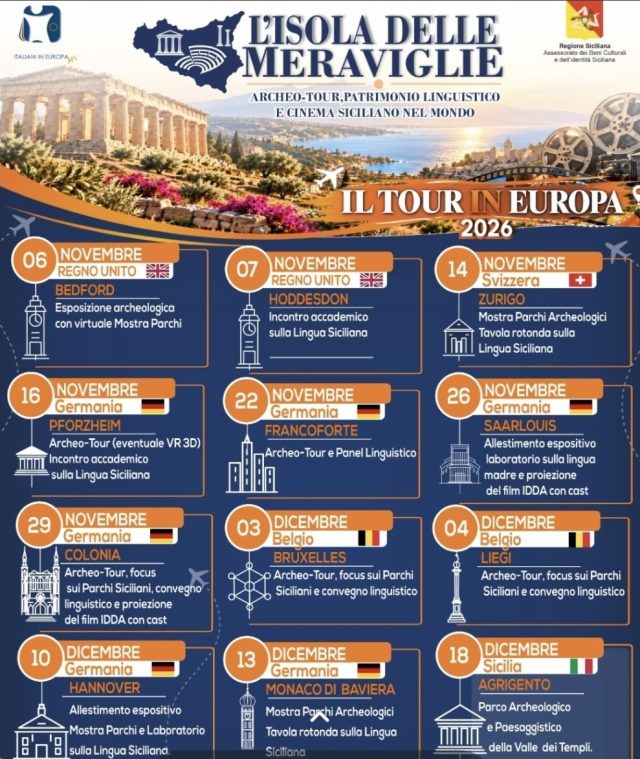
The 2026 Tour: A Roadmap for Reconnection The 2026 tour program, outlined in the promotional poster, is an ambitious roadmap crossing the heart of Sicilian Europe:
-
United Kingdom (Bedford, Hoddesdon): Begins with a combination of virtual archaeological exhibitions and academic meetings on the language, recognizing the strong, historic Sicilian community across the English Channel.
-
Switzerland (Zurich): Combines exhibitions of archaeological parks with language roundtables, in a country that has hosted generations of Sicilian workers.
-
Germany (Pforzheim, Frankfurt, Saarlouis, Cologne, Hanover, Munich): Germany, boasting the highest number of stops, reflects its importance as the primary destination for Sicilian emigration in Europe. Here the mix is complete: archeo-tours, linguistic panels, and film screenings with the cast, creating a total immersive experience.
-
Belgium (Brussels, Liège): Two key stops in the heart of political Europe, where the Sicilian community is well-integrated yet eager to reconnect with its roots.
-
Sicily (Agrigento): The symbolic and operational conclusion of the tour. The presentation in Agrigento, in the Valley of the Temples, is not an end, but a new beginning: it demonstrates that the tour has brought its “guests” right to the doorstep of home, ready to be welcomed. “L’Isola delle Meraviglie” is more than a project; it is a paradigm shift. It proves that tourism can be much more than an economic industry; it can be a powerful tool for social cohesion and identity recovery. By leveraging the love and nostalgia of nearly one million Sicilians abroad, and offering them an authentic key of access through archaeology, language, and cinema, Sicily is not merely promoting itself. It is weaving a network that unites its glorious past with its global present, ensuring that the echo of its ancient civilizations continues to resonate—not only in its stones, but in the hearts of its children around the world. This is true identity tourism: a journey home that never ends.