





 Subscribe


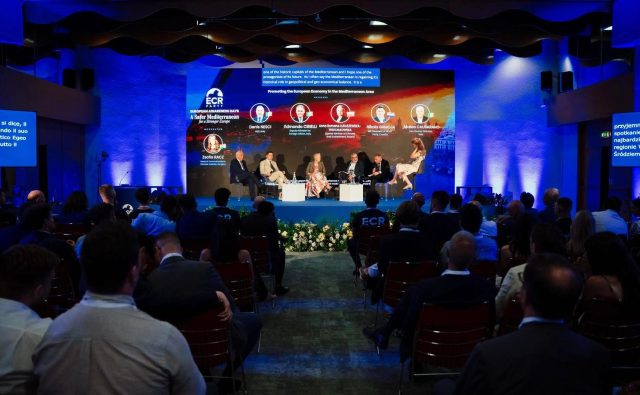
A captivating debate on development, cooperation, and the massive challenges facing Mediterranean countries took place during the panel “Promoting the European Economy in the Mediterranean Area,” held on Friday, July 17, on the first day of “European Awareness Days – A Safer Mediterranean for a Stronger Europe.” The conference, organized by the ECR Party last weekend in always stunning city of Catania, on the eastern coast of Sicily, brought together participants from twenty European countries and the United States.
Moderated by Zsofia Racz of the Danube Institute, the panel brought together distinguished representatives from the political and business spheres in Italy, Croatia, and Poland, namely: Edmondo Cirielli, Deputy Minister of Foreign Affairs in Giorgia Meloni’s government; Marco Causarano, CEO of Sicania Chimica; Nikola Grmoja, president of the Croatian Most Party and member of the Croatian Parliament; Anna Romana Lukaszewska-Trzeciakowska, former Minister of Climate and Environment of Poland; and Italian MEP Denis Nesci.
“Energy security has become economic security,” stated moderator Zsofia Racz, who emphasized the importance of the diplomatic commitment of Mediterranean countries’ governments, with Italy continuing to expand its significant role in energy, digital, and rail infrastructure advancement.
According to Edmondo Cirielli, Mediterranean area is regaining its historical role, and Italy’s destiny is to act as a “bridge between continents,” focusing on intercontinental trade, key infrastructure, and digital innovation. Insisting on a pragmatic approach, our goal, according to the Deputy Minister of Foreign Affairs, should be “to connect the shores of the Mediterranean” and ensure the political stability of Mediterranean countries. Edmondo Cirielli also referred to the Mattei Plan for Africa – which includes no fewer than 18 partner countries – Prime Minister Meloni’s strategic project to support Africa, “the continent of the future,” as the deputy minister said.
Marco Causarano, CEO of Sicania Chimica company from Catania, stated that less bureaucracy is the key to efficient development, and the goal of becoming a continental-level technology hub is completely achievable.
Speaking from his country’s perspective, Nikola Grmoja asserted that Croatia should become a strategic gateway for Europe, with a particular focus on secure and affordable energy, trade, logistics, and support for high-value manufacturing. Given its unique geographic position and its huge potential, Croatia should follow Singapore’s example by creating value through trade.
For Anna Romana Lukaszewska-Trzeciakowska, every effort must aim to promote common sense and achieve common goals. “More centralization means less freedom for companies and industries, and less competitiveness,” according to the former Minister of Climate and Environment of Poland, who also stated we must accept greater exposure to risk. Anna Romana Lukaszewska-Trzeciakowska also referred to the EU Emissions Trading System (ETS), which, under the pretext of combating climate change, is nothing more than an ideological tool that undermines industrial competitiveness, as well as to the Three Seas Initiative, the regional initiative focused on modernizing rail and road transport, promoting energy diversification, and digital connectivity.
Italian Member of the European Parliament Denis Nesci spoke about the concept of “territorial realities”. Sicily, the Mediterranean, and the Adriatic regions face different challenges compared to the industrialized countries of Central and Northern Europe. Our goal must be to achieve independence – not only from Russia, but also from Chinese technologies – and one of our main concerns should be ensuring that everyone has the freedom to choose where to work and creating the very conditions citizens need not to leave their own countries.
“How could we measure success?” the moderator asked the panelists. Certainly, the success shall be measured by efficient policies, better and stronger businesses and industries, achieving energy security and so on. A slightly different perspective was offered by the Most Party president, who answered that success can be measured by whether Europe returns to its roots and values and whether the Old Continent remains the home of its own citizens.
Promoting the economies of the Mediterranean region is not merely a topic for debate, but an imperative for increasing the well-being and genuine safety of Europeans.