


 Subscribe


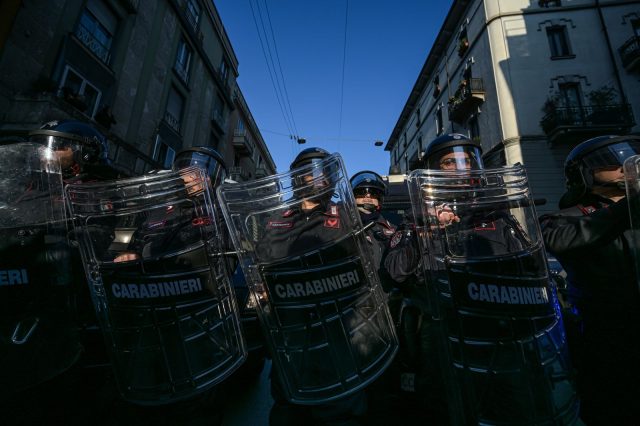
Italy wanted to imitate France. And, at least for a few days, it seems to have succeeded. Barricades, smashed shop windows, stones hurled at police officers, hooded youths and cities turned into battlegrounds. From Milan to Turin, via Bologna, the demonstrations of recent days have revealed a new face of protest in Italy. One that, on closer inspection, has increasingly little to do with students’ demands.
It all began on Friday, October 16, with the so-called No Meloni Day. Demonstrations took place across Italy, accompanied by slogans against Giorgia Meloni’s government. Yet the scale of the mobilisation deserves closer scrutiny. In Rome, police estimated that just over 5,000 people took part, far below the figure claimed by the organisers. In Mestre, the local police counted just 200 demonstrators, while approximately 1,000 took to the streets in Cagliari. The protests certainly reached numerous cities, but these figures hardly establish a mass uprising involving Italy’s millions of students. The official demand was straightforward: more investment in education, less money for weapons. Yet a closer look at the banners and a listen to the chants revealed how quickly a protest supposedly about education had become a much broader political mobilisation.
In Rome, American and Israeli flags were burned. In Turin, photographs of Meloni and other political figures were defaced, while some demonstrators threw stones and bottles at law enforcement officers. Among the leading organisations were OSA and Cambiare Rotta, groups belonging to the radical student left, which turned opposition to the government’s education policies into a wider attack on the administration itself.
So far, nothing particularly new. Italy is well acquainted with radical collectives, school occupations and anti-fascist demonstrations. But what happened over the following forty-eight hours tells a different story.
On Saturday, October 17, during the demonstrations known as Italia in Piazza (Italy Takes to the Streets), violence erupted particularly in Milan, Bologna and Turin. According to figures released by the police, approximately 5,000 people demonstrated in Milan, 3,000 in Turin and 2,000 in Bologna. Together with 600 in Brescia and 800 in Bergamo, the five cities recorded a total of around 11,400 protesters. In Milan, a march against the rising cost of living descended into urban warfare. Hundreds of very young protesters, many with their faces covered, confronted the police. On Sunday, October 18, the situation deteriorated once again: looted shops, shattered windows and burning rubbish bins. According to figures released by the police the following day, 271 people were taken to police stations and 32 were arrested.
And this is where the first great bluff becomes apparent: not every demonstration was a student protest, and not everyone involved in the clashes belonged to traditional political movements. In Milan, in particular, a generation of very young protesters emerged, often mobilised through TikTok and Telegram, with no recognisable leaders and no clearly defined political identity.
Many have been described in the Italian media using a term that is difficult to translate: maranza. It is a slang expression identifying a particular urban youth subculture, associated with groups of young people from the outskirts of cities, sportswear, street slang and a strong presence on social media. Reports also pointed to the involvement of numerous second-generation Italians in the clashes. Naturally, neither family background nor membership of a youth subculture determines violent behaviour. Nevertheless, the composition and methods of this new wave of protest represent a phenomenon that deserves attention.
This is where a possible convergence emerges: Antifa and the maranza, the ideological militancy of the far left meeting the urban rebellion of the TikTok generation.
The former have a clearly defined political enemy: the conservative government. The latter often appear to have a much broader target: authority itself, beginning with the police. In the footage from recent days, these two forms of protest end up sharing the same streets and, in some cases, even the same slogans.
The obvious comparison is France, where unrest in the suburbs and radical political mobilisation have long been two distinct phenomena that can overlap during major demonstrations. Italy now appears to be confronting a similar dynamic: organised political opposition is being joined by a less ideological, more unpredictable form of youth anger, often amplified by social media.
But there is a second bluff, and this one concerns education itself.
The organisers of No Meloni Day have accused the government of diverting resources away from schools. It is a narrative that deserves to be tested against the figures.
In 2026, the government allocated €300 million to the Piano Estate (Summer Plan), funding educational, sporting and recreational activities even during school holidays. For the 2025–2026 and 2026–2027 academic years, €207 million has also been earmarked for Agenda Sud and €204 million for Agenda Nord, programmes designed to reduce educational inequalities and tackle early school leaving. These are accompanied by €161 million for teacher training and €50.3 million for administrative, technical and auxiliary school staff, under a national programme co-financed by European funds.
As for school infrastructure, the current government is continuing to implement investments under Italy’s National Recovery and Resilience Plan (NRRP). The programme allocates approximately €4.4 billion to improving the safety and renovation of school buildings, more than €1 billion to constructing new schools and around €1.07 billion to expanding school canteens and full-day education. These are European funds originally programmed during the previous parliamentary term and therefore cannot be attributed entirely to the Meloni government. Nevertheless, their implementation represents a tangible intervention in the education system.
According to results announced by the government in 2026, these investments have led to the construction of 176 new schools, 1,100 canteens and 360 sports facilities, alongside the renovation or structural improvement of 1,600 school buildings. Over the past year, additional national funding has also been allocated, including approximately €430 million for fire safety and a further €114.4 million for earthquake-resistant construction, maintenance and remediation works.
Significant measures have also been adopted regarding school personnel. For the 2026–2027 academic year, the government authorised 46,642 permanent teacher appointments and the recruitment of 12,284 administrative, technical and auxiliary staff members. In November 2025, an economic agreement was also signed for the renewal of the 2022–2024 collective bargaining agreement, providing teachers with an average monthly pay increase of €144.
None of this means that Italian schools are without problems. Salaries remain relatively low, and public expenditure on education as a share of GDP continues to fall below the OECD average. But arguing that investment is insufficient is one thing; portraying a government as having simply abandoned education is quite another.
Then there is the question of integration, which has become one of the main targets of the demonstrations. The new education decree introduces, starting from the 2027–2028 academic year, a 30% limit in certain first-year classes for pupils without Italian citizenship who do not meet specific requirements concerning their place of birth or previous school attendance. It is therefore not a blanket cap on all students of foreign origin. The measure is intended to encourage a more balanced distribution of pupils and strengthen Italian-language learning.
It is certainly a political choice open to debate. But reducing it to a generalised attack on foreigners means ignoring what the legislation actually provides.
Ultimately, the problem is not that students are protesting. In a democracy, they must be free to do so, even forcefully. The problem arises when a legitimate demand becomes a vehicle for every possible form of political antagonism, eventually providing a backdrop for acts of violence.
And this is perhaps the most revealing picture of Italy today. On one side stands a government whose policies can certainly be criticised, but which has adopted and is implementing concrete investments in education. On the other is a protest movement bringing together students genuinely concerned about their future, political militants and new youth groups that seem to find in confrontation with the police a means of asserting themselves.
The radical left seeks a political revolution. The new rebels from the urban outskirts often seem to be looking for something less clearly defined: visibility, belonging and a challenge to authority. They are different worlds, and not necessarily allies. Yet they can end up fuelling the same spiral of unrest.
This is the challenge Italy should take seriously. Student protests are almost as old as the Republic itself. But the convergence, even if only occasional, between ideological antagonism and the urban violence of a generation raised on social media is something new.
And better schools are not built by setting the streets on fire.