


 Subscribe


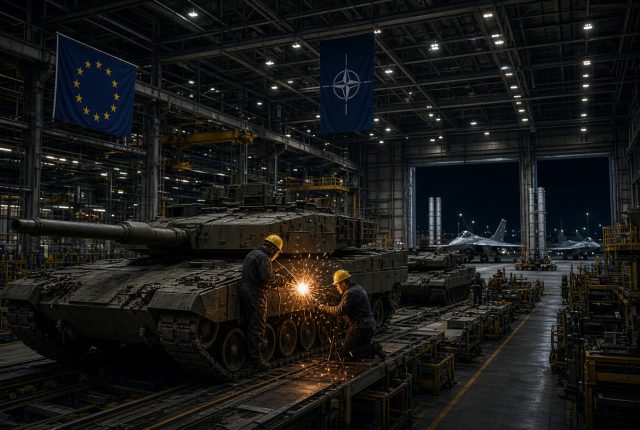
Europe has found the money and the will to rearm. What it still lacks is the industrial capacity, the speed and the shared rules to turn that money into working capability. That was the message from the 24 October panel on “Adapting Europe’s Military Capabilities to New Threats” at the ECR conference in Vilnius.
Małgorzata Samojedny (President, Opportunity Institute, Poland), moderator. She opened with the economics. Studies by the IMF and the ECB, she said, suggest defense spending lifts GDP in the short term, perhaps more than infrastructure spending. Her home neighbor the Czech Republic was her example. It sources 57% of its defense supplies domestically and exports 90% of its defense output. Czech firms have also bought abroad, such as Fiocchi Munizioni in Italy. Europe needs three things, she argued: sustainable financing, predictable orders and competitive supply-chain conditions. She complained that steel and aluminum producers carry “artificial” costs from emissions trading and ESG rules. She also called for governments, and companies, to set requirements and buy jointly.
Vojtech Munzar (Czech MP, Vice-Chair of the Budget Committee). Speaking as an economist, he framed defense around three questions: how to finance it, how the market works and how to spend public money responsibly. His headline figure was that Europe imports about 80% of its military equipment, so a large share of spending leaves the EU economy. He later stressed that buying kit is only part of the bill. Training, logistics, barracks and bases all cost money, and mixed fleets make it worse. If some states fly Gripens and others F-35s, training for each is expensive. On giving industry certainty, he said states should provide long-term demand and financing and cut artificially high energy and heavy-industry costs. Subsidies, he argued, should only supplement private companies and their ideas. He also said that “every euro invested in defense generates two or three euros” in related activity. Persuading voters is easier in Poland or the Baltics than in Italy or Spain, where it becomes a political fight. Debt-funded spending can raise interest rates, he warned, so he suggested shifting money from the green transition to defense.
Tomasz Szatkowski (ECR Group Secretary-General, former Polish ambassador to NATO). He gave the panel its hard-edged strategic view. Without the US nuclear umbrella, he said, Europe would risk Russian nuclear blackmail, because British and French arsenals cover only limited scenarios. He recalled that NATO had no proper theatre-wide plans before 2021–22. Its focus has since moved to denying Russia any early gains. NATO, he argued, should play to its strengths in air power and maneuver warfare rather than match Russian mass. Asked how NATO can finance a big expansion, he answered bluntly: “In short, it cannot.” It takes time and industrial capacity, which Europe lacks. Defense alone is not enough either: “like going into a medieval battle with a shield but no sword.” He warned against shooting down cheap Shahed drones with expensive Patriots indefinitely. He also asked for more snap exercises, where allies can fail early without blame.
Nikodem Racho (adviser to the Polish president, former National Security Bureau adviser). He placed Russian imperial aims on a long timeline that outlasts any peace deal. He argued that capabilities Europe cannot easily replace from the US include intelligence, space, cyber and command and control, with intelligence the hardest. Even so, Europe can sustain itself until reinforcements arrive. His practical demands were permanent US bases in Poland, with clear financing and legislation, and a maintenance facility for PAC missiles used by Patriot systems.
Nikodem Racho, speaking in his role as the panel’s industry voice, said the Baltic states lack strong defense industries and buy from the US, Germany and Poland. Local firms should therefore find niches that the big contractors leave open, and welcome allied investors, because factories also bring political support. Then came Lithuania’s Economy and Innovation Minister Edvinas Grikšas, who offered the speed argument. His country has about 100 defense and security firms, and sector revenue grew 50% last year alone. An investor can go from signed agreement to a producing facility in as little as nine months, which he believes is the EU’s fastest. His slogan for Europe was “speed, speed, speed”. He said existing EU procurement mechanisms are underused, and promised Lithuanian examples during its Council presidency.
MEP Aurelijus Veryga, answering a question about closing EU defense gaps, said: “We can debate how good or bad it is, but Europe is trying to do something.” He noted that the EU used to bar even the discussion of defense investment, so allocating money takes time. The EU mostly gathers and redistributes member-state money, he said, and its best contribution is rules that encourage cooperation.
Lithuanian MP Dainius Gaiauskas cited SAFE among the signs that a united EU was boosting its budgets, which pushed Moscow towards hybrid attacks on grey areas.
MEP Elena Donazzan said SAFE funds member states to buy what they need, but “public procurement often ends up benefiting companies outside Europe.” She would extend the cooperative model built for migration to military procurement.
Italy’s Undersecretary of State for Defense, Isabella Rauti, described the goal as a European pillar inside NATO, not a European army. Equipment should be interoperable “from the design stage,” with European production chains and eventually fully European kit. She called it an ambition rather than an impossible one. She mentioned a recent Rome meeting devoted entirely to European procurement.
Lithuania’s former permanent representative to NATO Deividas Matulionis was warier of Brussels. He wants the next EU budget to carry more defense and security money. He argued for standardization, saying: “Money will not defend us. Only capabilities will defend us.” He rejected an EU defense alliance, which would need treaty change and might settle for the lowest common denominator.
Matulionis added that Lithuania spends 5.38% of GDP on defense, with over 60% staying in the country. Racho also listed three EU steps: military mobility, EDIP (the program favoring European-located production) and a streamlined industry program. His example was troops who needed six weeks of paperwork to move west to east, and bridges not built for tanks.
The speakers agreed that Europe can no longer treat defense as an afterthought. They disagreed about whether Brussels or national capitals should lead, and about how much control to keep over where the money goes. SAFE sits in the middle of that argument. It offers new funding, but critics fear it may flow outside Europe, and even supporters say the real test is whether the orders become factories, trained crews and weapons that work together. As Szatkowski put it, shields alone will not do.