


 Subscribe


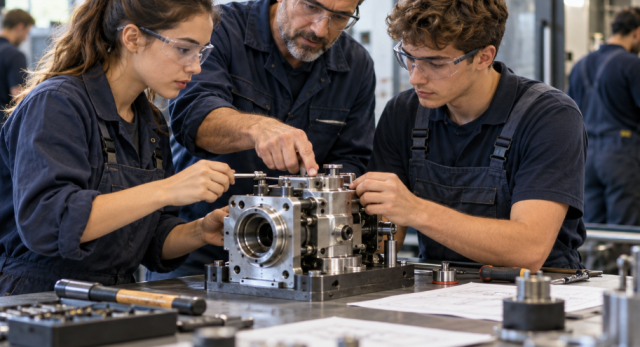
Europe’s competitiveness debate often focuses on energy prices, artificial intelligence, trade and industrial policy. Yet a quieter problem is becoming just as important: companies across the continent are struggling to find people with the skills they need.
The European Commission’s Union of Skills initiative puts the challenge in stark terms. One in five adults in the EU struggles with reading and writing, one in four 15-year-olds performs below basic levels in reading, mathematics and science, and nearly four in five small and medium-sized enterprises say they cannot find the talent they require.
For an economy that wants to lead in advanced manufacturing, digital technologies and the green transition, this is not simply an education problem. It is a competitiveness problem.
Europe Has a Skills Problem, Not Only a Labour Shortage
Europe’s ageing population is often cited as the main reason employers cannot recruit. Demography matters, but the shortage is also about matching workers to jobs.
Eurostat reported that labour market slack represented 11.7 per cent of the extended labour force in 2024, equivalent to 26.7 million people who were unemployed, underemployed or otherwise available for work but not participating fully in the labour market.
This suggests that Europe’s challenge is not simply to find more workers. It is also to ensure that people already in Europe have the qualifications and practical skills required by changing industries.
The mismatch is particularly visible in sectors such as engineering, construction, healthcare, information technology and advanced manufacturing. Employers may have vacancies, while workers in the same region struggle to find stable employment. Bridging that gap requires education systems to respond more quickly to economic change.
Vocational Training Deserves a Second Look
For too long, vocational education has sometimes been treated as a second choice compared with university. That distinction is increasingly difficult to justify.
Modern industry needs electricians, technicians, welders, mechanics, machine operators, software specialists and skilled construction workers. Many of these jobs require sophisticated technical knowledge and continuous training. They are not occupations of the past; they are essential to the industries Europe wants to build.
More than half of upper-secondary learners in the EU already choose vocational pathways, according to the Commission. Yet participation remains too low in some sectors experiencing the strongest demand, particularly those linked to the digital and green transitions.
That is why Brussels is preparing a new European strategy for Vocational Education and Training. The objective is to make VET more responsive to labour-market needs and more attractive to learners of all ages. This is also why vocational mobility across Europe should be treated as an economic asset, not merely an educational experience.
The debate is beginning to shift. Vocational education is increasingly being presented not as an alternative for those who do not attend university, but as a strategic part of Europe’s economic infrastructure.
SMEs Are Paying the Price
The skills shortage hits smaller businesses particularly hard.
Large companies can recruit internationally, establish internal training programmes and offer higher salaries to attract specialised workers. A family-owned manufacturer or local engineering company has far less room to manoeuvre.
When a small business cannot find a qualified technician, the consequence is not abstract. An order may be delayed, a new machine may remain unused, an investment may be postponed or an expansion plan abandoned.
This is why skills policy should not be designed only from the perspective of education ministries. Employers, chambers of commerce, training centres and local authorities need a stronger role in identifying which qualifications are actually needed in regional economies.
The European Skills High-Level Board moved in this direction in July, calling for closer business-education links and regional skills ecosystems that bring companies, training providers and public authorities together. The principle is sensible: training should take place closer to where jobs actually exist.
Skills, Technology and European Competitiveness
The skills debate is becoming more urgent as technology changes the workplace.
Artificial intelligence, automation and digital tools will eliminate some tasks, transform others and create new roles. But technology does not remove the need for skilled workers. In many cases, it increases it.
The Commission’s 2026 Digital Decade report found that more than 60 per cent of Europeans now possess at least basic digital skills, but shortages of ICT specialists remain significant. At the same time, many SMEs continue to face barriers to adopting advanced digital technologies.
Investment in technology produces limited gains if businesses do not have employees capable of using it effectively.
A factory can purchase advanced robotics, but it still needs technicians to install and maintain machinery. A company can adopt artificial intelligence, but workers must know how to integrate those tools into daily operations.
Human capital and technological investment are therefore complements, not substitutes.
From Degrees to Employability
None of this means universities are becoming less important. Europe needs excellent researchers, scientists, doctors, engineers and academics. But public policy should not measure educational success simply by the number of degrees awarded.
The better question is whether education gives people useful knowledge, adaptable skills and realistic opportunities to build a career.
That requires stronger connections between schools, universities, vocational institutes and employers. Apprenticeships can help young people combine theoretical learning with practical experience. Shorter professional qualifications and lifelong training can also help adults adapt without leaving the labour market for years.
Europe should also make it easier for skills and qualifications to be recognised across borders. A genuine single market for labour cannot function efficiently if workers repeatedly encounter unnecessary obstacles when moving between Member States.
At the same time, mobility should not become an excuse for countries to neglect their own education and training systems. Attracting skills from abroad can help address shortages, but developing domestic talent remains essential for long-term resilience.
Investing in People Is Industrial Policy
The EU increasingly talks about industrial policy, strategic autonomy and economic security. Skills belong in the same conversation.
Semiconductor plants, defence production, energy infrastructure, artificial intelligence and advanced manufacturing all depend on people who know how to design, build, operate and repair complex systems. Announcing investment targets is easier than creating the workforce required to deliver them.
This is where subsidiarity matters. Brussels can support mobility, common standards and cross-border programmes, but education and training systems remain closely connected to national and regional economies. A successful European skills strategy should leave room for local solutions rather than impose a single model from above.
The goal should be practical: give workers more opportunities to improve their skills, give businesses a stronger voice in training, and give young people more than one respected path into a successful career.
Europe’s competitive challenge will not be solved by regulation or subsidies alone. It will be decided partly in classrooms, workshops, laboratories and workplaces.
For years, European economic policy has concentrated on capital: how much to invest, where to subsidise and which industries to support. The next phase must pay equal attention to human capital.
A continent that cannot match people with productive work will struggle to compete, regardless of how ambitious its industrial strategies appear on paper.
Europe does not lack talent. The challenge is to develop it, recognise it and connect it more effectively with the economy. If the EU can do that, skills policy may prove to be one of the most important competitiveness reforms of the decade.