





 Subscribe


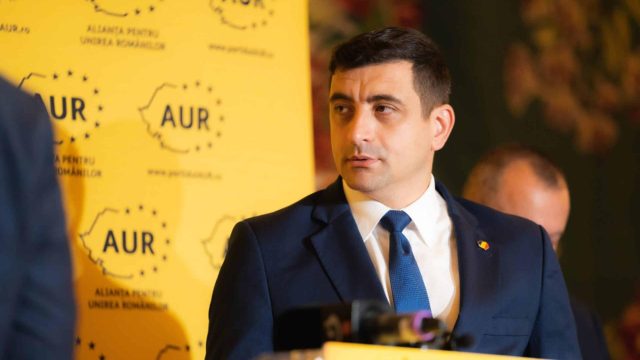
There’s a moment in every political crisis when one player stops reacting and starts dictating. On June 26, 2026, that moment belonged to George Simion.
The vote on the Veștea government never really stood a chance, not because the numbers were impossible to reach, but because AUR made sure they stayed that way. While Romania’s political establishment spent weeks dismissing, mocking, and outright ignoring AUR’s conditions, Simion was quietly counting votes. And when the moment came, he didn’t just pull the rug, he announced it on Facebook before the official result was even declared. “Guvernul Veștea/Nicușor a picat la vot!” The verdict of a man who had already loaded the gun.
Before AUR’s 90 parliamentarians rose in unison and walked out of the joint session, Simion delivered a short but devastating address. “For 35 years in Romania, betrayal has been the order of the day and it’s become something banal,” he said. He didn’t instruct his colleagues how to vote. He didn’t need to. He offered them a mirror: whoever stays in the room is, by definition, a traitor. Whoever leaves, isn’t. No one stayed. That’s not just discipline, that’s political architecture. The “90 loyal MPs, zero defectors” brand is AUR’s most valuable asset, and Simion protected it with surgical precision. One crack in that wall and the party’s entire identity collapses. Instead, they walked out as a single, synchronized bloc, and the image was worth more than any press release.
The temptation to play the “responsible adult in the room” was real. Some argued that AUR should demonstrate maturity, support a government, stabilize the country, and prove it can govern. It’s a compelling narrative, but it was also a trap. Here’s the core problem: AUR wasn’t offered a seat at the table. Veștea’s team never seriously negotiated with them. No ministerial posts, no genuine concessions on the eight-plus-two justice conditions AUR had outlined, not even a courtesy phone call. Giving your votes to someone who didn’t bother to ask for them isn’t statesmanship, it’s the worst kind of political self-sabotage. You absorb the reputational cost of enabling a cabinet you fundamentally oppose, while PSD and the PNL dissidents pocket the actual governing power.
Veștea needed roughly 33 AUR votes to cross the 233-vote threshold with everything playing out at millimeter precision, as observers noted. That leverage was enormous. But leverage only works if you’re willing to walk away, and Simion made absolutely clear he was. Beyond the tactical calculus, there’s a deeper principle at stake. AUR’s entire electoral capital is built on one promise: we are not the establishment. Voting for a government that explicitly declared it would continue Bolojan’s program “without changing a single comma” would have been ideological suicide. It wouldn’t have been a pragmatic compromise, it would have been proof that AUR is just another face on the same machine.
What makes this more than just a successful boycott is the collateral damage Simion inflicted on every other player simultaneously. USR, which has been trying to survive through PNL’s oxygen supply, took a significant hit. PNL, already in the middle of an internal cannibalization process, lost more credibility it couldn’t afford to lose. PSD, polling just barely above 10%, is now staring at a moment of reckoning: if Grindeanu doesn’t move faster than Bolojan, the party risks irrelevance. And Nicușor Dan, who entered this saga with the backing of the entire establishment, exits it repudiated by virtually everyone across the political spectrum, isolated and politically immobile.
Meanwhile, the people who spent months labeling AUR as “extremist,” “pro-Russian,” and “anti-Western” were the same ones who then had to come hat in hand to Simion’s door, hoping for votes. That contradiction didn’t go unnoticed and it stripped those labels of whatever power they had left.
Here’s the structural absurdity Romania is now trapped in: PSD and PNL still refuse to formally collaborate with AUR, continuing to float names like Siegfried Mureșan and Sorin Grindeanu as potential prime ministers, neither of whom can form a majority without either AUR support or yet another fragile patchwork coalition. The result is a perpetual government block. A political Groundhog Day where the same parties that caused the crisis keep proposing the same solutions and expecting different results. The president’s failure to bring AUR into consultations at the right moment means that now every vote from AUR costs significantly more. That’s not cynicism, that’s basic market logic: scarcity drives price. AUR’s cooperation is now a premium product, and the establishment burned the discount window.
There’s a before and after to June 26. Before, George Simion was a loud, energetic, controversial political figure. After, he’s something the Romanian political class hasn’t really had to deal with in decades: a genuine kingmaker who plays the long game, controls his caucus completely, and understands that the most powerful move is sometimes the one you don’t make.
The system thought it could keep winning by keeping AUR out. Simion just proved the opposite: that being outside the system, and staying there on his own terms, is exactly where the power is.