





 Subscribe


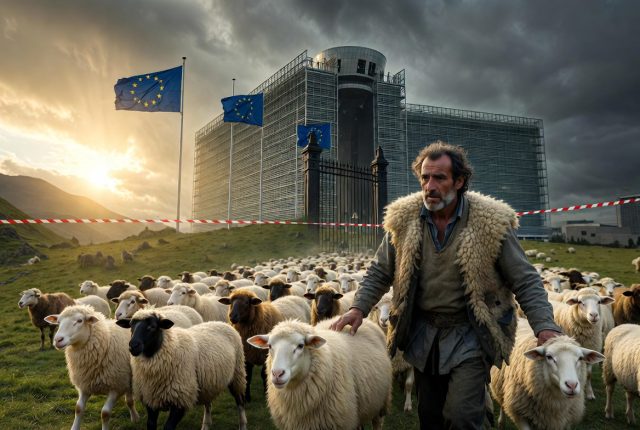
There is something deeply wrong when a country that has spent years building itself into the European Union’s strongest live sheep exporter wakes up one morning to find its gates slammed shut by the very institution it belongs to.
That is exactly what happened to Romanian farmers in June 2026. Following the confirmation of a localized outbreak of peste des petits ruminants (small ruminant plague) in Mureș County on June 8, the European Commission moved swiftly. Brussels extended its existing ban on sheep and goat movements from Romania to other EU member states until December 31, 2026, and then went a step further: it expanded the prohibition to cover exports to third countries as well. The entire country was, all at once, locked out of its most profitable livestock trade.
Romania is not a minor player in this sector. It is the EU’s second-largest sheep producer after Spain, with a national flock of 10.75 million animals as of 2025. In the first ten months of that same year, exports to non-EU markets alone generated more than €210 million. By early 2026, the momentum was extraordinary: one million animals had already been exported in just the first four months, generating €120 million in revenues according to Eurostat data, with projections pointing to a 40% increase over the full year.
Interim Agriculture Minister Barna Tanczos did not mince words: the restriction is “a profoundly disproportionate measure relative to the existing epidemiological situation and the major economic impact on Romania’s sheep sector”. His frustration is shared by Alexandru Bociu, president of Romania’s National Sanitary Veterinary and Food Safety Authority (ANSVSA), who traveled to Brussels on June 23 to contest the decision.
What makes this ban particularly infuriating for Romanian farmers is not just its economic weight, but its apparent inconsistency. The outbreak in Mureș is localized and, according to Romanian authorities, under control. No new outbreaks had been reported for over a year before the June 8 confirmation. Yet the ban applies to the entire national territory. Every flock, every farmer, every county, regardless of disease status. Romanian officials have made a reasonable argument: restrictions should target affected zones, not the whole country. Other EU member states that have faced similar animal health situations have not been met with measures this sweeping. The question that hangs in the air is whether this is pure biosecurity policy or whether competitive interests among EU member states are quietly shaping how Brussels responds to outbreaks in regards to newer members of the bloc.
What amplifies the damage is a structural vulnerability that Romania has never fully addressed: the chronic shortage of domestic slaughterhouses. While Romania can technically still export sheep and goat meat to both EU and non-EU markets, the sector is overwhelmingly built around live animal trade. Without adequate processing infrastructure to convert livestock into export-ready meat products, farmers are left with animals they cannot move, feeding costs that don’t stop, and no revenue coming in. This is not a new problem. It is a systemic failure years in the making, the result of underinvestment in rural agri-industrial capacity. The export ban has effectively turned that old vulnerability into an acute crisis. Farmers in the field right now are facing a brutal arithmetic: feed costs accumulate daily, animals grow beyond optimal export weight, and the window for profitable sales shrinks with every passing week. For many small and medium-scale shepherds, especially in rural mountain communities where sheep farming is the only economic activity, the losses will not be recoverable.
It is easy to cite a figure like €200 million and move on. But in the context of Romania’s agricultural economy, where rural incomes remain among the lowest in the EU and where livestock farming underpins entire village economies, that number represents far more than a line in a trade report. It represents wages, rents, equipment loans, veterinary bills, school fees, and heating costs for tens of thousands of families.
Romania became the EU’s top live sheep exporter not by accident, but through years of work expanding into Middle Eastern and North African markets, even pioneering cargo plane shipments to Algeria just weeks before the ban. To see that hard-won position threatened by a blanket EU decision is a bitter pill for an industry that had finally found its footing.
The ban must be challenged, and challenged loudly. If Brussels truly stands for proportionality and solidarity among its members, it needs to prove it before Romania’s shepherds have nothing left to export.