





 Subscribe


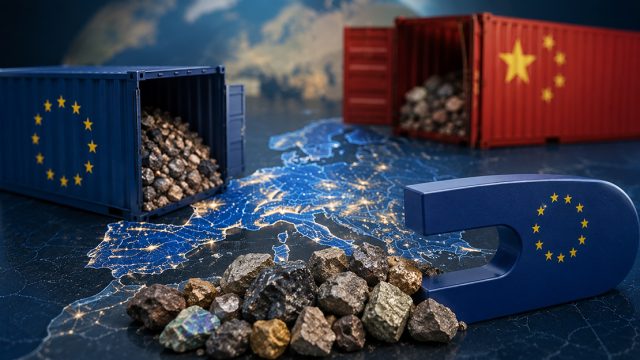
Imports and exports of strategic minerals recover after a difficult 2024, highlighting Europe’s growing technological ambitions while underscoring its continued dependence on Chinese supply chains.
The European Union significantly expanded its trade in rare earth elements during 2025, reversing the sharp slowdown experienced the previous year and reinforcing the strategic importance of these critical raw materials. According to the latest figures released by Eurostat, the EU’s statistical office, both imports and exports of rare earths recorded double-digit growth, reflecting increasing industrial demand as Europe accelerates investments in advanced manufacturing, clean technologies, and digital infrastructure.
Rare earth elements comprise a group of 17 metallic minerals that are indispensable for modern economies. Despite their name, these elements are relatively abundant in the Earth’s crust, but economically viable deposits are difficult to develop and process. Their extraction, refining, and separation require complex industrial capabilities, making supply chains highly concentrated and vulnerable to geopolitical tensions.
These strategic materials are essential components in a broad range of high-technology applications. They are found in smartphones, computers, electric vehicles, wind turbines, aerospace systems, defense equipment, medical imaging technologies, industrial robotics, and numerous electronic devices used in everyday life. As the global transition toward digitalization and clean energy accelerates, securing reliable access to rare earths has become a major economic and geopolitical priority for governments worldwide.
Eurostat’s latest report shows that the European Union imported 15,100 tonnes of rare earth materials in 2025, representing an increase of 17.1% compared with the previous year. Export volumes also recovered strongly, rising by 21.1% to reach 6,700 tonnes. The rebound follows a particularly challenging 2024, when trade volumes contracted amid weaker industrial activity and continued uncertainty across global supply chains.
The increase was even more pronounced in monetary terms. The value of rare earth imports climbed by 23.2%, reaching €124.9 million, while exports increased by 29.9% to €124.7 million. The stronger rise in value than in volume suggests that prices remained relatively firm throughout the year, reflecting sustained demand for strategic minerals despite ongoing market volatility.
China once again consolidated its position as the European Union’s largest supplier of rare earths. During 2025, nearly half of all imported rare earth materials originated from China, accounting for 46.8% of total import volumes, or approximately 7,100 tonnes. The figures further reinforce Beijing’s dominant role in one of the world’s most strategically sensitive supply chains.
China’s leadership in the rare earth sector extends well beyond mining activities. Over several decades, the country has invested heavily in refining, processing, and manufacturing capacities, allowing it to dominate virtually every stage of the value chain. As a result, even rare earth minerals extracted elsewhere are often shipped to China for processing before entering global markets.
Russia ranked as the European Union’s second-largest supplier in 2025, accounting for 25.9% of total imports, equivalent to around 3,900 tonnes. Malaysia followed closely with a 23.1% share, supplying approximately 3,500 tonnes. Together, these three countries represented the overwhelming majority of the EU’s rare earth imports, illustrating the concentration of Europe’s external sourcing.
Other trading partners played only a marginal role. Japan accounted for 1.6% of imports, while the United States supplied just 0.9%. Although both countries possess advanced technological capabilities and are actively expanding domestic production and processing facilities, their contribution to Europe’s current supply remains limited.
The data highlight one of the European Union’s most pressing strategic challenges. While the bloc continues to pursue greater technological sovereignty through investments in electric mobility, renewable energy, semiconductor manufacturing, and digital innovation, it remains heavily dependent on external suppliers for many of the raw materials that enable these industries.
Reducing this dependence has become a central objective of European industrial policy. Recent initiatives aimed at diversifying supply sources, encouraging domestic mining projects, strengthening recycling capacity, and developing new refining facilities are intended to improve long-term resilience. However, building an integrated rare earth supply chain requires substantial investment, regulatory certainty, environmental safeguards, and years of industrial development.
The strong recovery in rare earth trade during 2025 therefore reflects both positive economic momentum and an enduring structural vulnerability. As global competition for critical minerals intensifies and geopolitical rivalries increasingly shape international trade, securing stable access to rare earth elements will remain one of the defining industrial and strategic priorities for the European Union in the years ahead.
Alessandro Fiorentino