





 Subscribe


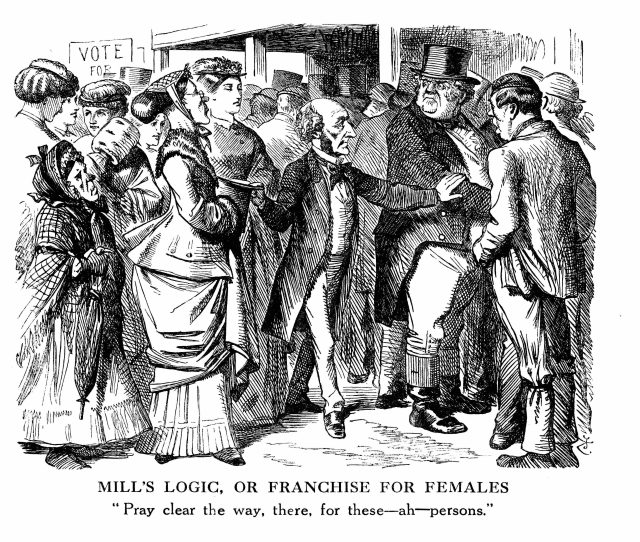
In May 2026, 220 years had passed since John Stuart Mill’s birth. On this occasion, an Icelandic book club invited me to discuss two of Mill’s works, An Essay on Liberty and The Subjection of Women. Although the latter is less well known, it is certainly worthy of attention. Mill makes a compelling case for complete equality before the law for men and women, arguing that we should not forego the enormous pool of abilities and skills that women will develop if they are free and equal to men. He is right. But what is the situation today?
Where Women Do Better
Some evidence suggests that women today cope better with life than men. On average, women live about 5 years longerthan men in most countries. Of those who commit suicide, about 80 per cent are men. Of those undergoing rehabilitationfor drug abuse or alcoholism, about 65 per cent are men. In most countries, about 95 per cent of the prison population is men. Of people killed in road accidents, about 75 per cent are men. These figures are relatively stable across countries and over time. Needless to say, many more men than women have also been, and still are, killed in wars.
A Real Struggle?
It is true, however, that men have had, at least until recently, a higher average income than women. One possible explanation is that this gender gap can be blamed on a ‘Patriarchy’, which exploits women in a similar way to how capital exploited labour in the nineteenth century. But is such an analogy really plausible? While employers and employees have, to some extent, conflicting interests, every man is the son of a woman and, quite often, the father of a daughter; they all seem to have a common interest in one another’s well-being. This is a fundamental difference between the sexes and the classes.
The Gender Gap
What causes the gender gap, if not the systemic exploitation of women by a ‘Patriarchy’? Some economists, such as Thomas Sowell and Phil Gramm, argue that the gender gap is largely a statistical matter. They point out that in the labour market, women tend to gravitate towards two types of jobs: those that can be left for a few years without a significant decline in earning potential, and those that can be held part-time. These two types of jobs tend to be valued less by employers than jobs that require greater commitment, most importantly, the willingness to work long hours, as Harvard Professor (and Nobel Laureate) Claudia Goldin points out. This would imply that there is no conscious decision by a ‘Patriarchy’ to pay women less than their worth (if there was, it would pay for women to start their own companies and outdo their less able male competitors).
The reason women tend to gravitate towards those two types of jobs is easy to explain: for most of them, having and rearing children is part of their life plan. Goldin, however, adds that she has not found a plausible reason why the willingness to work long hours carries a premium. Moreover, as men participate more in child-rearing, the gender gap will probably shrink significantly.
Higher Proportion of Male Outliers
The question remains: Why do women do significantly better than men on most criteria for happiness? The answer is hardly that masculinity is more challenging than femininity; that would be circular reasoning, simply giving what has to be explained another name. Nor is the answer plausible that a ‘Matriarchy’ is keeping men down. A plausible explanation is that, while abilities are probably equally distributed between the sexes on average, their distribution within each sex may differ, with a higher proportion of outliers among men, both the very gifted and the quite daft. (This is sometimes called the greater male variability hypothesis.) It is to be expected that those two groups of outliers, especially the quite daft, adapt less easily to life than those more normal.