





 Subscribe


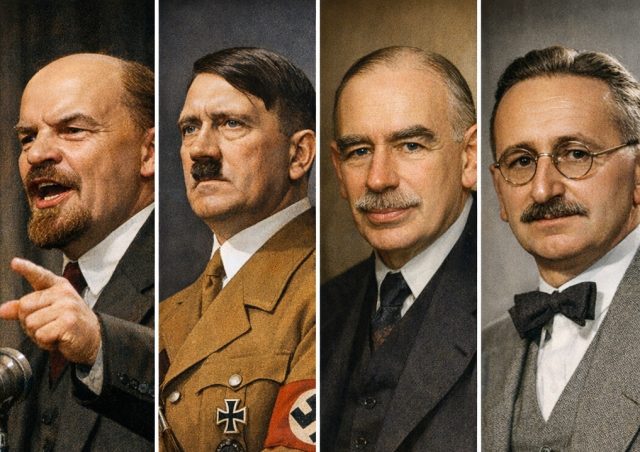
Labels, lists, and classifications inevitably simplify, but they can also clarify. They may enable us to see the forest, not just the trees. Here, I suggest dividing the twentieth century into four quarters, each named after an individual whose ideas, good or bad, were most relevant to that era.
The Era of Lenin
The first quarter of the twentieth century, from 1901 to 1925, can be named after Vladimir Ilyich Ulyanov (1870–1924), who adopted the name Lenin. In the autumn of 1917, after the Russian Empire collapsed for lack of resources to continue the First World War, he seized power with his small, ruthless, well-organised group of Bolsheviks. Immediately after the coup, Lenin established the secret police, which suppressed all opposition. The first labour camps were established in the early 1920s. Lenin was no less cruel than his successor, Stalin. Twentieth-century communism was the greatest—and costliest—social experiment in history, claiming the lives of 100 million people. But the unique feature of Leninism (and later Stalinism and Maoism) was that the dictators sought to control not only the actions of their subjects but also their thoughts. You must not only obey Big Brother; you had to love him.
The Era of Hitler
The second quarter of the twentieth century, from 1926 to 1950, can be named after Adolf Hitler (1889–1945). His National Socialism was Leninism without the class struggle; it pursued power for its own sake. Hitler felt no need to nationalise business, because he was nationalising the people. He managed to channel the Germans’ post-First World War frustrations into military aggression and anti-semitism. As Chancellor, he met almost no resistance when he assumed dictatorial powers. He was surprisingly successful at first, annexing Austria and the Sudetenland, occupying the rest of Czechoslovakia, and negotiating with Stalin to divide Central and Eastern Europe into spheres of interest. When he attacked Poland in 1939, Great Britain and France finally tried to stop him. The Second World War broke out. It touched everybody. You might not be interested in war, but war was interested in you. In a few years, Hitler turned the world upside down. After France was defeated, only the Anglo-Saxon powers stood up to him: Great Britain, her Commonwealth allies, and the United States (and Stalin after Hitler broke their treaty and attacked him). Failing to destroy Western civilisation, Hitler committed suicide.
The Era of Keynes
After the Second World War, Lenin’s heirs ruled Russia, China, and their satellite states, while in the West a consensus emerged around a mixed economy in which the state refrained from nationalising enterprises, redistributed income through taxation, and sought to ensure full employment. The West also embraced free trade, which stimulated economic growth. From 1951 to 1975, the English economist John Maynard Keynes (1883–1946) was the most influential political thinker of this era. He was a social liberal in the tradition of John Stuart Mill, a man of good will and great intelligence, but he believed the state had an important, indeed indispensable, role in promoting stability. We are all Keynesian now, it was said.
The Era of Hayek
In the last quarter of the twentieth century, from 1976 to 2000, Keynesianism in the West and Marxism in the East both foundered. Problems could not be solved by throwing money at them, as Keynes had proposed. Under regimes as different as a military dictatorship in Chile, a conservative government in Great Britain, and a social democratic one in New Zealand, new policies were adopted: liberalisation, privatisation, and deregulation. The Soviet Empire collapsed in 1989–1991 for lack of resources to continue the Cold War. Communism in Eastern Europe ended, not with a bang but a whimper. Post-communist countries implemented economic liberalisation and prospered. Former colonies that did the same—Hong Kong, Singapore, South Korea, and Taiwan—also prospered. International free trade expanded greatly. If any one thinker can be said to have anticipated and even inspired these changes, it was the Anglo-Austrian economist and philosopher Friedrich A. von Hayek (1899–1992), who had warned against both incremental and revolutionary socialism in his Road to Serfdom in 1944. He and his fellow members of the Mont Pelerin Society, an international academy of conservatives and liberals, revived and reinforced the venerable tradition of John Locke, David Hume, Adam Smith, Alexis de Tocqueville, and Lord Acton.
(AI-generated image of the four men discussed.)