





 Subscribe


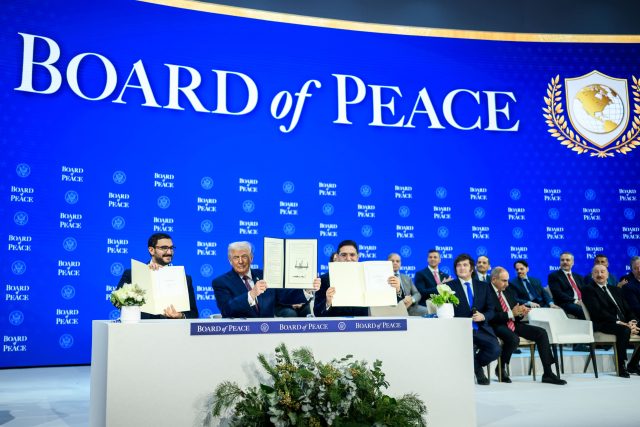
The Board of Peace, an international organization whose objective, according to its statute, is to “promote stability, restore accountable and legitimate government, and ensure lasting peace in areas affected or threatened by conflict” is an international organization created for centralized crisis management, with the aim of achieving a new global order based on direct agreements between allies.
The BoP, created by US President Donald Trump, who is its president for life, was made official on January 22, 2026 with the signing of the founding statute during the World Economic Forum in Davos, Switzerland.
Among the first to sign as members of the board were the representatives of Bahrain and Morocco, followed by Argentine President Javier Milei, Hungarian Prime Minister Viktor Orban, the foreign ministers of Turkey and Saudi Arabia, and the Prime Minister of Qatar. On February 19, Board was officially launched at the Donald J. Trump Institute of Peace in Washington.
The purpose of the Board of Peace was stated by the US President in his inaugural address: “What we are doing here is very simple: peace. It’s called the Board of Peace, it’s all about an easy word to say but a hard word to produce.”
And the first peace objective, the first conflict it is committed to resolving, is that of the Gaza Strip, and indeed the Board of Peace was created with the intention of implementing the Gaza Peace Plan 2025. Consisting of 20 points, the Plan, as published by the White House, calls for the liberation of Gaza from terrorism, the cessation of hostilities, the return of hostages, the dismantling of war facilities, and the entry and distribution of international aid. Once peace is achieved, the Peace Plan provides for the establishment of a technocratic and apolitical committee composed of Palestinian and international experts to manage various public services, under the control of the new international body, the “Board of Peace”, chaired by Trump, to manage funding for the reconstruction of Gaza.
The Gaza Peace Plan also calls for the development of a Trump economic development plan to revitalize Gaza and attract investment, and the establishment of a special economic zone with preferential tariffs and access rates to be negotiated with participating countries. To support the Palestinian police forces, an International Stabilization Force is planned, in which U.S., Arab, and partner military personnel will work together to maintain peace.
Among the participants at the first official BoP meeting, in addition to the members who accepted Trump’s invitation, were representatives from Italy, Greece, Romania and Cyprus. The European Union also sent a representative, the Commissioner for the Mediterranean Dubravka. Šuica.
Many European allies and traditional organizations such as the Vatican did not join, mentioning concerns about the Board’s legitimacy and relationship with the United Nations.
The initial results of the meeting are the commitment of several states (including Kazakhstan, Azerbaijan, the United Arab Emirates, Morocco, Bahrain, Qatar, Saudi Arabia, Uzbekistan and Kuwait) to contribute to the reconstruction of Gaza with funding totaling $7 billion, to which the United States matched its pledge of approximately $10 billion. Some countries, including Indonesia, Morocco, and Albania, also announced their commitment to send troops to the International Stabilization Force.
The approach demonstrated for achieving the goal of peace is innovative. In contrast to the bureaucratization of the United Nations, the Board presents itself as a faster and more efficient body, aiming to resolve conflicts through private and targeted negotiations and replacing the traditional balance between states based on diplomacy with a logic of corporate efficiency and strategic performance. One could cynically define it as a geopolitical business, a privatization of the peace process. A paradigm of this approach is found in J.D. Vance’s words: “I think it’s important that the American people recognize why we are here today. And the reason we are here today is, yes, to save lives and yes, to promote peace, but this creates incredible prosperity for the American people. The countries we represented here represent trillions of dollars of investments in the United States of America that would not have been possible without this President leadership and advocacy for peace”.
Laura Perreca