





 Subscribe


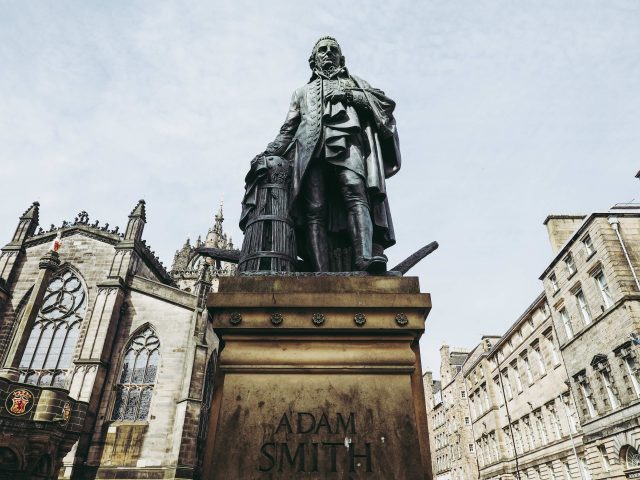
On 9 March 2026, 250 years have passed since Adam Smith published his seminal work, The Wealth of Nations. It is much more readable than most people think, full of penetrating analyses and profound insights. Some of these insights were not really new in the second half of the eighteenth century. Joseph Addison (and Voltaire) had celebrated the great benefits of the division of labour and trade between nations. Bernard de Mandeville had described the idea of unintended consequences, or how vices could, under an appropriate framework, serve virtues. Unbeknownst to Smith, the Swedish pastor Anders Chydenius had, in a 1765 pamphlet, presented the two most powerful ideas in Smith’s book: that your gain need not be my loss, and that order can be brought about without commands. These two ideas have not, even after 250 years, been fully grasped by many pundits and prophets.
Your Gain Not My Loss
Perhaps the idea that your gain need not be my loss goes against deeply ingrained instincts. For millennia, mankind lived in stationary societies where gain to some indeed meant a loss to others. But Adam Smith cogently explained that through the division of labour and free trade, people could increase society’s total product so that all would benefit. Game theorists distinguish among three types of games. In zero-sum games, one is only better off if someone else is worse off. In negative-sum games, everybody is worse off, for example, a war. In positive-sum games, everybody is better off. Free trade is a positive-sum game. The players are all better off by doing what they are most efficient in doing, and then trading among themselves. The unequal distribution of human abilities and natural resources makes exchange effective and productive.
Order Without Commands
Adam Smith’s second powerful idea is that of spontaneous order. Again, it may seem counterintuitive. Does not a watch require a watchmaker? Does not a society need somebody in charge just like a ship needs a captain? But Smith described how an order could arise by countless mutual adjustments by individuals in the marketplace, in a process of trial and error. This is an order based on good results rather than good intentions. Your customer may have only his own interests in mind, but he will buy from you if your product is cheaper or better than your competitors’. This order enables strangers, perhaps living far away from one another and feeling little or no sympathy to one another, to benefit from one another. Smith made a crucial distinction between the small circle of friends and family, and perhaps in some cases extending to neighbours and compatriots, governed by sympathy and shared values, and the world of strangers outside any such circle, governed by mutual benefits.
The Test of Reality
Smith’s argument for economic freedom is amply backed by facts. Annually, the Fraser Institute in Canada, jointly with several other research institutes around the world, publishes a report on the economic freedom of the world. According to the 2025 report, based on 2023 data, the five freest economies in the world are Hong Kong, Singapore, New Zealand, Switzerland, and the United States. The five unfreest economies are Iran, Algeria, Sudan, Zimbabwe, and Venezuela. It is instructive to divide the world’s economies into quartiles and compare their average performance. In the freest quartile, the GDP per capita was on average no less than US$66.434 in 2023, whereas in the unfreest quartile, it was only US$10.751. Extreme poverty is defined as having an income of less than US$3,65 a day. In the freest quartile, 2 per cent of the population lived in extreme poverty, whereas in the unfreest quartile, 52 per cent did. Economic freedom certainly delivers the goods. It may not make us happy (although according to international surveys, prosperous nations tend to be happier than poor ones), but it makes unhappiness more bearable. It is better to cry inside a Rolls-Royce Phantom than a Volkswagen Polo.