





 Subscribe


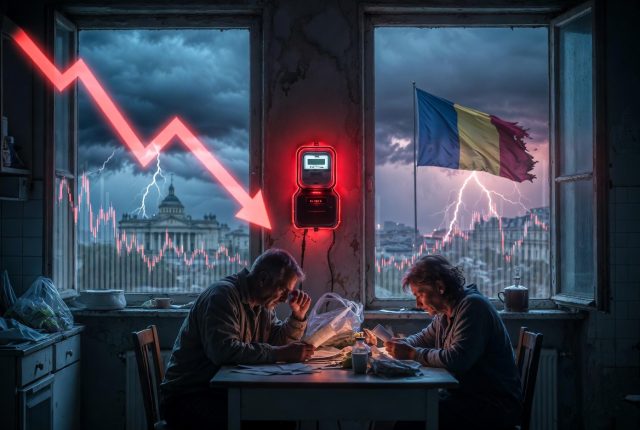
There’s a particular kind of exhaustion that settles over a country when the numbers stop being abstract. When your grocery bill climbs for the third month in a row, when your electricity statement feels like a personal insult, and when your paycheck stays stubbornly still. That’s the Romania of 2026, and it’s a reality that official statistics are finally catching up to.
Romania has officially entered recession. Romania’s GDP contracted by 1.5% in the first quarter of 2026, after a 1.5% decline in the last quarter of 2025. Romania has entered into the textbook definition of a technical recession, two consecutive quarters of contraction, and it’s done so with grim precision.
Romania and Ireland were the two countries with the strongest economic decline in Q1 2026. While Ireland’s contraction of -6.3% is sharper, it’s largely tied to the volatile behavior of multinational corporate profits distorting Irish GDP. Romania’s decline, by contrast, is structural and deeply felt. The EU average for the same period was growth of 1%. Romania isn’t just lagging; it’s moving in the opposite direction from nearly every other member state.
Economist Andrei Rădulescu noted bluntly that “the data confirms Romania is facing a new recession, for the first time since the COVID-19 pandemic”. The causes aren’t mysterious: a collapse in private consumption, the ripple effects of aggressive fiscal consolidation measures introduced in 2025 to tame a ballooning budget deficit, and a sharp slowdown in investment. Sectors once considered Romania’s growth engines (construction, the automotive industry, retail) are now under visible strain.
If recession is the headline, inflation is the relentless subtext. Romania’s annual inflation rate was 9.87% in March 2026, almost three times the EU average of 2.8%. Services became 11.05% more expensive every year, non-food goods rose by 10.89%, and food prices climbed 7.67%. For a household already squeezed by stagnant wages, these aren’t percentages, they’re choices people have to make between heating and eating.
Romania has held the unenviable title of “highest inflation in the EU” for an extended period. While Western European economies have largely tamed post-pandemic price surges, Romania is still wrestling with a combination of structural weaknesses: a central bank navigating between inflation control and recession risk, a government that spent years running some of the EU’s largest budget deficits, and an economy where energy costs feed directly into the price of almost everything else. The result is a cost-of-living crisis that official figures struggle to fully capture.
Energy is where Romania’s economic contradictions become almost surreal. A country that sits atop significant natural gas reserves and operates nuclear, hydro, and renewables capacity somehow manages to saddle its households with the highest electricity costs in the EU when adjusted for purchasing power.
Expressed in PPS (“Purchasing Power Standards”, the metric that strips away income differences to show what costs actually mean to people), Romanian households pay 49.52 euros per 100 kWh, compared to the EU average of 28.96 euros per 100 kWh. That’s 71% above the European average in real terms. For context, in the same ranking, the Czech Republic comes second at 38.65 euros, and Poland third at 37.15 euros.
The nominal price of Romanian electricity is nominally about 21% below the EU average, which sounds reassuring until you account for the fact that Romanian incomes are also far lower. When corrected for purchasing power, Romania is actually 15% above the EU average. In other words, Romanians work more of their monthly income to pay an electricity bill than almost any other European citizen.
Romania consistently ranks among the countries with the lowest hourly labor costs in the EU. Wages have grown in recent years, but they’ve been systematically outpaced by inflation, energy costs, and the creeping price of basic services. The net result is a population with less real purchasing power than the nominal growth in salaries would suggest.
The social consequences are predictable and already visible. Young Romanians that are educated, skilled, and increasingly fluent in English, continue to leave in large numbers. Romania has one of the highest emigration rates in the EU, a demographic hemorrhage that drains the workforce, weakens the tax base, and creates a feedback loop where fewer taxpayers must fund the same (or expanding) public expenditures. For those who stay, the calculation is harder every month.
Romania’s recession is not inevitable in its duration. Economies contract, stabilize, and recover. But recovery requires conditions that are currently absent: a credible fiscal path that doesn’t choke domestic demand, an energy market reformed to reflect Romania’s actual production capacity, and wage growth that genuinely outpaces inflation. None of these are overnight fixes.
The numbers published by Eurostat and the National Institute of Statistics this spring don’t tell the story of an economy in freefall, they tell the story of an economy that has been living beyond its means in some respects and below its potential in others, and is now paying both debts simultaneously. For ordinary Romanians, that abstract reckoning feels very concrete indeed: in electricity bills, in supermarket aisles, and in the quiet calculation of whether this is still the country where their future makes sense.