





 Subscribe


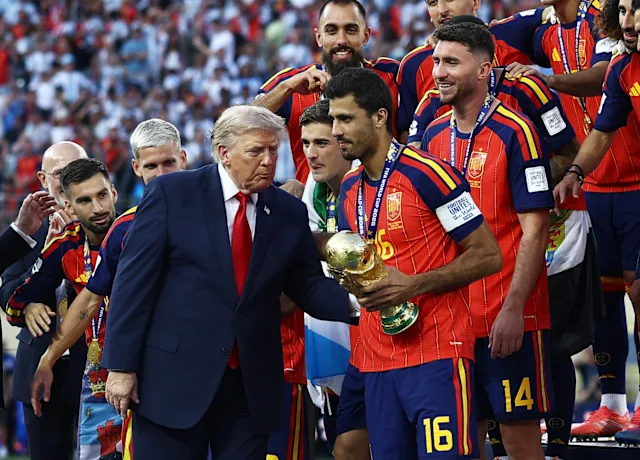
The moment the second half of extra time began, Ferran Torres bundled the ball into the MetLife net and Spain was crowned world champion for the second time in its history. In the directors’ box, Donald Trump waited to hand over the trophy; when he came down to do so, alongside Gianni Infantino, the New Jersey stadium greeted him with a loud chorus of jeers. On the turf, Lionel Messi — surely at his last World Cup — wept. Rarely has a sporting result composed a tableau so charged with political meaning.
Let us not feign innocence. Football is never only football, and the powerful know it better than anyone. As a recent analysis by Spain’s Institute for Strategic Studies (IEEE) puts it, «while the world watches the ball, geopolitics is playing its own match»: from Mussolini’s Italy in 1934 to Videla’s Argentina in 1978 — whose national side was crowned a few kilometres from the ESMA, the junta’s most infamous secret detention centre, while the regime was disappearing its opponents — governments have always sought to have a little of sport’s guiltless glory rub off on their lapels. And it is precisely because they were the ones who first tried to appropriate the team that the defeat strikes squarely at the frame they themselves had built.
No Party for Argentina
Around the Albiceleste, in the hours beforehand, a curious confluence had gathered. In the Casa Rosada, Javier Milei; in Washington, a Trump who turned the American World Cup into a showcase for his comeback; and in Jerusalem, a Benjamin Netanyahu who, on the eve of the final, received an official national-team shirt from the hands of the Argentine ambassador and recorded a message of encouragement. He made no secret of it: he was backing Argentina, he said, out of his friendship with Milei and for the turn the Argentine president had given to relations between their two countries. «Vamos Argentina», he signed off. The support was not for Messi, nor for football; it was for a political project with a name and a surname.
It was, at bottom, a small International: that paradoxical internationalism of the nationalists, united less by the flag than by ideological affinity. That this bloc should be left without its coronation carries, inevitably, a symbolic reading. The Spain that lifted the cup is that of a government at the antipodes of all three; and it did so on American soil, before Trump himself, who was obliged to hand over the trophy while the stands booed him. For those who had turned the match into an extension of their cause, the scoreline was a public repudiation.
The Adversary Was Called “Sánchez”
For Netanyahu’s support of Argentina is not explained by his rapport with Milei alone, but also by his animus towards the victor. Pedro Sánchez has become one of the most forceful critics of Israel’s conduct on the international stage: he has openly called the offensive in Gaza «genocide» — «the extermination of a defenceless people», he went so far as to say — decreed a total arms embargo, pressed within the European Union for the suspension of the Association Agreement with Tel Aviv, and extended his condemnation to the offensive in Lebanon. And, in a sporting register, he demanded that Israel be excluded from international competitions just as Russia was after invading Ukraine. That it should be Spain, of all countries — the nation leading the campaign to expel Israel from the international community, the sporting one included — that lifts the World Cup by defeating the friend Netanyahu had publicly endorsed, is an irony hard to swallow in Jerusalem.
With Trump, the falling-out is louder still, and it arrives wrapped in the same gunpowder. Spain came to the final with a Sánchez in open conflict with Washington. The Spanish prime minister branded the war that the United States and Israel waged against Iran an «extraordinary mistake» and denied the use of the Rota and Morón bases for offensive operations; and Spain was the only NATO ally to reject the target of devoting 5% of GDP to defence. The sum — defiance over Iran and non-compliance on military spending — unleashed the presidential fury. Barely eleven days before the final, at the Alliance summit held in Ankara, Trump called Spain «a wasted cause» and «a terrible partner» and ordered all trade with Madrid cut off. So that, when he had to hand the cup to Rodri on American soil and amid whistles, the tableau wrote itself: the ally he had vilified in Turkey was lifting the trophy, days later, before his very eyes.
The Mirage of the Scoreline
And yet one must resist the easiest temptation, which is to read into a 1–0 in extra time a verdict of history. Sport is contingent by nature: a rebound, a penalty not given, a second yellow card — Enzo Fernández’s, which left Argentina with ten men — are enough to invert the narrative we later build as though it were destiny. Had Torres not bundled in that ball, today we would be writing that Milei’s Argentina had held firm, and the very same tableau would serve the opposite thesis. Whoever expects football to pronounce on politics exposes himself to football, sooner or later, pronouncing against him.
The irony is that the symbol works only because the leaders themselves loaded it with politics before the opening whistle. It was they who staked their prestige on eleven footballers foreign to their offices. In doing so, they turned a final into a referendum they did not control and whose outcome they could not guarantee. The lesson is not that football is of the left or of the right — it is neither — but that whoever politicises chance ends up its prisoner.
The Next Final: 2030
It is worth turning already to the next geopolitical contest. Not the one played on Sunday in New Jersey, but the one being played, quietly, in the corridors of FIFA. The 2030 World Cup will be co-hosted by Spain, Portugal and Morocco — with centenary opening matches in Uruguay, Argentina and Paraguay — and the question that truly moves interests is where the final will be held.
Spain takes the answer for granted. The president of its football federation has repeated that the organisation falls to Spain and that the cup will be lifted there, whether in a reborn Bernabéu or a Camp Nou still under construction. It is the attitude of one who believes the final belongs to it by birthright: the tournament, the argument runs, «was born» between Spain and Portugal, and Morocco joined later. Morocco, meanwhile, does not argue; it builds. On the outskirts of Casablanca it is raising the Grand Stade Hassan II, a colossus designed for some 115,000 spectators that aspires to be the largest stadium in the world. And where Spain proclaims, Morocco manoeuvres: sources within African football confirm a discreet, sustained push to have the final played in Casablanca. Everything suggests that this behind-the-scenes work will end up prevailing, even if FIFA has not yet spoken the last word.
It is no minor tussle, nor an incidental one. That same IEEE analysis stresses how the 2026 World Cup expanded Africa’s places from five to nine and shifted football’s centre of gravity towards the Global South — a continent that by 2050 will hold more than a quarter of the world’s population. If the final ends up in Casablanca, it would be only the second played on African soil after Johannesburg in 2010. And it is worth recalling where Spain won its first and only World Cup before this one: in that very Johannesburg. The continent that gave it its first star could now wrest from it the stage for the next. The decision, moreover, lies not with Spain or with Morocco, but with a FIFA that — with no territory, army or coercive power — has set itself up as a form of global private governance capable of imposing conditions on states. And that kind of power is not won on the grass, but in the office.
Winning the Match, Losing the Board
Here lies the heart of the matter, and it reaches far beyond football. Soft power — that capacity to attract and persuade that Joseph Nye set against coercion — is not won on the turf, but in the institutions; not in ninety minutes, but in the years of patient work that precede the whistle. Spain excels at the first and neglects the second. It has cultivated a footballing school that is the envy of the world, yet it approaches sporting diplomacy with the nonchalance of one who knows himself great and assumes that greatness recognises itself — or of one who fails to grasp that foreign policy, too, needs an academy of its own and long-term planning.
Morocco has understood the opposite, and has turned the 2030 World Cup into strategy and a matter of state. Its World Cup bid is one more piece of a deliberate projection — pharaonic infrastructure, investment across the continent, the simultaneous courting of Europe, the Gulf and the Global South — with which Rabat has spent years carving out a centrality its size would not grant it on its own. It is, on its scale, a manual for how a middle power turns ambition into influence: by making itself useful, indispensable, hard to ignore. Against that resolve, Spain’s certainty that the final «cannot be understood» outside the Peninsula sounds less like strength than like complacency.
And yet, little by little, Spain seems to be stirring. LALIGA’s own business school and the Ministry of Defence —through CESEDEN (Centre for National Defence Studies), which is the main military teaching and research institution for the Spanish Armed Forces— have just signed an educational agreement aimed precisely at security, diplomacy, soft power and the forging of international alliances: an explicit acknowledgement that sport is an instrument of influence, and that such influence must be studied, taught and planned rather than simply assumed. It is, in miniature, the very academy Spain has lacked, and other ministries may soon engage in similar efforts. The question is whether it comes too late.
Spain has just shown that it knows how to win when the referee blows the whistle (and lets play run). It has yet to show that it knows how to win when the referee is an ever more capricious and forgetful geopolitics. On Sunday, the country Trump called «a wasted cause», and the one Netanyahu would like to see expelled from the pitch, lifted the cup before them both. It was a statement slammed down on the table, and a resounding one. But statements slammed on tables are forgotten; stadiums, investments and votes in committees are not. Spain lifted a cup in New Jersey; it runs the risk of losing, in Casablanca, its own geostrategic board. On Sunday Spain won the match. The other final, the one decided in the shadows, it may still lose.