





 Subscribe


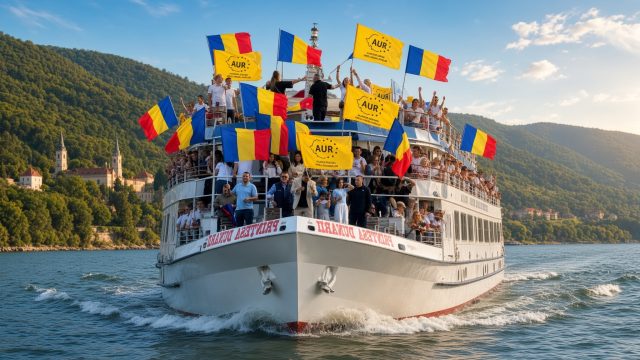
Drobeta-Turnu Severin isn’t the first place you’d expect a political earthquake to start, but on Saturday it became the stage where AUR laid out its entire playbook for the parliamentary session opening this Tuesday. The party’s National Leadership Council (CNC) met for what was billed as a routine strategy session and walked out with a fiscal manifesto, a fiery anti-government resolution, and a clear signal that it’s not backing down from its push to suspend President Nicușor Dan.
The party wants the cash-payment ceiling for companies raised to 50,000 lei, and it’s pushing to gradually roll back this year’s tax hikes: bringing standard VAT back to 19%, the reduced rate to 9%, and the dividend tax down to 8%. AUR also wants the micro-enterprise threshold restored to 500,000 euros, a direct reversal of the squeeze that pushed many small Romanian firms out of that tax-friendly bracket.
On the state-reform side, AUR reaffirmed support for a 300-seat bicameral Parliament, invoking the 2009 referendum where Romanians voted for exactly that, plus keeping two-round mayoral elections and, notably, capping public institution leadership at two terms. That last point is a direct response to the kind of long-serving bureaucrats who’ve held their posts for decades without meaningful turnover.
In education, the party wants to scrap the parallel high-school admission exam and restore a single, unified national admission system, along with reducing teaching workloads and reversing class-size increases introduced by last year’s so-called “Bolojan Law” from August 2025. On energy, AUR is pushing to legalize continued operation of all CE Oltenia coal units by amending the emergency ordinance that would force their closure by August 31, 2026. There’s also a long-stalled bill on NGO funding transparency, currently stuck in the Chamber of Deputies after Senate approval, and a proposal for a “dynamic VAT” on fuel (5% for the first three months of a price shock, rising to 9%, and automatically deactivating once oil prices normalize).
AUR’s proposal to cap leadership mandates at two terms applies across public institutions, not just one agency or one official. The party frames it as a way to prevent “influence networks” from calcifying inside public administration and to ensure regular turnover at the top of state bodies.
The council’s other major output was symbolic but unmistakably combative: a resolution titled “Romania is being governed into abyss,” adopted unanimously. The text accuses the PSD-PNL-USR-UDMR coalition of stacking up two percentage-point VAT hikes (to 21% and 11% respectively), gutting the micro-enterprise regime by dropping its threshold to 100,000 euros, raising dividend tax to 16%, killing coal-based energy while blocking new gas plants and sabotaging pumped-storage hydro projects.
The resolution also singles out the SAFE loan, a roughly 17-billion-euro borrowing facility to be repaid over 35 years at an undisclosed interest rate, which AUR claims was used mainly to buy heavy military vehicles from a single German supplier, Rheinmetall. AUR’s closing argument is blunt: over the last ten quarters, the Romanian economy grew in only three while the rest stagnated or contracted. “Today, the only coherent and solid opposition in Parliament is represented by AUR and its 91 MPs,” the party’s statement declares, arguing the self-appointed “pro-European” coalition is in fact economically decoupling Romania from Europe.
Senate group leader Petrișor Peiu, speaking to Antena 3 CNN, flatly denied any formal or informal talks toward building a governing majority with either PSD or PNL, pointing out that PSD leader Sorin Grindeanu has publicly ruled out governing with AUR anyway . “If he doesn’t want to form a government with AUR, it’s hard to negotiate. What exactly would we be negotiating?” Peiu said. He also confirmed that AUR is preparing public statements on its strategy for the upcoming consultations with President Nicușor Dan, who has announced he’ll resume talks with parties in early September about forming a new cabinet. Peiu was skeptical about the value of attending purely for photo-ops, saying AUR “probably won’t participate” if the process is just informal deal-making dressed up as formal consultations. Notably, he also confirmed that AUR’s push to suspend Nicușor Dan is still moving forward, since “the president hasn’t changed his attitude”.
Nicușor Dan has been refusing to propose a prime minister for 62 days, the country has been without a full-power government for 110-114 days, and the president’s “stubbornness” is costing Romania real money. “Suspension is a constitutional solution, because his stubbornness is already producing costs that are too high for Romania,” AUR said in a late-August press release. The party is actively collecting signatures from MPs across other parties who are “dissatisfied with the way Nicușor Dan has exercised his presidential powers,” and Peiu says new colleagues have already signed. PSD could theoretically form a government without AUR by leaning on UDMR, minority MPs, splinter groups from PNL, and former SOS/POT lawmakers, but Peiu also called that strategy “extremely dangerous” and warned it would produce a “fragile majority” built on buying off unaffiliated MPs.
Taken together, the day wasn’t really about a single law or a single resolution. It was AUR positioning itself as the sole disciplined opposition bloc heading into a tense autumn.