





 Subscribe


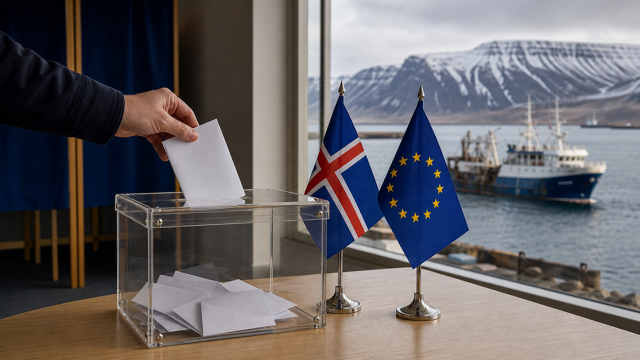
A closely fought referendum brings economic anxiety, fishing rights and Arctic security into a debate that could reshape Reykjavík’s relationship with Brussels
Icelanders are voting on whether their country should restart membership negotiations with the European Union, reviving a political question that has remained unresolved for more than a decade. The referendum does not ask voters to approve EU membership itself. Instead, it will determine whether Reykjavík should resume the talks suspended in 2013.
Although the ballot is formally consultative, the government has promised to follow the result. A victory for the “yes” campaign would therefore reopen negotiations with Brussels. Any agreement eventually reached would then have to be submitted to Icelanders in a second referendum before the country could join the bloc.
The outcome is highly uncertain. Two final opinion polls placed the opposing camps within the margin of error. Maskína measured support for renewed negotiations at 50.4 per cent, while Gallup put the “no” side slightly ahead, at 51.6 per cent.
Around 270,000 people are eligible to participate. Polling stations opened at 9am local time and are due to close at 10pm. Advance voting has been unusually strong: by midday on the eve of the referendum, 56,774 ballots had already been cast, including approximately 17,000 votes from abroad. The capital region recorded its highest level of early participation to date.
Counting will begin immediately after polls close, with the first partial results expected from the southern district. No nationwide exit polls have been announced.
Behind the close contest lies a debate about how Iceland should protect both its prosperity and its independence. The country is already connected closely to the EU through the European Economic Area, the Schengen zone and the European Free Trade Association. It participates in the single market and applies a substantial share of European legislation, despite having limited influence over how those rules are written.
Supporters of restarting negotiations argue that Iceland should gain a seat at the table if it is already required to implement many EU decisions. Opponents believe the present arrangement is preferable because it combines access to European markets with greater national autonomy.
No issue illustrates that concern more clearly than fishing. Marine resources are central to Iceland’s economy and national identity. Full membership would require negotiations over the EU’s Common Fisheries Policy, including questions of quotas and access to Icelandic waters. Critics fear that decisions now made in Reykjavík could become subject to compromises in Brussels.
Fishing was also the most difficult part of the previous accession process. Iceland applied for membership in 2009, after a financial collapse devastated its banking system and weakened confidence in the national currency. By the time negotiations were halted four years later, 27 policy chapters had been opened and 11 provisionally completed, but the fisheries chapter remained unresolved.
Economic pressures have now returned the European question to the foreground. Inflation, expensive mortgages and an Icelandic central-bank interest rate of 8 per cent have strengthened arguments for closer integration. The European Central Bank’s rate, by comparison, stands at 2.25 per cent. Pro-European campaigners present eventual adoption of the euro as a possible source of stability. Their opponents warn that giving up the krona would remove a valuable tool for responding to the particular needs of Iceland’s small economy.
The geopolitical environment has also changed dramatically since 2013. Russia’s invasion of Ukraine, intensifying competition in the Arctic and uncertainty about long-term US policy have increased Iceland’s strategic importance. The island lies between Europe, Greenland and North America, near the GIUK Gap, a vital North Atlantic corridor for military and maritime security.
Iceland, a founding member of NATO, recently expanded its security cooperation with the EU through a partnership covering the Arctic, critical infrastructure, maritime affairs and cyber threats. Membership would consequently matter beyond Iceland’s population of roughly 400,000: it would strengthen the EU’s political presence in a region attracting growing attention from Russia, China and the United States.
If voters approve renewed talks, Iceland’s foreign ministry believes negotiations could begin before the end of the year and take between 18 and 24 months. Yet even then, accession would remain undecided. The referendum can reopen the door to Europe, but Icelanders would still have to choose whether to walk through it.
Alessandro Fiorentino