





 Subscribe


In the referendum on 29 August 2026, Iceland rejected negotiations on EU membership for five reasons: three economic and two existential. First, the choice was not between isolation and Europe. Iceland had been a member of the European Economic Area since 1994, alongside Norway, Liechtenstein, and, for practical purposes, Switzerland. This meant Iceland was part of the Single Market, while fisheries, agriculture, foreign trade, and monetary affairs were not under EU control. Secondly, the Icelanders did not want to cede control of those four important sectors to the EU, especially their sustainable and profitable fisheries, and to lose the possibility of making free trade agreements with countries such as China, India, the US, and Brazil. The third economic reason was that prosperous Iceland would contribute much more to the EU than it would receive from it. The Icelanders were not amused when Politico quoted an EU official who said he hoped Iceland and Montenegro would join at the same time because the gain from Iceland would cover the cost from Montenegro.
EU’s Prospects
One existential reason for the membership rejection was that the EU’s prospects seem less than bright. It faces significant financial challenges in the near future: unfunded pension liabilities, whereas the Icelandic pension system is the world’s strongest; persistent government deficits in many member countries; substantial planned spending on military capabilities, whereas Iceland has a defence treaty with the US; and the inevitable cost of the nine relatively poor applicant countries in Southeast Europe. Despite these challenges, the Brussels elite is trying to turn the EU into a federal state, against the wishes of most European voters.
Strong National Identity
Another existential reason may explain why the Icelandic Right and Left united against EU membership, with support for the EU largely confined to urban intellectuals and public employees. This is the strong Icelandic national identity forged in the nineteenth-century struggle for independence, culminating in Denmark granting Iceland sovereignty in 1918. This identity was further strengthened by the four cod wars Iceland fought until 1976 to gain control of the fertile fishing grounds surrounding the island. This national identity rested on the memory of the independent Icelandic Commonwealth of 930–1262, governed by law rather than a king, as well as on the memory of the dark age that followed, when Iceland had to succumb first to the Norwegian and then the Danish king. Unsurprisingly, some of my colleagues at the University of Iceland, such as Professors Baldur Thórhallsson and Gudmundur Hálfdanarson, who have been generously funded by the EU, have done their best to disparage and even mock this memory.
Clever Slogan
These five reasons not to join the EU were presented in a well-organised and almost flawless campaign by the No-sayers. The Yes-sayers, on the other hand, relied mostly on one clever slogan, Já til ad sjá, which is difficult to translate into English. In an admirably concise way, it really means: Vote yes to find out what the EU can offer Iceland in negotiations. Who could be against this? Only those who had read the detailed EU instructions for applicant countries, of course.
Vicious Personal Attacks
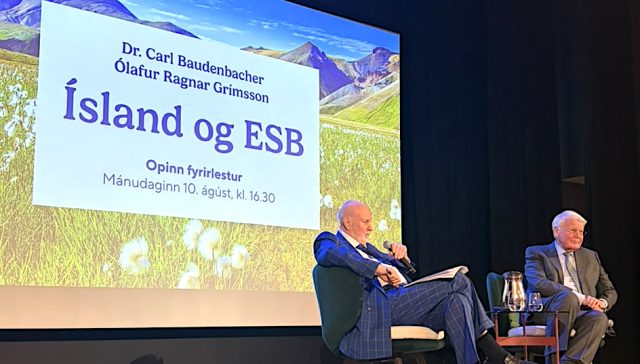
The Yes Camp also relied on three ploys. One was to promise a much higher standard of living if Iceland joined the EU than the one it already enjoyed. This was unconvincing in a country much more prosperous than most EU countries. The second ploy was to make US President Donald Trump an issue. This did not fly, either. Reckless remarks by a president who has only two and a half years left in office do not change a nation’s long-term foreign policy. The third ploy was vicious personal attacks on the two most effective spokesmen for the No Camp, Dr Carl Baudenbacher, an internationally acknowledged expert on European Law, who, as President of the EFTA Court in 2013, had found for Iceland in an important case about liabilities stemming from the 2008 Icelandic bank collapse, and Ólafur Ragnar Grímsson, who had been president of Iceland for twenty years, 1996–2016. Dr Baudenbacher published a book on Iceland and the EU and gave a lecture to a packed meeting. Ólafur Ragnar gave a series of compelling speeches and television interviews. The Yes Camp’s attacks on them backfired.
(The photo shows Dr Baudenbacher giving his lecture on 10 August 2026, with Ólafur Ragnar Grímsson chairing the meeting.)