





 Subscribe


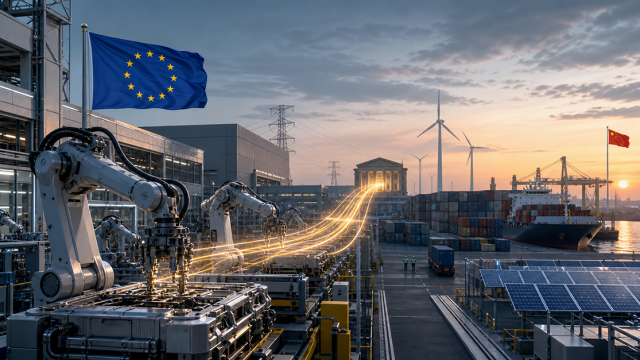
Ursula von der Leyen calls for stronger trade defences, lower business costs and a new strategy to channel household savings into European companies
The European Union must rebuild its economic strength around domestic industry, according to European Commission President Ursula von der Leyen, who has outlined a more assertive strategy for competing with China and financing the continent’s future. Speaking to French business leaders in Paris, she presented a vision of Europe as a region capable of producing essential goods, attracting investment and protecting strategic sectors.
Her message reflected a recognition that the assumptions underpinning Europe’s previous economic model have disappeared. The continent can no longer rely on cheap imported energy, steadily expanding access to China, an open global trading system and largely guaranteed American protection. Western technological leadership, once taken for granted, is also facing increasingly strong competition.
Von der Leyen argued that Europe must consequently restore industrial capacity to the centre of policymaking. Her approach follows many of the recommendations contained in Mario Draghi’s report on European competitiveness, which warned that insufficient investment and fragmented markets were weakening the EU’s ability to keep pace with other economic powers.
Energy represents the most immediate obstacle. European manufacturers continue to face costs that often exceed those of their international competitors, damaging investment and production. Von der Leyen described energy as the primary constraint on competitiveness and said the next EU budget should become a financial instrument supporting greater European independence.
Brussels also intends to reduce the regulatory burden placed on companies. The Commission aims to cut administrative costs by 25 per cent for businesses generally and by 35 per cent for small and medium-sized enterprises by 2029. European companies, von der Leyen suggested, should not be disadvantaged both by complicated domestic rules and by foreign competitors operating under less demanding conditions.
China was the clearest target of her address. Beijing remains an essential trading partner, and the EU is still pursuing a policy of limiting economic risks instead of separating the two economies. Cooperation, however, cannot mean tolerating structural imbalances indefinitely.
According to figures cited by the Commission president, some Chinese companies benefit from subsidies up to eight times larger than those available to comparable businesses in OECD countries. Meanwhile, Europe’s trade deficit with China has approached €1 billion per day and now affects every EU member state.
Von der Leyen said discussions with Beijing must lead to measurable changes. If negotiations prove ineffective, Brussels is prepared to make full use of its trade-defence mechanisms. The Commission opened more than 30 new investigations into allegedly unfair trade practices last year, nearly three times its historical annual average.
The EU also possesses an anti-coercion instrument, designed to respond when a non-member country uses economic pressure to influence European decisions. Although von der Leyen did not mention the mechanism directly, her warning indicated that the Commission is willing to defend industries considered essential to Europe’s security and autonomy.
Protecting production is only one part of the strategy. Europe must also find the money needed to modernise factories, develop clean technologies and expand innovative companies. European households currently hold an estimated €10 trillion in bank deposits. Much of that capital does not reach businesses seeking funds for growth.
The proposed Savings and Investments Union is intended to create deeper and more integrated European capital markets, making it easier for private savings to support companies across national borders. Commission proposals could generate as much as €470 billion in additional investment, helping Europe narrow its financial gap with the United States and other competitors.
Von der Leyen wants member states to reach an agreement by the end of the year. Her preference is for all 27 countries to participate, but she signalled that a smaller coalition could move ahead if unanimous support proves impossible. The comment suggests that Brussels may increasingly rely on groups of willing governments when EU-wide decisions become stalled.
Taken together, the proposals mark a shift towards a more defensive and interventionist European economic policy. Lower energy costs, simpler regulations, stronger trade enforcement and better access to capital are being treated as connected parts of the same challenge.
The ambition is not to isolate Europe from global markets, but to ensure that openness does not produce dependency. For the Commission, the central question is whether Europe can transform its wealth, industrial knowledge and single market into genuine strategic power. Von der Leyen’s answer is that it can—but only if it invests more decisively and becomes prepared to protect what it builds.
Alessandro Fiorentino