





 Subscribe


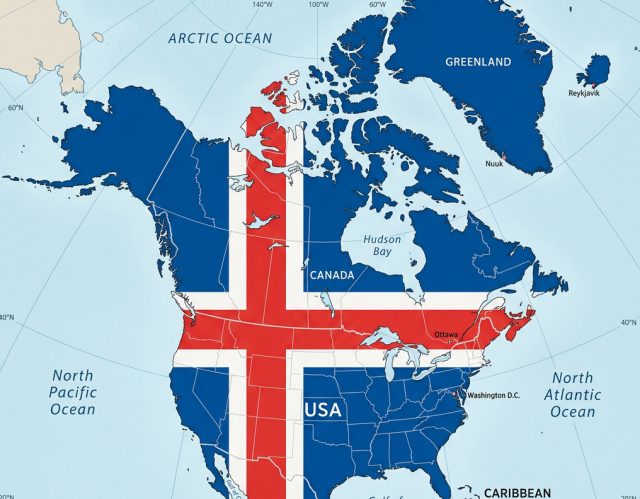
President Donald Trump recently published a map of North America showing Canada, Greenland, and Iceland covered with the American flag alongside the United States. This was clearly meant as a joke by a politician who likes to provoke. But Iceland’s anti-American, pro-EU Foreign Minister, Thorgerdur K. Gunnarsdóttir, was not amused. She summoned the US Ambassador to Iceland to complain about the map. Thorgerdur is in no joking mood these days, having just lost a referendum in which Iceland’s membership of the EU was rejected. But the wisest response to Trump’s map is, of course, to draw another map in which the same countries are covered with the Icelandic flag, as I did (see above). Indeed, Icelanders have a historic claim to North America, as they were the first Europeans to discover it.
The Icelanders Discovered America
The Icelandic discovery of America is well documented, not only in two Icelandic sagas from the late twelfth century, The Saga of Eric the Red and the Saga of the Greenlanders, but also in a comment by the German chronicler Adam of Bremen in the 1070s. Ruins of a Viking base camp have also been found at L’Anse aux Meadows on the northern tip of Newfoundland. Leif Ericson—who was born in Iceland but settled with his father in Greenland—first reached America in 1000, when he was blown off course on a journey from Norway to the Icelandic settlement in Greenland. He stayed only one winter in the new country, but in 1008 a group of Icelanders sailed from Greenland to North America on two ships, led by Thorfinn Thórdson and his wife, Gudríd Thorbjörnsdóttir. They brought livestock and intended to settle in the new country. In the autumn of 1008, Gudríd gave birth to a boy, Snorri, the first European to be born in North America. They settled in what they called Tidal Pool, now known as Upper New York Bay. They encountered some natives, and relations were friendly at first, but in 1010 a fight broke out between the settlers and the natives; eventually, Thorfinn, Gudríd, and their people decided it was not feasible to settle there, as they were vastly outnumbered. They returned to Greenland in 1011 and eventually to Iceland, where they stayed to the end of their lives. As an old woman, Gudríd went on a pilgrimage to Rome, so she must have been the most widely travelled woman in the world at the time. Later, Oscar Wilde quipped that the Icelanders discovered America but had the good sense to lose it again.
The Americans Saved Europe
These details are from a short book I published in English in 2019, The Saga of Gudrid, in which I condensed and merged the two Icelandic sagas about the discovery of America, drawing also on an excellent book by Icelandic meteorologist Páll Bergthórsson, The Wineland Millennium. Christopher Columbus likely heard tales of a vast country in the west in 1477 when he went to Bristol, then the centre of trade with Iceland. Each summer, a large fishing fleet sailed from Bristol to Iceland. Columbus rediscovered America in 1492, as everybody knows, but the continent was already populated by people who had crossed the Bering Strait (then a land bridge) some twenty thousand years earlier and had spread across the Americas. Indeed, Georg Christopher Lichtenberg remarked that the American who first discovered Columbus was unlucky. There may be some uncomfortable truth in that, but a much larger truth is that North America is a real miracle: millions and tens of millions who crossed the North Atlantic from Europe found freedom and prosperity there. Twice, the Americans saved Europe from itself: first in the Second World War, and then in the Cold War. Without America, the European continent would probably have been carved up by Hitler and Stalin. Maintaining the alliance between the democracies of North America and Europe is crucial.